
jackieschmidt
Gold $$ Contributor
Here is our unit.Yup! I'll opt for liquid cooled power for anything when it's available.
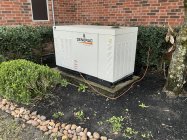



Here is our unit.Yup! I'll opt for liquid cooled power for anything when it's available.
Wow, how many kW is that unit?Here is our unit.View attachment 1633897

I think that “copper tubing” is an extension cord for a battery trickler. It looks like my 20 KW.Wow, how many kW is that unit?
Judging by the age of new generator and the old concrete pad, it would appear you might have recently replaced an older generator? The copper tubing looks fresh (which BTW probably could have been routed and protected better than as is now)
You are correct. The trickle chargers that Generac installs are junk. I keep an 1 amp battery maintainer on the battery at all times.I think that “copper tubing” is an extension cord for a battery trickler. It looks like my 20 KW.

I found out not all maintainers are equal. I bought a couple that charged at 15.5 volts. Trashed them and spent the extra money for better ones.You are correct. The trickle chargers that Generac installs are junk. I keep an 1 amp battery maintainer on the battery at all times.
Are you sure it’s 20kW? Never seen a 20kW steel enclosed Generac unit and it looks quite larger than their poly enclosed 20kW units. Yes everything is expensive nowadays but $13k for a 20kW standalone unit without transfer switch, etc. seems quite steep.You are correct. The trickle chargers that Generac installs are junk. I keep an 1 amp battery maintainer on the battery at all times.
The pad was a used one the Generac dealer had. They darn near gave it to me to close the deal.
A unit like this runs about $13,000. Of course, you also have to get the huge transfer switch, all of the electrical hook up, plus the gas line hook up. That has to come off of the meter. They will not splice into an existing line. Since the electrical box is on the other side of the house, they went through the attic with the power lines.
This is not a do it yourself installation. With all of the permits, generator, parts, and labor, I think our total installation bill was around $22,000.

That’s about what I spent. Our purchase was a perfect example of the differences between me and my wife. My electrician arrived, we mapped out what necessary things I wanted to run in the house and decided on a 5kw machine. I told him we should “check with the wife” to see if she had anything extra she wanted to add to the “run” list. We found my wife and asked her what she wanted to “run” on the generator during a black out. She said “Everything!” We wound up with a 20kw.You are correct. The trickle chargers that Generac installs are junk. I keep an 1 amp battery maintainer on the battery at all times.
The pad was a used one the Generac dealer had. They darn near gave it to me to close the deal.
A unit like this runs about $13,000. Of course, you also have to get the huge transfer switch, all of the electrical hook up, plus the gas line hook up. That has to come off of the meter. They will not splice into an existing line. Since the electrical box is on the other side of the house, they went through the attic with the power lines.
This is not a do it yourself installation. With all of the permits, generator, parts, and labor, I think our total installation bill was around $22,000.
I know my 150AH battery bank goes down much quicker than what is theortical time wise
I can run my TV for about 5 hours on 150 AH watching DVD's or whatever before the low voltage alarm sounds
That is ionly roughly a 4 amp total draw
Theoretically I should be able to go 37 hours
150 AH / 4 Amps = 37
So there are many factors that contribute to time loss in battery banks,
I use 6 feet of 2/0 copper welding cable going from battery to the inverter as well to minimize voltage loss
So I dont know what is going on there with my real world available usage time compared to theoretical
It’s a 28KW unit.Are you sure it’s 20kW? Never seen a 20kW steel enclosed Generac unit and it looks quite larger than their poly enclosed 20kW units. Yes everything is expensive nowadays but $13k for a 20kW standalone unit without transfer switch, etc. seems quite steep.
Our house is around 5200 sq ft. I decided I would not be without power. I have been there and done that.Yes, you're right, Sacre. Buy enough generator to run only what's necessary.
Those huge units remind me of friend who always bought 1 ton, heavy duty, 4 wheel drive, pickups, even though he'd seldom need that much capacity. He'd then bitterly complain about the purchase price, gas mileage, the cost of tires and parts. I told him it would be a lot cheaper in the long run to buy less truck, and hire-rent something heavy duty only when needed. Did he take that advice? Right! Might as well have talked to the nearest telephone pole.
Obviously, this does not apply to those folks who have large homes, operations, farms, ect., that require a lot of standby power when the grid goes fails.
SJ
I put a clamp meter on the 2/0 leg 12 volt lead coming from the bank of 12 volt batteries going to the inverterIf your using 4 amps @ 120 volts, your using 38 amps at 12.6 volts, so 150 AH would be dead in approximately 4 hours. Inverters are not very efficient either. Cheap ones might consume 30% converting from DC to AC with heat loss.
I put a clamp meter on the 2/0 leg 12 volt lead coming from the bank of 12 volt batteries going to the inverter
reads 3- 4 amps on the 12 volt legs for what I usually do
----------------------
Thanks for your post
I do understand how 4x 120 = 460 watts
just as 12.6 x 38 = approx the same wattage of useage
----------------------
I am also new to the LIFEPO batteries and their depth of charge in relation to their voltage
When fully charged it shows 13.3
Last night I ran a pump that draws approx 5 amps for HOURRRRRS
and the batteries never went below 13.02
So perhaps I did not have them charged fully thinking 12.9 to 13.0 is enough
these batteries are very sensitive to 0.1 volt of charge
I'm using a Victron 100/30Hopefully you had a hall-effect clamp on or it won't read DC amperage. LiFEPO4 12 volt batteries need a special charger that outputs at least 14.2-14.4 volts. A regular lead acid charger will never charge them correctly. If you have a solar charger, you need to change the profile to LiFePO4 or they won't charge correctly.

I have a 16kw Kubota diesel on my house. Its a manual setup, but I have run for several days at a time during hurricanes. It uses about a half a gallon per hour....
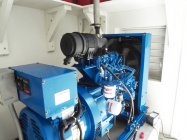
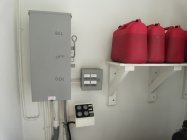

Great looking setup and some good engineering involved also.I also lived in hurricane country once. So solar and wind was out of the question. I would assume tornado country would be the same thing.
I built a solid concrete bomb proof gen room and put in the smallest genset I could use to power my entire house. It had a 5 ton cental a/c and I installed a giant quick start capacitor in it so my puny 7.5kw Northern Lights - Kubota could start it. My system was fully manual and it sipped fuel. Can't remember the rate but it was so low it was not an issue. I was able to keep all my treated fuel in 5 gal plastic cans so I could rotate them by using in my diesel vehicle. It worked great and was a lifetime system. The cheap part of the project was the cost of the generator. If I had to do it again out of hurricane zone I would still go diesel. And of course always have a Honda 2000 for backup. You can back feed it into your house and run everything selectively. Thats what I do now. View attachment 1634776View attachment 1634777View attachment 1634778



We use essential cookies to make this site work, and optional cookies to enhance your experience.
