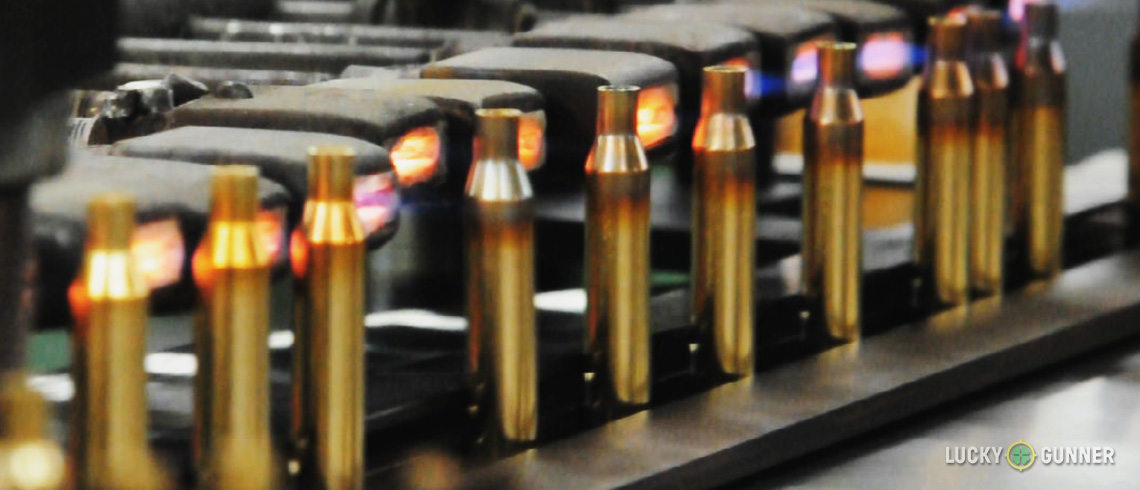
The quicker you can get the necks up to a temperature that'll anneal, the better. IMHO, using two torches, especially "itty-bitty ones" is a good idea.
Keep in mind that getting a "proper" anneal is a function of both the amount of heat the brass is brought to AND the amount of time. Less time when more hot and more time when less hot. Like
@Webster said, the brass needs to get to ~1,100°F (600°C) for about 1 second. You can tell this temperature when the neck turns red (best observed in a darkened room). It may take 8 - 9 seconds for the neck in the flame to get that.
I went with a single torch, but use a swirl flame torch head instead of a pencil flame torch head as it tends to heat the necks up faster and I found I get a more consistent result around the full diameter of the neck and shoulder. Using two torches as you're about to, tends to give you that consistency too.
If you haven't already read through my thread where I did some actual hardness testing to see what works or not, you might want to take a read there. I got tired of guessing and hearing different takes of what annealing brass actually does. Here's a link to that thread:
As I
mentioned in another thread, I recently bought a Webster Hardness Tester (it's a counterfeit) to get a better idea of what my annealing efforts were actually like. Am reporting back with what I've observed after doing some testing to see how this tester might help.
It's always been my objective to try and anneal my brass to a hardness at or close to what new brass is. . . like Lapua's brass. But I never had any way to take any kind of measurement and would just anneal to what I thought would be close enough. It was really nothing more than guess work. Now that I have this...
View attachment 1748132 View attachment 1748133