• This Forum is for adults 18 years of age or over. By continuing to use this Forum you are confirming that you are 18 or older. No content shall be viewed by any person under 18 in California.

Annealing Questions

That is true, but we're not welding and any part of the flame is hot enough to destroy brass. Regardless, I pull it out when I see a red glow.
My point was that with the tip of the flame near the case neck a large amount of heat is only going to one side. The case has to rotate to get the other side as hot. If you wrap the flame around the neck both sides get heated at the same time. If you watch a couple of videos on this website you can see the front side is red and the backside takes a 1-2 seconds to turn red even though it is rotating.
 
Last edited:
The quicker you can get the necks up to a temperature that'll anneal, the better. IMHO, using two torches, especially "itty-bitty ones" is a good idea.

Keep in mind that getting a "proper" anneal is a function of both the amount of heat the brass is brought to AND the amount of time. Less time when more hot and more time when less hot. Like @Webster said, the brass needs to get to ~1,100°F (600°C) for about 1 second. You can tell this temperature when the neck turns red (best observed in a darkened room). It may take 8 - 9 seconds for the neck in the flame to get that.

I went with a single torch, but use a swirl flame torch head instead of a pencil flame torch head as it tends to heat the necks up faster and I found I get a more consistent result around the full diameter of the neck and shoulder. Using two torches as you're about to, tends to give you that consistency too.

If you haven't already read through my thread where I did some actual hardness testing to see what works or not, you might want to take a read there. I got tired of guessing and hearing different takes of what annealing brass actually does. Here's a link to that thread:

View attachment 1748132 View attachment 1748133

Cannot believe someone agrees with me. It goes on and on forever. Your pix on the right is like I have my flame.
 
Having never annealed, I have a few questions. I have the Bench Source annealer, and bought an additional torch mount.

I'll be reloading for the 17FB thru 6.5CM. Would dbl torches even be necessary, especially on the itty-bitty ones?
I might as well post this chart for at least the 5th. time.

Remember new cases have the necks factory annealed. No evidence of cold working of the brass. Looking at the etched metallograhic cross-sections on AMPS website. New case necks show no sign of cold working (the grains are not elongated). After firing and resizig 3 time the grains look the same (no elongated grains. Don't think the cases were annealed after each firing. Need to review pix to check.

550C = 1022F.

OK, now look at the below chart. If you assume the neck has 15% cold work which it probably doesn't based on AMPS etched cross-sections. Assume for discussion: 15% cold work, 32 minutes at 1022F no recrytallization of grains. These temp are constant time at temp not flashing up to.

15 seconds at 1022F, 5.3% CW hardness drops about 5 hardness units.
15 seconds at 1022Fwith 20.9 % CW hardness only drops about 9 hardness units.
Actually the cold work should be under 5% based on AMPS pictures.

If there is little change in 15 seconds at constant temp what do you think happens flash annealing for maybe 1 second at peak temp?

1772484267607.png
 
The technique then was to set cases in a cake pan of water, about half way up the case. Heat neck shoulders to just slightly cherry red then tip over in water to cool. The important part was not the get the case head too hot.
This is my method
Very easy and pretty much foolproof
Even though it would take a bit of time to get the head hot enough to anneal
the water in the pan ensures it is impossible to anneal below water line.
-
Plus I am not advocating doing this BUT
I have annealed primed cases since the water acts as a heat sink
Again - I am just saying "what I have done"
-
Some may say this is dangerous, stupid etc but - I never had a primer go off with water in the pan,
(Just don't point the flame into the neck, keep it outside)
This is just an FYI, bit of "do at your own risk type of info"
---

If you choose to try this, wear face protection, keep your head out of the way,
take precautions for that 1:10000000 chance
I've done much more dangerous things than that
Owning a Wolf is just one of them
---
Welding on a fuel tank is another
---
Understand the physics of what you're doing, and you'll do fine.
 
Last edited:
Now I'm having trouble just lighting the tip or tips. I know propane doesn't go bad. I have a new dbl line with individual line shut offs. When it lights, it won't stay lit long. I'm also having troubles with the individual shut off on each line. I'm thinking the dbl line (new) is bad???

The torches are Bernzomatic for general use.
like kelbro says or could be the air in hoses needs bled out. the pressure is only a few ounces (11WC) i think — so it may take a little bit. propane is heavier than air so if it leaks it will lay on the floor. dangerous stuff- be careful
 
The tanks have a shutoff valve built in if there's a sudden rush of propane out like a hose break or similar situation. With those shut offs, you are going to need to open them one at a time and very slowly to keep from activating the protection valve. Then do the same on the second hose.

That's my guess. I have a propane cooker with a very similar setup and that's how I solved the same problem.
As-in purging? I have pressure coming out, but It is NOT propane. I unscrewed everything and visually check, then blew out with compressed air. I have opened and ran for over 10 minutes, and I am still not getting the propane smell. Could there be that much dead air in each of those tubes???
 
As-in purging? I have pressure coming out, but It is NOT propane. I unscrewed everything and visually check, then blew out with compressed air. I have opened and ran for over 10 minutes, and I am still not getting the propane smell. Could there be that much dead air in each of those tubes???
I don't see any sort of regulator in you setup. That doesn't seem right.
 
So, after all the reads, I'm guessing I have to have air in the lines, mixed with enough propane to half-ass light for a minute. I will open them up tomorrow and make sure of this!
 
It's impossible to anneal at 750F. You need to be at 1050-1100F for 1-2 seconds. Real annealing data has been put on this website many times. Do a search.

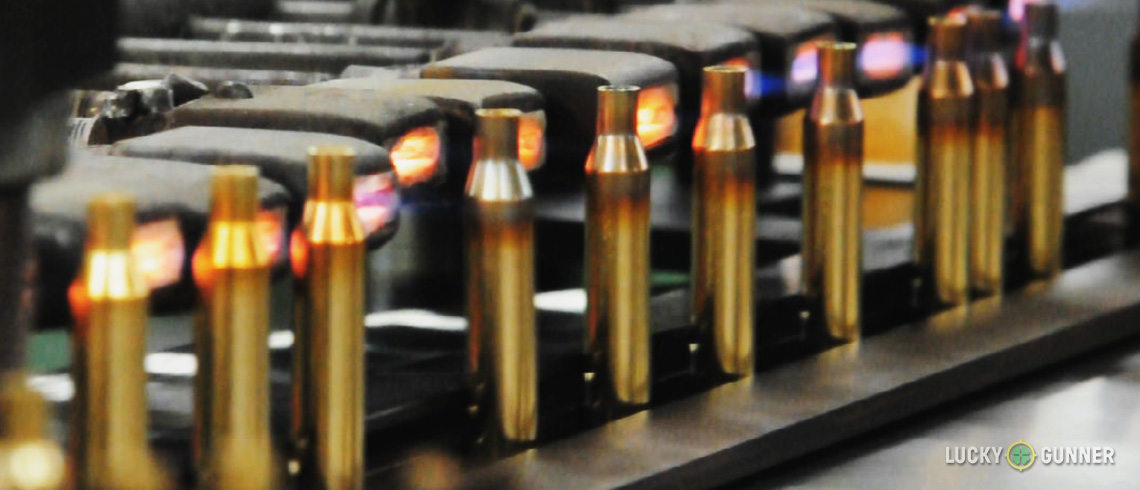
It's impossible to over anneal the body. 750F for several minutes does not anneal. I anneal until the neck just turns red with a single torch. About 8-9 seconds in the flame. I hold the case in my neck turner case holder and rotate with a drill. I push the case into the flame so it wraps around the neck. Most setups in videos show the very hot pointed flame tip just off the case neck. Some of the videos show the side away from the flame being colder. I see the entire neck red at the same time this way.
Was that you that posted about, I think, annealing RWS Hornet cases some years ago, to include feedback from RWS?

Danny
 
Now I'm having trouble just lighting the tip or tips. I know propane doesn't go bad. I have a new dbl line with individual line shut offs. When it lights, it won't stay lit long. I'm also having troubles with the individual shut off on each line. I'm thinking the dbl line (new) is bad???

The torches are Bernzomatic for general use.
When using these 20lb propane tanks, it's a good idea to use a regulator for easier control of the flow, giving you a visual, and helps keep the flow constant. I use a regulator when hooked up to my 20 pounder but seldom when using my 1 lb bottles. For a dual torch set up like you have, I'd highly recommend you use a regulator.
 
Pick and choose your “expert” carefully. Online opinions are not always reliable. Get on the annealer manufacturerers websites and research it. I chose the Giraud annealer 10+ years ago. I was taught to anneal in 1986. The technique then was to set cases in a cake pan of water, about half way up the case. Heat neck shoulders to just slightly cherry red then tip over in water to cool. The important part was not the get the case head too hot.
It's really hard to get case heads too hot unless you really leave the case in a fame for a really long time, like it'd have to look something like the one in this picture: 1772506483266.jpeg

Getting the neck to turn red for a second or a fraction of a second doesn't give enough time for heat to move down build up to a level that'd initiate any annealing effect at the head due to the short time and much lower temperature at the head. And the brass very rapidly cools off just subject to the ambient air; . . . the speed of cooling down happens in an exponential fashion. You can use water to cool them down really fast so you can handle them sooner, but then they're wet and takes time to dry them out; simply an unnecessary precaution with the additional step in the process.

If one wants to see just how hot the case gets at the head, one could paint some stripes of various temperature Tempilaqs down the side at the bottom to get a good idea what the maximum temperature it gets to. Just keep in mind that any annealing that takes place is a function of a temperature over a period of time. If the head were to get to 750°F (400°C), it'd have to be at that temperature like for 30 minutes or more to get any annealing (if any) done.
 
I'll have to look into this, sir!
having an independent regulator is a good idea but i use a 30 pound tank with 4’ hoses and two torches and no regulator. the propane torch heads have a regulator function in them.. it has always worked ok for me. if i was you id start wondering if there is propane in my tank. id take it to the propane place and have them check and ask them about the trouble youre having while i was there. it shouldnt be this hard.
 
Lots of good advice here as well as differing setups and opinions.
Max heat is "hotly" debated and there have been some rather technical metallurgical write-ups here by smart folks in that field.
My take-away was to do it in a dark room and not agonize about overheating.
Turning to results, what you should see is more consistent shoulder setback measurements after FL resize.
Same for neck OD/ID.
 
having an independent regulator is a good idea but i use a 30 pound tank with 4’ hoses and two torches and no regulator. the propane torch heads have a regulator function in them.. it has always worked ok for me. if i was you id start wondering if there is propane in my tank. id take it to the propane place and have them check and ask them about the trouble youre having while i was there. it shouldnt be this hard. Pop
 
That is true, but we're not welding and any part of the flame is hot enough to destroy brass. Regardless, I pull it out when I see a red glow.

The problem with trying to "sneak up on" the temperature by using just one torch (instead of two) or using a too-small flame is the same problem you get when trying to "sneak up on" welding temperature with aluminum. Like aluminum, brass is an excellent conductor of heat ... so thermally conductive that if you try to heat it too slowly, the heat "wicks away" from the area you're trying to heat (neck and shoulder only) faster than you're putting heat into the system. This method risks annealing everything -- neck, shoulder and head -- in one fell swoop. (Although if the heads are submerged in water, you should be OK.)

(This is also why you need such a huge power source to weld aluminum: You need to dump heat into the aluminum so fast that it can't conduct away from the weld area faster. If you try to weld aluminum at too-low a power setting, the heat wicks away into the rest of the piece, the whole piece heats up until a large section of the piece hits melting temperature, and then collapses onto the floor with a big wet PLOP.)

When I anneal, I tumble cases first so they're clean/shiny, then I use a homemade case holder in a cordless drill with propane torch, and watch for the color change to move from the tip of the neck, down through the shoulder and into the body, while counting off seconds. It's not hard to see the color change with a little practice.
 
Last edited:
I have no regulator on my bench source. Dual tourch. Open valves very slowly starting at tank I use cutting torch striker Hold the striker against the tourch heads and when lighting. I also use a dark room to anneal
 

Upgrades & Donations

This Forum's expenses are primarily paid by member contributions. You can upgrade your Forum membership in seconds. Gold and Silver members get unlimited FREE classifieds for one year. Gold members can upload custom avatars.


Click Upgrade Membership Button ABOVE to get Gold or Silver Status.

You can also donate any amount, large or small, with the button below. Include your Forum Name in the PayPal Notes field.


To DONATE by CHECK, or make a recurring donation, CLICK HERE to learn how.

Forum statistics

Threads
169,264
Messages
2,273,509
Members
81,945
Latest member
CarbonX
Back
Top