• This Forum is for adults 18 years of age or over. By continuing to use this Forum you are confirming that you are 18 or older. No content shall be viewed by any person under 18 in California.

Lapping scope rings

This was on my to-do list and since this is being discussed, last evening was a good a time to get to it.

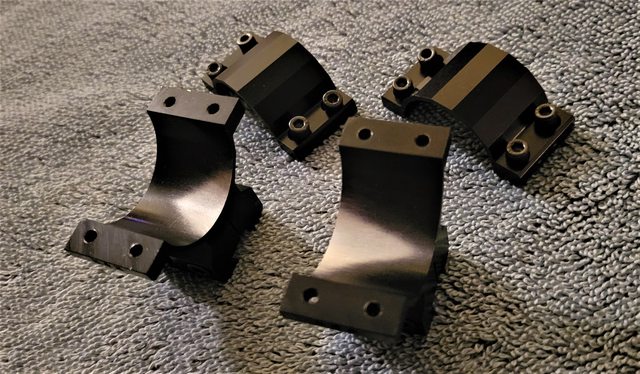
I opened the box on this set of new-in-the-box, never installed on anything, Kelbly 30mm black anodized double screw rings. These are matched sets CNC'd from the same billet of aluminum...these are basically perfect rings in terms of alignment and dimensions.

Then, I mounted them on my Kelbly's Panda. With the Panda's integral rail, and precisely CNC'd rings from the same manufacturer, this should be the theoretical 'perfect' when it comes to scope tube contact to the rings. And from shooting Pandas and Kodiaks for over 25 years, I can assure you it doesn't get any better than this when it comes to out-of-the-box stuff. Kelbly's fitment of rings on their rails is that good!

The next step was to take the ground (not turned) 30mm lapping bar and with a bit of 400 grit Clover lapping compound on the rings, a few very light passes were made through the rings. The 400 grit is much finer than I use when lapping prior to bedding of course. But I used it in this instance so as to better illustrate what we're talking about.

Dots can be connected or ignored, as you wish. ;)

Good shootin' -Al

ipK8DoFl.jpg
 
Last edited:
Well that’s the argument for selling annealing machines. Myself I’m not qualified to judge out side of my own little program.
Use a seating force gauge and you will see it, with your own eyes. Maybe you don't shoot enough rounds to value extending the life of your brass or do not need the level of precise accuracy some are trying to achieve. Not picking, just making the point every one does not have the same needs or desires.The only fly rod I own I bought for about 10.00 as a teen 60 some years ago. The level of use I need it for requires nothing more. I have had custom built rods from exotic material. I could not appreciate them. I gave them away to friends who could. My old 10.00 rod , a red and, a black ant, and a wet Hairs Ear Nymph is all I need.
 
Use a seating force gauge and you will see it, with your own eyes. Maybe you don't shoot enough rounds to value extending the life of your brass or do not need the level of precise accuracy some are trying to achieve. Not picking, just making the point every one does not have the same needs or desires.The only fly rod I own I bought for about 10.00 as a teen 60 some years ago. The level of use I need it for requires nothing more. I have had custom built rods from exotic material. I could not appreciate them. I gave them away to friends who could. My old 10.00 rod , a red and, a black ant, and a wet Hairs Ear Nymph is all I need.
If you shoot long range BR like I do, you’ll hear both sides of these topics discussed. I don’t tell other guys how to do anything but the brass I use pretty much last indefinitely and performs at a very high level with nothing more than a quick wipe down. I like cheap fishing rods also..
 
How many mils thick is that compound applied and how much material do you estimate was taken off ?
Just curious ..
Interesting point.

Is there a way to test the amount of contact between the scope and rings? That way we'd be able to see the difference in contact before and after lapping the rings.
 
Interesting point.

Is there a way to test the amount of contact between the scope and rings? That way we'd be able to see the difference in contact before and after lapping the rings.
There's a very easy way to test how much stress is in a scope mounting setup.

With the scope mounted in the rings and the ring tops tightened, place a dial indicator on the top of the scope tube close to a ring, zero it, loosen that ring top and see what it shows. You can also do this at 90 degrees to the top of the scope tube. Doing this on both rings, then on the objective and ocular ends of the scope can be quite revealing.

Good shootin' -Al
 
There's a very easy way to test how much stress is in a scope mounting setup.

With the scope mounted in the rings and the ring tops tightened, place a dial indicator on the top of the scope tube close to a ring, zero it, loosen that ring top and see what it shows. You can also do this at 90 degrees to the top of the scope tube. Doing this on both rings, then on the objective and ocular ends of the scope can be quite revealing.

Good shootin' -Al
I think I will try that when it gets nasty out.
 
As Al and Boyd said, the action, base, and rings should work as a unit. Everything in the machining world has a tolerance, period. Stacking tolerances is a real thing, and not a good thing. The scope tube is the weak link in all of this. I use Burris Signature rings or lap rings. In my opinion, anything less is leaving money on the table! Just my personal opinion and nothing more.
Paul
 

Upgrades & Donations

This Forum's expenses are primarily paid by member contributions. You can upgrade your Forum membership in seconds. Gold and Silver members get unlimited FREE classifieds for one year. Gold members can upload custom avatars.


Click Upgrade Membership Button ABOVE to get Gold or Silver Status.

You can also donate any amount, large or small, with the button below. Include your Forum Name in the PayPal Notes field.


To DONATE by CHECK, or make a recurring donation, CLICK HERE to learn how.

Forum statistics

Threads
168,120
Messages
2,247,959
Members
81,005
Latest member
Bryan530
Back
Top