Follow along with the video below to see how to install our site as a web app on your home screen.
Note: This feature may not be available in some browsers.
This Forum is for adults 18 years of age or over. By continuing to use this Forum you are confirming that you are 18 or older. No content shall be viewed by any person under 18 in California.
Not trying to start anything,
Is a good group @100yds more than not going to group
good @600yds?
I know a .1 @100yds doesn't mean a .6 @ 600yds.
But reasonable size.
In the "warehouse" test he mentioned that a good group close
translated to a good group at distance.
No guessing, want actual testing done on load development.
Well, you started a thread, so you already started *something* lol.
I think in general a .2 @100 is a .4 @200 and such. At least if you are ignoring wind. But it's not true at 1-moa load at 100 will become half-moa at 200.
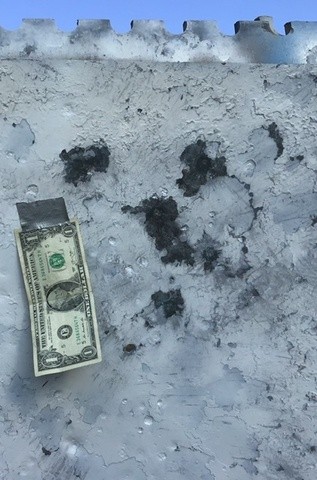
That is what I have found to be true. I hear people talking about rifle/ammo shooting great at 100 but lousy farther out, but I have not seen it. Here is a good example, a 5-shot group at 800 yards that were about 6". That rifle/ammo shoots about 1/2 minute at 100 yards. So, yeah, you lose at bit but it is still real good.
Lot more going on at 600 than 100. Accuracy of load and subsequent consistent velocity. What scope and magnification.Tiny errors in hold are magnified. Variable wind conditions. I am a short range guy. Never had a range nearby i could stretch it out at. It is a completely different game.
My goal in load developing is five rounds touching at 100 yards , and it will "print" nicely at 600 . And being able to duplicate that "proofs" to be a viable load . I think ; in reading Mr. Cortina's writings , that he had arrived at that conclusion after extensive testing . His writings are what I accepted as a "Benchmark" for load development . But not necessarily a "Rule" , based on caliber , and longer ranges .
Good groups at 100yds = good groups at 600-1000yds. Not necessarily. I've had 5 shot 100yd groups under .25" that were decent at 600yds....like 4-5" of vertical in a match and really open up at 1000yds. I've had loads that were .5-.7" 5 shot groups at 100yds that shot 600-36X at 600yds. I am making every attempt to do final tuning at 1000yds now.
A gun has to consistently shoot small at 100 to shoot well at 600 and 1000. I do all my tuning at 100 yards, but I have a lot of experience shooting short range Benchrest.
There are several "camps" of thought in regard to what distance is needed to tune a platform for further distances you will be competing at or just for fun. though I have my own opinions in regard to the question at hand I think the best suggestion I can give is this, if a given method is working and you continue to improve through regular personal bests stick with it. If not try a different method to create more regular personal bests.
I think if you want to shoot small at longrange you need to shoot really small at short range. .25 at 100 = .5 at 600 at least that's how it always works for me. Mike
I agree with most here, you have to have
at least a good group @100 to be good at distance.
You don't hear about a .5-.7 at near and getting better at distance (except Robin)
Shawn has a good point. if your not getting consistent good groups near than
you need to do something different, cause it isn't going to get better.
I know a good group to one person isn't always a good group to others.
It's subjective to what you want to accomplish.
I've had groups that were great @ 100 and not so great at 200. I've had groups that were lousy at 100 shoot good at 200 and I have many that shoot good at both and beyond. I'd like to say a.25moa @ 100 is .025 @ 1000 but think that is rarely the case; just too many factors as the distance is extended.
I do all of mine at 200 yards but I think to get a good feel, one should start @ 300 if they can.
Good groups at 100yds = good groups at 600-1000yds. Not necessarily. I've had 5 shot 100yd groups under .25" that were decent at 600yds....like 4-5" of vertical in a match and really open up at 1000yds. I've had loads that were .5-.7" 5 shot groups at 100yds that shot 600-36X at 600yds. I am making every attempt to do final tuning at 1000yds now.
My first 300 WSM LR BR rifle shot half MOA at 100 yds and managed five groups between 3.5" and 4" five-shot groups at 1000 yds in good conditions.
The 6mm Dasher and 6BRAs I have been shooting lately really need to shoot under 3/8" (5 shot groups) at 200 yds to shoot better than 2" at 600 and better than 5" at 1000. The 6mms are much more sensitive to conditions than the 30s. On a tuning day before a match, one of my 6BRAs shot three sub 2" three-shot groups at 1000 yds. That load's 5 shot groups at 200 yds were in that 1/4" to 3/8" range.
The 300 WSM I just built is averaged .6" at 200 yds for four five-shot groups. It did manage one 1.5" group at 600 at the only match I have been able to shoot this year. I think this gun will be very competitive.
Given the above, and adding in what other competitors have told me, I think I see the following:
1. For a long range BR rifle, well tuned short range loads (100-200 yds) will also shoot well at long range (600-1000 yds). However, fine tuning at the competition distance the day prior at the match range may result in a slight tweak to that load. This is a bigger deal if the competition range is at a significantly different elevation than the range used for load development.
2. A short range BR rifle will outshoot a long range rifle at short range, but the short range rifle will not be competitive at long range
3. To be competitive at long range, the 6BRA and similar needs to shoot better short range groups than the 300 WSM. I think this is driven by BC. The 6mms are typically shooting bullets with BCs in the low .5s while the 30s are shooting bullets in the upper .6s. The 6mms seem to have greater dispersion at long range than the 30s, so they need to start smaller.
I reserve the right to adjust the views as I progress in the sport.....
I can assure you of one thing- groups do not get smaller at distance. If its shitty at 100 dont expect it to magically get good farther out. So if you cant shoot real good ones at 100 youre not going to suddenly shoot good ones at distance where the other effects come into play.
Typical 6mm 103-105 class bullet shooting .000" at 100 and has an extreme velocity spread of 20 fps. You've done a great job sorting and the B.C. variations of the 5 bullets is .000. My program says this would be a 4.5" vertical spread at 1,000 yards.
Can anyone explain why it is that several groups, and piles of groups with less than 2" of vertical, have been achieved at 1,000 with loads that have 15-20 fps of extreme spread? And i don't mean like once or twice a year, I mean like EVERY time conditions are half decent.....as in EVERY SINGLE TIME. Is the chronographs still no better than the old oheler? Or is something else at play? I do my tuning, because I can, at distance. Have been using a spot i can access easily at 871 yards. And just like at 1,000, the odds of shooting a poor group actually increases once my ES dips below about 5-8 fps. I see this anomaly more than once a year as well, lol....somewhere around 97.2% of the time
I think a good gun can be determined at 100, it still has to shoot and agg. I just don't know about the specific load though. Possibly competitive out to around 800ish with what I've seen on the BR based 6mms that I glean my experiences from. For sure still pretty solid at 600.
Just a couple extra penny's for everyone, since there's no damn matches yet lol
I think if you want to shoot small at longrange you need to shoot really small at short range. .25 at 100 = .5 at 600 at least that's how it always works for me. Mike
I think it's simple has this: a load cannot consistently shot smaller (in MOA) at longer range than at shorter range because there's simply more time for the ocean of air to disturb the path somewhat.
So a 1moa load at 100 might approach 2 moa at 200, but it won't be <2moa. If it shoots under 2moa consistently at 200, then it will consistently shoot under half that at 100.
Like with my first 300 WSM, where 1/2 MOA turned into .35 to .4 MOA at 1000 yds, I think the simplest answer it this. Few if any of us are checking groups at 100 yds and 1000 yds with the same group. I suppose that is now possible with sonic targets. Regardless, had I been able to see the 100 yd group that the 3.5" 1000 yd group would have made, it may have been .35 MOA as well.
Or even more likely, given how the wind can "blow them in" as much as it can "blow them out", it could all be the wind. All it would take is a very small wind change during one or two shots of the group to tighten it up at long range.
Also, a Berger Tech recently told me that he has seen bullet behavior in high humidity conditions, and that they do not always fly a straight line to the target. He said they do indeed need some distance to "settle down" and fly straight. A long time BR competitor who does a lot of testing told me the same thing.
So there are many possible explanations to why sometimes we see slightly better MOA at longer range. I think it would be cool too see results with various kind of bullets at say 100, 200, 300, and 1000 yds with sonic targets.
This Forum's expenses are primarily paid by member contributions. You can upgrade your Forum membership in seconds. Gold and Silver members get unlimited FREE classifieds for one year. Gold members can upload custom avatars.





 lol
lol


