• This Forum is for adults 18 years of age or over. By continuing to use this Forum you are confirming that you are 18 or older. No content shall be viewed by any person under 18 in California.

Time to make the donuts....

Also I forgot yes Sierra lubes the core wire cuts squirts and then straight into jackets to coreseat and pointup
That’s good to know.
I just got 10,000 new cores from Charlie, I could sacrifice some jackets to see how it works.
The question:
What to use? I still use pure lanolin on the jackets.
How much? I am using .5 grains of Lanolin on approx 500 jackets tumbled for 30 minutes during core seat. It’s barely detectable but seems to work.
 
just rinse in white gas or acetone if you want it evaporate quicker with enough atf to just turn it slightly red it will leave just a slight residue
George
Does the oxidation on the cores from etching with vinegar serve the same purpose as the transmission fluid
In other words, are they having the same effect on core seating
 
just rinse in white gas or acetone if you want it evaporate quicker with enough atf to just turn it slightly red it will leave just a slight residue
5 ml atf to 16oz of acetone is a good place to start but you can play with the mix a little bit. That's what I use on my Rorschach fb Dies.
It's hard to detect that the cores are even lubed. I think when people hear the term "wet" cores they think of dripping wet.......
 
Has anyone done any dry lubes on the cores such as Mica types,
Molybdenumdisulfides or the Teflon powders ?? Could just dust
them up in a cloth bag.......I was just touching up my bench bags
with some moly powder and said.....Hmnnnn ??
 
Has anyone done any dry lubes on the cores such as Mica types,
Molybdenumdisulfides or the Teflon powders ?? Could just dust
them up in a cloth bag.......I was just touching up my bench bags
with some moly powder and said.....Hmnnnn ??
Not that I know of. But I will say the last thing I want to do is introduce anything dusty to my bullet making environment. Lubed jackets would attract that stuff like a magnet.
 
I've been running "wet" cores for quite awhile now. I only use pure lead wire and at times (many) would get flakes sticking on the core seat punch and never in a convenient spot to pick it off.
The recipe I use(modified) came from Gary Conaway.
Degrease the cores after squirting. 7 or 8 ml of ATF mixed in 16 oz of methylene chloride, then put your cores(3 to 5 thousand) in a large stainless bowl and pour the mix on. Just stir lightly to make sure everything is covered and scoop the cores out onto some towels, they dry very very fast. pick one up and you really can't feel the lube--but a handful--yup. I can go through at least a couple of buckets and never get flakes sticking to the punches.
There are lots of folks using Hood cores who seat them as they come--still with the lube on them with no issues.
Later, Mark Buettgen
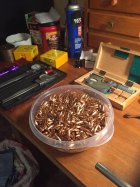
IMG950448.jpgIMG951491.jpgIMG950699.jpg
 
Since I'm having some difficulty with the manufacturing process, I was getting neurotic about cleaning it. After washing it 3 times with acetone, I was still boiling the core with TPS and then with white vinegar.
Lubricating the core was one of the last things I would have thought of doing.
But isn't the fact that it doesn't harm the bullet due to the fact that most custom bullets makers produce for calibers with a very slow twist (1/13 for 6 PPC and 1/17 for 30 BR?)
For 6mm bullets with a weight of 105,or 30 caliber 200 grains , which require a fast twist, is lubrication still a good idea?
*** I know I have to find out for myself, but I'd like to hear from those with more experience.
 
Since I'm having some difficulty with the manufacturing process, I was getting neurotic about cleaning it. After washing it 3 times with acetone, I was still boiling the core with TPS and then with white vinegar.
Lubricating the core was one of the last things I would have thought of doing.
But isn't the fact that it doesn't harm the bullet due to the fact that most custom bullets makers produce for calibers with a very slow twist (1/13 for 6 PPC and 1/17 for 30 BR?)
For 6mm bullets with a weight of 105,or 30 caliber 200 grains , which require a fast twist, is lubrication still a good idea?
*** I know I have to find out for myself, but I'd like to hear from those with more experience.
Obtain and read RIFLE ACCURACY FACTS, by Harold Vaughn - in chapter 8, Bullet Core Problems,
Mr. Vaughn addresses the issue of core slippage, describing his methods, and other interesting "stuff".
The book, a TROVE of not only direct, but also, between the lines knowledge/facts, was/is largely dismissed by mainstream bench-rest/precision fanatics. ;) Good shootin'! RG
 
Last edited:
Randy. Unless I missed it, you haven’t said whether you use squeaky clean cores or some type of personal formula as a lube that makes your 30 caliber Bullets as great as they are.

Also, since I look at consistent excellency in Match Performance as a gage, I would like to have some inside info on what Wayne Campbell does in his operations. He obviously makes an excellent bullet.
 
I decided to try the lubed core operation on my 68 grn 6mm bullets.

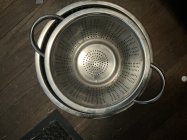
I bought a 1 gallon stainless colander set. I poured it 2/3 full of acetone, then added enough ATF to give it a light pink tint.
I then put 350 clean cores in the colander and submerged it into the liquid. I let it soak for a few minute, and then took the colander out and let them dry over night.
Yesterday morning, I core seated 350 jackets, and early this morning pointed them up.
The finished bullet is close to .0002 fatter than the previous ones done with clean and dry cores. The pointed up really nice with no anomalies.

We have the Texas State LV/Sporter this week end in New Braunfels. I am going to (try) take off tomorrow and test these bullets against the previous ones.
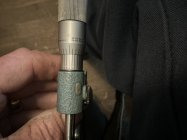
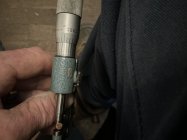
The first bullet measurement is bullets I just made, the next the one is the bullets with clean cores.IMG_0733.jpegIMG_0732.jpeg
 

Attachments

  • IMG_0731.jpeg
    IMG_0731.jpeg
    481.1 KB · Views: 29
Last edited:
Randy. Unless I missed it, you haven’t said whether you use squeaky clean cores or some type of personal formula as a lube that makes your 30 caliber Bullets as great as they are.

Also, since I look at consistent excellency in Match Performance as a gage, I would like to have some inside info on what Wayne Campbell does in his operations. He obviously makes an excellent bullet.
Jackie, after testing several of the practices, and making some pretty decent "wet" cored bullets @ few customer requests, except for those few [large] custom orders, I stayed with "squeaky clean" (dry) cores . . . My dies don't need the diameters getting any larger. ;) The clean dry cores produce very consistent bullet [shank] diameter, if making for only myself, a couple of 0.0001s wouldn't matter. "Pressure-ring" diameter, "is-what-it-is", and from jacket & lead wire LOT-to-LOT will be different/vary.

As compared to "wet" cores, I "like" the extremely small probability of variation the dry core method provides. Though it does add a potential variable, with a little common sense, even the wet method should be quite controllable & predictable.


With the pressure involved, I'd bet that most of the lube is evacuated - as would be most air. Several years ago, pal, Terry & I observed bullet production at the Sierra plant: the cores on their GREAT 168 Gr. International HP BT were getting seated with a LOT more lube than I would have imagined! :eek: RG
 
Last edited:
Jackie, after testing several of the practices, and making some pretty decent "wet" cored bullets @ few customer requests, except for those few [large] custom orders, I stayed with "squeaky clean" (dry) cores . . . My dies don't need the diameters getting any larger. ;) The clean dry cores produce very consistent bullet [shank] diameter, if making for only myself, a couple of 0.0001s wouldn't matter. "Pressure-ring" diameter, "is-what-it-is", and from jacket & lead wire LOT-to-LOT will be different.

As compared to "wet" cores, I "like" the extremely small probability of variation the dry core method provides. Though it does add a potential variable, with a little common sense, even the wet method should be quite controllable & predictable.


With the pressure involved, I'd bet that most of the lube is evacuated - as would be most air. Several years ago, pal, Terry & I observed bullet production at the Sierra plant: the cores on their GREAT 168 Gr. International HP BT were getting seated with a LOT more lube than I would have imagined! :eek: RG
Thanks for the reply, Randy.

If these 6MM bullets shoot, I will dedicate some 30’s and try it. If not, I will just continue with what we have been doing.
 

Upgrades & Donations

This Forum's expenses are primarily paid by member contributions. You can upgrade your Forum membership in seconds. Gold and Silver members get unlimited FREE classifieds for one year. Gold members can upload custom avatars.


Click Upgrade Membership Button ABOVE to get Gold or Silver Status.

You can also donate any amount, large or small, with the button below. Include your Forum Name in the PayPal Notes field.


To DONATE by CHECK, or make a recurring donation, CLICK HERE to learn how.

Forum statistics

Threads
167,946
Messages
2,243,571
Members
80,908
Latest member
Ecto-B
Back
Top