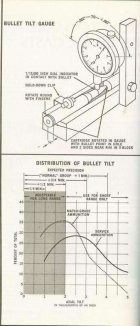
I got theHornady on a whim. Not sure why... I don't like most of what else they make....Hornady gage is ok. I think there are fair more accurate and repeatable gages on the market. I love the 21st Century but I also own an Accuracy One




I got theHornady on a whim. Not sure why... I don't like most of what else they make....Hornady gage is ok. I think there are fair more accurate and repeatable gages on the market. I love the 21st Century but I also own an Accuracy One

Lol. Neither do I but I still find myself loading on a 20+ yr old hornady single stage press that makes some pretty damn consistent ammo.I got theHornady on a whim. Not sure why... I don't like most of what else they make....

THIS ^^^ and what, XTR and Clark, have to say, in their Post's, are MY,. "thought's",.. EXACTLY and "Key" idea's for good, CONSISTENT,.. Accuracy. And WHY, I won't use, .006 to .09, TIR, "out of Round", Bullets for IMPORTANT ( Elk , Deer, Antelope, or, Moose, ) shots at,.. "Longer ranges". Then, you ADD IN, the WIND Factor, so WHY ,. "chance it" ??Not entirely. The bullet can enter the throat either concentrically or not. If it's concentric; and so is everything else in the system, then the lands will all begin to engrave the jacket at the same time and the forces are evenly distributed. If it enters out of kilter then the engraving forces on one side "could" be different and the resultant swaging of the bullet to make it straight again will change its shape somewhat and could unbalance the mass distribution which could, because of rifling and high spin rates that come of it, cause an imbalance once the bullet is in free flight with essentially unpredictable consequences. On the whole though, I suspect that what XTR talks of, the straightening effect of the throat, will dominate.

It is the opposite. Gyroscopic stability increases with range, given adequate initial spin. General Hatcher demonstrated this in his 1947 work, "Hatcher's Notebook".Hmmmm??? My thoughts regarding this question is this: Just as when spinning an imbalanced top or ceiling fan or with the spin of a clothes dryer, a bullet that's not fully balanced (like due to some uneven deformation from the way it engaged the lands) will not have as much wobble when spinning as a high rate of speed as it does when the spin slows down. Therefore, a cartridge with a bullet having something like .006 TIR has little effective wobble from its imbalance (pretty stable) at 100 yds. due to its high rate of spin, but there's a much greater effective wobble at 1,000 yds. as the spin has slowed down substantially. So it seems to me that when shooting 100-200 yds. a lot of runout need not be of much concern, but when shooting long or extreme distance, you want to be close to perfect as possible. But if one is inclined to OCD with cartridge prep, it doesn't matter.
Brian Litz has an interesting discussion about this and a few other things reloaders seem to obsess over. He says that in his lab, they tested many calibers with run out as high as .008" and it made no measurable difference in groups sizes or accuracy.I like the statement above, just size and seat like Tony does. If you only knew the lengths he went through to get straight ammo and everything else perfect.
Joe Hynes
Brian Litz has a good discussion about this topic and other practices that reloaders obsess over that really dont have any measurable differences in group sizes or accuracy. And explains that the time saved by not doing those things should be spent on marksmanship techniques like wind reading and things like that.Oh my God. Really?
I've been agonizing over this since I started using some new Redding dies a couple months ago and have worse run-out than I used to with my Lee dies. With those, I'd usually get 0.001-0.002 tir, and an occasional 0.003. With my Redding, I'm getting a wider range and a lot more at and above 0.002 with a couple 0.004.
I mean... My reloading the last couple of weeks has been more stressful and aggravating than enjoyable due to this. And you guys are telling me it doesn't matter much below 0.009 and no difference below 0.005?

The problem with Litz's proclaimation is that it's entirely empirical. There is exactly zero way to establish a threshold for the start of a causal relationship since the moment of bullet release takes place well after the initiation of a chain of interrelated events which we lump under the unhelpful heading of internal ballistics. As well, pinning the discussion to total indicated runout from base to tip helps to make the analysis doubly meaningless as the bullet is going to possibly be at an angle to the central axis of the case along its length and the seating depth will add even more variables to the equation. One cannot normalize this kind of complex system very well enough for a cause-effect relationship to be successful much less predictable.Brian Litz has an interesting discussion about this and a few other things reloaders seem to obsess over. He says that in his lab, they tested many calibers with run out as high as .008" and it made no measurable difference in groups sizes or accuracy.
Coffee jitters. Ain't that the truth....you're almost certainly missing the chance to obsess over something more important and more easily fixed, like how much coffee one has before sitting down to fire a group.
Perhaps one of you would call the rest of us idiots for no apparent reason just to make it a little more familiar with respect to typical interweb forum discussions on any point of fact.


Or changing neck grip relative to a concentric round that isn’t “straightened”.As a side note, I have watched shooters use loaded round straighterners such as the Bruno, using substantial hits to “straighten” the thing out.
I ask……”how do you know you aren’t bending the bullet”.



We use essential cookies to make this site work, and optional cookies to enhance your experience.