• This Forum is for adults 18 years of age or over. By continuing to use this Forum you are confirming that you are 18 or older. No content shall be viewed by any person under 18 in California.

What distance for tuner testing?

Less...it should happen in about a half of a revolution on my std cf tuner. The light model takes a bit more. Just shoot that test I posted a few posts back. It covers 15 marks and the standard tuner has 32 per revolution.

edit...I went back and saw that you're using a different tuner. There can be significant differences in different designs, so there's really no way I can answer your question definitively. But, that test, or a modified, probably longer version of it, will show ya how far it is with any tuner. But it may well take some effort to get there in regard to establishing mark values and how they correlate to group shapes etc. I spent countless hours and thousands of rounds testing for these things. It wasn't a coincidence that my tuners have the number of marks on them that they do. In fact, the standard 7oz tuner has 32 and the 5oz model has 10. Big difference in that 2 ounces of difference in weight. Again, testing is why that is the case. Not random at all.
Hi Mike, your comment "it wasn't a coincidence that my tuners have the number of marks on them that they do. In fact, the standard 7oz tuner has 32 and the 5oz model has 10. Big difference in that 2 ounces of difference in weight. Again, testing is why that is the case. Not random at all." has me intrigued.
I built one to see if there was an effect and if so, I'd buy a real one.
Not knowing what I was doing, I just drew up a quick sketch, put a piece of stainless in the lathe and went at it. Finished part weighs 4.13 oz. and has 5/8"-24 threads, and I had a friend laser marks "0" thru "8" with long lines and short lines in between, so 10 marks per rev - seems like I'm closer to your 5 oz model except for the thread pitch. Does it sound like I can stick with those marks? I can also make a DYMO label with just about any increment needed.
I should be able to get to the range sometime this long weekend and send back the target.
Thanks for your input here.
Scott
 
Hi Mike, your comment "it wasn't a coincidence that my tuners have the number of marks on them that they do. In fact, the standard 7oz tuner has 32 and the 5oz model has 10. Big difference in that 2 ounces of difference in weight. Again, testing is why that is the case. Not random at all." has me intrigued.
I built one to see if there was an effect and if so, I'd buy a real one.
Not knowing what I was doing, I just drew up a quick sketch, put a piece of stainless in the lathe and went at it. Finished part weighs 4.13 oz. and has 5/8"-24 threads, and I had a friend laser marks "0" thru "8" with long lines and short lines in between, so 10 marks per rev - seems like I'm closer to your 5 oz model except for the thread pitch. Does it sound like I can stick with those marks? I can also make a DYMO label with just about any increment needed.
I should be able to get to the range sometime this long weekend and send back the target.
Thanks for your input here.
Scott
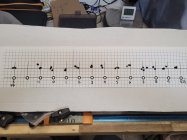
The only way to know is to test. I can't answer that. Tried calculating it on my light model and missed it by a country mile and still have no idea why the calculation was that far off from real world results.
 
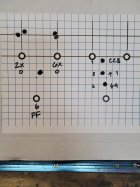
Made it to the range this morning, but will probably have to repeat this. I didn't have enough brass from one annealing session (AMP not in budget at the moment) to do this and noticed a difference in seating pressure between the 2 sets that I had available - All the same lot, though. So now I have all my brass fired and can anneal all 300 cases in one session. 6BRA, Alpha brass, N150, 30.2 gn, 107 SMK +0.006" (1.860" CBTO with my comparator)
Order of fire - small target; first 3 shots on clean cold barrel with elevation adjustments, 2X fired brass, 6X fired brass all on '0', Long target; '-1' to '5' (on 6X fired brass) - Line Break - Small target Lapua BR fire forming load on setting '6' (2 shots), long target '6' to '(1)0' (on 2X fired brass), then Lapua FF on '3' Far left, 3 shots). For the 36 rounds fired for the tuner settings, avg vel 2854, ES 21, SD 4.7.
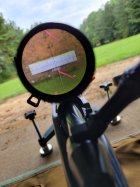
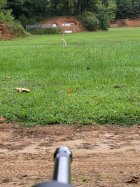
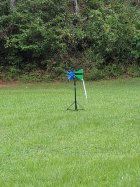
Shot over "flags", but the gentlemen a few benches down had proper flags that didn't move a bit.
 

Attachments

  • 20250901_151106.jpg
    20250901_151106.jpg
    340.1 KB · Views: 164
  • 20250901_151119.jpg
    20250901_151119.jpg
    360.2 KB · Views: 158
  • 20250901_090335.jpg
    20250901_090335.jpg
    257.5 KB · Views: 140
  • 20250901_082505.jpg
    20250901_082505.jpg
    903.7 KB · Views: 80
  • 20250901_085558.jpg
    20250901_085558.jpg
    717 KB · Views: 109
Last edited:
This is curious to me, if I may ask what inside diameter is the comparator you’re using and what is the freebore of the chamber ?
I will need to check with a gauge pin, but a Derraco "24" comparator (measures 0.2325" with calipers) and 0.120" FB (Criterion 6 BRA). It's a couple thou more now with 1480 rounds ;)
 

Attachments

Made it to the range this morning, but will probably have to repeat this. I didn't have enough brass from one annealing session (AMP not in budget at the moment) to do this and noticed a difference in seating pressure between the 2 sets that I had available - All the same lot, though. So now I have all my brass fired and can anneal all 300 cases in one session. 6BRA, Alpha brass, N150, 30.2 gn, 107 SMK +0.006" (1.860" CBTO with my comparator)
Order of fire - small target; first 3 shots on clean cold barrel with elevation adjustments, 2X fired brass, 6X fired brass all on '0', Long target; '-1' to '5' (on 6X fired brass) - Line Break - Small target Lapua BR fire forming load on setting '6' (2 shots), long target '6' to '(1)0' (on 2X fired brass), then Lapua FF on '3' Far left, 3 shots). For the 36 rounds fired for the tuner settings, avg vel 2854, ES 21, SD 4.7.
Shot over "flags", but the gentlemen a few benches down had proper flags that didn't move a bit.
Looks like 2 3 4 would be a tad more stable than 8 9 10 on the tuner test.
 
Looks like 2 3 4 would be a tad more stable than 8 9 10 on the tuner test.
Yes, I think I got a full sine wave from -1 to 5 (which was one set of annealed brass). I liked 3 as its the top, but need to explore half marks... after I get annealing and neck tension under better control.
 
OK, so "window" may be a poor term, but let me rephrase; Using the attached target as an example (not my target), I can't imagine that settings (at 100 yds) of 2-5 would be chosen over settings 9-12 (given that 4 and 11 have a bit of vertical to them), to go to 600 with. So the question is, would the 600 yd setting usually be found in the 9-12 range (+/- 1) ?
@Northridge @64Rambler That is a very nice graph test. Do you have anymore? I would like to see others. What yardage did you perform this test? I would be inclined at that charge seating combo to run in the 11-12 range. ?
 
OK, so "window" may be a poor term, but let me rephrase; Using the attached target as an example (not my target), I can't imagine that settings (at 100 yds) of 2-5 would be chosen over settings 9-12 (given that 4 and 11 have a bit of vertical to them), to go to 600 with. So the question is, would the 600 yd setting usually be found in the 9-12 range (+/- 1) ?
@Northridge @64Rambler Is 9 to 14 a rotation direction in or out?
 
@Northridge @64Rambler That is a very nice graph test. Do you have anymore? I would like to see others. What yardage did you perform this test? I would be inclined at that charge seating combo to run in the 11-12 range. ?
No more yet. I did a bunch of stock work during the off season and a change in bullet and powder, so now I'm trying to get back to groups in the 2s. For the pic referenced, all shots were the same load and seating depth, same lot of brass, and fired at 100 yds. Shots at tuner settings -1 thru +5 was on one annealing campaign, shots at tuner settings +6 thru +1(0) (a.k.a. "10", or one full revolution out) was from brass annealed during another campaign. This illuminated an inconsistency I had not seen before. My tuner has 10 marks, 0 through 9, and is on 24 tpi threads, so each mark is ~0.0042" movement. Minus numbers being closer to action, positive numbers away from action. Based on this thread and several others on the topic, the sweet spot I should be looking for, in this case, was setting "3", as it is at the top of the sine wave, which should help with positive compensation as well.
As with all my range trips, I always need one or two more loads, or seating depths, or ??, etc. So yes, I'd have loved to see what the next 2 settings would have looked like on paper.
The tuner, so far, has been the last knob to turn, literally, in load development and with the current setup, I'm not quite ready to work with the tuner.
 
What are the expectations of a 1000 yard shooters shooting a 1/4 MOA Agg in a 10 to 12 mph switching wind.
I’ll take this time to clarify that we just can’t get good data 10-12 mph switching wind so I’d likely skip that opportunity and rely on previous data, however as to Shawn’s point a bit of an honest wind doesn’t slow us down at all and shows you what a load can do under real world conditions.

Jim
 
@Northridge @64Rambler Thanks for the reply. I noticed that you potentially have more room for "positive compensation" on the shot 11 side. I don't know what others are thinking but seems to me try to stay in the middle or top of the rise. The top might be a little risky.. but one may be able to speed it up or slow it down by moving the tuner some unknown amount in or out. ?
Thanks for the reply
 
This. Its so much more valuable to learn to tune the right way. So many have gone down the easy path and it limits you.
I 100° agree. When I first had tuners no one at the ranges for the most part knew what they were. In my experience tuners are not to develope your load with. Your load should be developed in a conventional manner with a process that works for you. I use, and think the value of a tuner is to keep a well tuned rifle on point as your initial tune starts to change with very minimal additional shots. Whats most often overlooked in these threads is the skill of the shooter and the limits of the equipment used. To me the practical distance to adjust the tuner is 200yds and in. Environmental impacts beyond that make what you think you see questionable. If a rifle is shooting in the 1s and zero and now it's creeping into the 2s getting the proper results with the tuner is fatally dependent on shooter skill and level of equipment. One other observation, if your twisting on it and have not set wind flags I am laughing at you.
 
@Northridge @64Rambler Thanks for the reply. I noticed that you potentially have more room for "positive compensation" on the shot 11 side. I don't know what others are thinking but seems to me try to stay in the middle or top of the rise. The top might be a little risky.. but one may be able to speed it up or slow it down by moving the tuner some unknown amount in or out. ?
Thanks for the reply
That right there is the key! If ya don't know a predictable and repeatable result from moving any tuner, ya really have to do a lot of testing unless the mfg offers guidance, like we all should do. I wish it was as simple as saying just move x amount, on any tuner, when you see this or that...but it's just not. Somebody, somewhere, has got to do very thorough testing to know and explain what to expect or it's a pretty long and uphill climb. That's exactly why good instruction is worth its weight in gold when it comes to any tuner. Sure, you can find a sweet spot that shoots small because there are several within the range of adjustment of virtually any tuner. The real trick is knowing what to do when it doesn't hold up due to condition changes. Any change really. There is a method to the madness and randomness has no place in it. If your moving without knowing...you're just guessing..and hoping.

Like many things often are...sometimes things are just as good as the instructions you get with them. I've done the leg work on mine for ya and I do very detailed instruction by phone or in person. This is why! It'd certainly be easier to have an online store, get your money and ship a tuner without detailed and personal instruction...but it just doesn't work well that way on the target and there are no generic tuner instructions for all of them. So...ya sometimes get what ya asked/paid for.

Not the same, but it might as well be...If I by a rocket ship without any instructions, I'm probably not gonna be happy with the end result, regardless of the price. But...if it takes me to the other side of the moon because I was well instructed about how to drive it...I'm tickled pink with it".

Sometimes it's more about how and less about what! If I spend my money with someone on a product, I should never, ever be told that how to use it is a secret. I mean...damn. Just sayin, is all. If I make my own, I should expect that, though.
 
I 100° agree. When I first had tuners no one at the ranges for the most part knew what they were. In my experience tuners are not to develope your load with. Your load should be developed in a conventional manner with a process that works for you. I use, and think the value of a tuner is to keep a well tuned rifle on point as your initial tune starts to change with very minimal additional shots. Whats most often overlooked in these threads is the skill of the shooter and the limits of the equipment used. To me the practical distance to adjust the tuner is 200yds and in. Environmental impacts beyond that make what you think you see questionable. If a rifle is shooting in the 1s and zero and now it's creeping into the 2s getting the proper results with the tuner is fatally dependent on shooter skill and level of equipment. One other observation, if your twisting on it and have not set wind flags I am laughing at you.
Just looking to make sure that I understand your Initial load Development and the Re-tuning when required. Are you saying that you developed a load that shoots in the 0's and 1's via Powdr Charge, Seating Depth and sizing Bushing. And when it starts opening up Shooting in the 2's at that time you add a Tuner to the barrel for the purpose of reducing the Vertical in your group size?
 
Just looking to make sure that I understand your Initial load Development and the Re-tuning when required. Are you saying that you developed a load that shoots in the 0's and 1's via Powdr Charge, Seating Depth and sizing Bushing. And when it starts opening up Shooting in the 2's at that time you add a Tuner to the barrel for the purpose of reducing the Vertical in your group size?
I think he means that he already has a tuner on the bbl and then uses it for exactly what you described...to adjust the tune as it changes...not to establish a good tune/load in the gun.
 
Just looking to make sure that I understand your Initial load Development and the Re-tuning when required. Are you saying that you developed a load that shoots in the 0's and 1's via Powdr Charge, Seating Depth and sizing Bushing. And when it starts opening up Shooting in the 2's at that time you add a Tuner to the barrel for the purpose of reducing the Vertical in your group size?
Mike answered correctly. Tuner I use is one piece. I screws it on the barrel until it stops, back off 4 turns and that becomes zero. Lock it and do load development. When I feel the load is going away I utilize the tuner.
 
I 100° agree. When I first had tuners no one at the ranges for the most part knew what they were. In my experience tuners are not to develope your load with. Your load should be developed in a conventional manner with a process that works for you. I use, and think the value of a tuner is to keep a well tuned rifle on point as your initial tune starts to change with very minimal additional shots. Whats most often overlooked in these threads is the skill of the shooter and the limits of the equipment used. To me the practical distance to adjust the tuner is 200yds and in. Environmental impacts beyond that make what you think you see questionable. If a rifle is shooting in the 1s and zero and now it's creeping into the 2s getting the proper results with the tuner is fatally dependent on shooter skill and level of equipment. One other observation, if your twisting on it and have not set wind flags I am laughing at you.
I agree 100% on doing all the “things” first while tuner is in a fixed location then clean up a slipping tune get every bit out of it… then back to my typical tweaks to nail that in match tune

Shawn Williams
 

Upgrades & Donations

This Forum's expenses are primarily paid by member contributions. You can upgrade your Forum membership in seconds. Gold and Silver members get unlimited FREE classifieds for one year. Gold members can upload custom avatars.


Click Upgrade Membership Button ABOVE to get Gold or Silver Status.

You can also donate any amount, large or small, with the button below. Include your Forum Name in the PayPal Notes field.


To DONATE by CHECK, or make a recurring donation, CLICK HERE to learn how.

Forum statistics

Threads
170,275
Messages
2,291,983
Members
82,772
Latest member
dfelix
Back
Top