• This Forum is for adults 18 years of age or over. By continuing to use this Forum you are confirming that you are 18 or older. No content shall be viewed by any person under 18 in California.

Unsupported case, again.

Doug Beach

Silver $$ Contributor
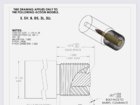
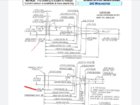
Just utilizing this drawing, with a .223 chamber, I come up with .194” of unsupported case. LC cases seem to have about .185” of solid case head, and Lapua somewhat less.
I know that I don’t have to cut it exactly this way, and I would, of course, not assume the headspace measurement is correct. This isn’t my question.
My question: assuming the chamber is cut according to the drawing, is this amount of unsupported case safe, or unsafe. My bet is on unsafe. What say you?
https://share.icloud.com/photos/0pUKTHN18lDLsEjGMTRWh2FcA
 
The image that appeared in the link for me didn’t contain chamber dimensions.

Your question led to looking up the .223 Remington in SAAMI to determine if there was a requirement regarding unsupported case length. Regretfully, none could be found. Though not illustrated/dimensioned in the chamber drawing, one can infer that the chamber’s end face is offset .200 inches from the breech face and that the unsupported case length would be the same.

Being that I’m not a gunsmith, I hope that @DaveTooley responds again and indicates how smiths know where to locate the chamber end face in relationship to the breech face. Similarly, as SAAMI doesn’t specify internal case head dimensions, it makes one wonder how brass manufacturers decide how thick to make the case head?
 
I’ve been operating under the assumption that any unsupported case wall, forward of the web, would be bad. You have 60k psi, on a brass wall that might be .040” thick, with nothing behind it.
If I’m mistaken, I’d feel a lot better about some of the action / cartridge combinations out there.
 
SAAMI drawings show .200" B (basic). If you expand this thick web area on firing & enlarge the primer pocket, the pressure is over 76,000 PSI?
Or a higher PSI then the cartridge was designed to work at?

"Basic" may mean there is room for adjustment?

20200706_074623.jpg

Cartridge Brass-
Material is 70 copper/30 zinc with trace amounts of lead & iron , called C26000. Material starts to yield at 15,000 PSI when soft (annealed), and 63,000 PSI when hard.
Material yields, but continues to get stronger up to 47,000 PSI when soft, and 76,000 PSI when hard.
 
I sectioned various cases years ago and for me I could say .190-.200" was the number I could consider safe. Consider any belted case. The belt is .220" from the bolt face. Case walls aren't any thicker than a beltless cases in front of the belt but it takes more than a few firings to get that area to expand and cause extraction issues. I was shooting BR when we transitioned from 222 class cartridges to the PPC. The brass, 220 Russian Sako had a balloon head. Meaning there wasn't much more than the primer pocket depth you could consider solid. Lots of Remington actions and not much experience by smiths with the new cases lead to the usual deep counterbores and large chamfers on the chamber mouths. Many ended up shooting belted cases where the cases expanded to fill the chamber chamfer. I still have several sets that have visible belts on them.
Now the flip side of this. We have all these custom actions where we can minimize the amount of unsupported case. Is it a good thing? Yes and no. Yes on the safety side though when you get to the moment you destroy the cartridge case bad things are going to happen no matter what. I'll preach a little bit here. I have some nasty examples of guns coming apart. Only minor injuries because the owners weren't looking into the loading port. The very first line of defense is not looking directly at the ass end of a bomb.
I'll down off my soap box now.
If .190-.200" is safe, and it is, are we causing any self inflicted problems by minimizing case exposure? With repeated firings everything will expand and work harden at the larger diameter. Just posing a question here. Might it be better to stay at that .190" mark and allow a portion of the exposed case to interface with FL sizing die without interference from the chamber? We know to little chamber clearance causes extraction issues regardless of FL sizing.
 
Remington 700 actions. Three Rings of Steel?

The first component in the “three rings of steel” is the bolt face, which completely encapsulates the cartridge head. The second is the action end of the barrel, which the bolt face tucks in to. This feature is especially important as it ensures that the bolt and the barrel are aligned correctly. The third ring of steel is the action itself, which the barrel threads into. All put together this makes for a very solid design, one that has withstood the test of time for 47 years.

https://sites.google.com/site/accur...ilable,supported by three separate components.
 
Last edited:
I can't see the document. I can't recall ever chambering any rifle with more than .155" of exposure (Remington 700) most are around .135 with Mausers at .110 or so. If others have done so with no issues, I'll take their word for it but I would rather avoid it. WH
 
Can't be done on gas guns with a cone for feeding. There's one company I do work for that puts a .025" radius on the edge of the cone. No problems.
Then I have another with a shallower cone angle that uses a.049" radius.
They all end up around .180" give or take some.
 
Last edited:
Less is better. Here are a couple of blown Dashers to show what too much can cause. The first was cut with an incorrect angle and blew brass bits in the shooters face. He almost lost an eye.
blown dasher case.JPG
This one I found at a PRS match. Probably over pressure and old brass. I'm guessing had to change his underwear after this.
blown dasher case prs2.jpg
 
Less is better. Here are a couple of blown Dashers to show what too much can cause. The first was cut with an incorrect angle and blew brass bits in the shooters face. He almost lost an eye.
View attachment 1188786
This one I found at a PRS match. Probably over pressure and old brass. I'm guessing had to change his underwear after this.
View attachment 1188787

Do you think that fire formed cases are more prone to this failure mode due to case wall thinning?
 
That print does not tell you how much unsupported case you will have.
The BATS I have played with do not make me nervous.

Yes, but it would appear that the cartridge is supported to the extractor
That print does not tell you how much unsupported case you will have.
The BATS I have played with do not make me nervous.

Yes, but it appears that the case is supported to the extractor groove.
The barrels i have are as the drawing, fully supported case.
 
Can't be done on gas guns with a cone for feeding. There's one company I do work for that puts a .025" radius on the edge of the cone. No problems.
Then I have another with a shallower cone angle that uses a.049" radius.
They all end up around .180" give or take some.
There you go. Virtually all of my work has been with bolt action and single shot rifles and I've not given much thought to the gas guns. I understand what we're talking about now. WH
 
Do you think that fire formed cases are more prone to this failure mode due to case wall thinning?
No I don't think it weakens the cases. Some of the material comes from the neck. They usually get shorter and then some from the body. It would be tough to get material to flow from what is essentially a solid head. I have seen the start of case separation at times but that's much further up the body. The case head remains intact.
 
SAAMI drawings show .200" B (basic). If you expand this thick web area on firing & enlarge the primer pocket, the pressure is over 76,000 PSI?
Or a higher PSI then the cartridge was designed to work at?

"Basic" may mean there is room for adjustment?

View attachment 1188586

Cartridge Brass-
Material is 70 copper/30 zinc with trace amounts of lead & iron , called C26000. Material starts to yield at 15,000 PSI when soft (annealed), and 63,000 PSI when hard.
Material yields, but continues to get stronger up to 47,000 PSI when soft, and 76,000 PSI when hard.

A "Basic" dimension is a theoretical exact dimension given from a Datum to a feature of interterst with no plus or minus tolerance. It is defined in ANSI Y14.5M-2009 Dimensioning and Tolerancing Standard.
 
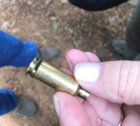
Lapua BR brass has a head thickness of ~.175. This chamber left .190"-.200" unsupported and it failed catastrophicly. The ruptured case is still in the chamber if you look close to illustrate exactly how and where the failure occured.
 

Attachments

  • Screenshot_20200911-075934.png
    Screenshot_20200911-075934.png
    907 KB · Views: 468
  • Screenshot_20200909-124319.png
    Screenshot_20200909-124319.png
    861.7 KB · Views: 425

Upgrades & Donations

This Forum's expenses are primarily paid by member contributions. You can upgrade your Forum membership in seconds. Gold and Silver members get unlimited FREE classifieds for one year. Gold members can upload custom avatars.


Click Upgrade Membership Button ABOVE to get Gold or Silver Status.

You can also donate any amount, large or small, with the button below. Include your Forum Name in the PayPal Notes field.


To DONATE by CHECK, or make a recurring donation, CLICK HERE to learn how.

Forum statistics

Threads
168,063
Messages
2,246,330
Members
80,965
Latest member
Blados33
Back
Top