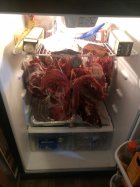
Over the years I've heard a lot of guys talk about building a walk in cooler to hang their deer in when its warm outside. I, too, was one of those people. I'm in Indiana, and it always sucked passing up on a nice doe in archery season because it was just too warm to butcher her. As the years went by, it seemed like this became an issue during our firearms season as well, but I could never justify the cost AND the dedicated space required for a deer cooler. Then I had an idea. What about using a chest freezer, and just replacing the thermostat? I decided to give it a try so I found a cheap external temp controller on ebay, and a relatively small chest freezer (probably 5cu ft) on craigslist for about $75 and gave it a whirl. It worked out great! I still had to skin and quarter the deer to get it in the cooler, but I was fine with that. The only real problem was the cheap analog temp controller didn't really give me a good way of knowing what the temp was inside so I didn't know if I was going to end up freezing something solid on accident, and the cooler would really only hold 1 deer at a time. A few years later I stumbled across this dandy little digital temp controller on Amazon, so I decided to build a larger cooler and just use the 5cu ft unit as a regular freezer.
I found a 13 cu ft freezer near by on craigslist for $125, and whala, I had a larger deer cooler that easily holds a big buck and a nice doe (skinned and quartered). The only real trick is installing and wiring the temp controller. Wiring really isn't tough to figure out. The wiring on a freezer is VERY basic. The built in thermostat just interrupts power to the compressor. You just need to disconnect the outgoing line from that switch and connect it to one of the the cooling contacts on the inkbird controller, and then run a new wire from the other contact to where ever you pulled the original line from. You can also splice into that line and do the same thing. The part that concerned me more was figuring out a way to route the new thermocouple into the freezer. I could have just laid it over the top and closed the lid, but I wanted a more permanent solution so that I could use the cooler as a freezer during the "off season" without having to unhook and reconnect wires every time I wanted to switch from deer cooler to freezer. I decided I was going to risk drilling a hole in the side of the freezer to run the thermocouple wire through, and just HOPE that I didn't hit a freon line. Looking the freezer over, and noticing where frost did and did not condense, I noticed that the inset box where the compressor is located never had frost on it so maybe it didn't have any freon lines in those walls (which would make sense from a manufacturing perspective). I stopped at the hardware store and bought a LONG 3/8" drill bit (bigger than needed, but I wanted plenty of room). I drilled from the outside of the freezer inward to avoid accidently jabbing the bit into something important when it broke through. A freezer wall is a piece of sheet metal, and then about 3" of some kind of foam, and then another piece of sheet metal. Pretty easy to drill through. Once the hole was there, I threaded the thermocouple through it along with 2 strands of 16ga twisted electrical wire (I wanted to install a receptacle for a small fan to circulate air which was a GREAT idea if I do say so). I wrapped the thermocouple wire and conductors together with some electrical tape to provide added protection against the sharp edges of the new hole, threaded that portion into the freezer wall, and then applied some RTV silicone to the inside to seal the hole. When I say some, I mean I tried to squirt it all the way through the hole to keep the wires from ever rubbing on the sheet metal.

That was 15 years ago, and its still working great today. When I quarter my deer, I put the quarters into reusable poly game bags, and then put that into a new contractor trash bag to contain any blood and keep from making a mess in the freezer/cooler. There are others, but I use these.
These are the small size. On a big buck (+200 lbs field dressed) they will hold one rear leg, or 2 front legs. On a decent size doe (130 lbs field dressed), I can fit one over the entire hind quarter (both legs and pelvis), but they are still a little small for the ribcage. They make a Large size also and those work well for the chest cavity, or the rear legs and pelvis on a large buck.
Here's a pick of the neck and ribcage of a 2yo doe in a small game bag. I cut the ribs as far up as I could because I didn't want to go get a large game bag (aka I was lazy). This is the absolute most that the small bag can hold.

When I get the deer home, I basically skin it right away, cut out the back straps and put those in a container, and then break the deer down into 3 pcs. Front legs go in one bag (sometimes I'll drop the back straps in this bag also), neck and ribcage goes in a 2nd bag, and back end goes in the third. it all sets down in the cooler. I try to stand them up as best I can to allow air movement around them so they will cool better. I set the temp at 27 deg, make sure the fan is turned on, close the lid and walk away. If I'm not going to start boning it out within the next day or so, I'll set the temp at 28 deg instead. I've found that at 28 deg, the meat will not freeze solid, but at 27 it will after a few days. When I'm boing the deer out, I put the meet in to 12qt Sterilite Containers. Walmart has them 4 for $11.
They stack well, aren't terribly difficult to clean up afterwards, and they fit well in a refrigerator. As I bone the meat out and fill the containers, the full containers go back into the cooler. They comfortably hold about 17lb of meet each. While I'm filling it, I often slide the partial container and the next empty container into the refrigerator. I butcher in our mudroom which is not climate controlled, so the fridge is helpful in October, but not always needed in December. When everything is deboned and back in the cooler, I'll run the cooler down to 26 deg over night so its nice and firm for grinding. The outer few inches are often ice, but they thaw out a little while i'm getting my grinder set up. I normally mix a pork shoulder in with each deer, so I grind it all twice to get a more consistent mix. I spray the grinder head, plates, blades, auger, and feed tray with olive oil, and put them in the freezer for an hour to two. The olive oil really helps with cleanup later, and I've found that there's less fat/meat buildup in the grinder when I switch cutting plates/blades. The Sterilite containers are handy for this as well, but be careful. The plastic is a lot more brittle when its -20 degrees. With heavy, frozen grinder parts in them, they are a little fragile and require some common sense when handling.
Here's a couple of pics of the cooler with a container of meat in it, and a quarter still in a bag laying in the bottom. The receptacle is laying under the basket. The hole and thermocouple are behind the container.


As I empty the game bags, I put them in a grocery sack and keep them in the cooler until they are all empty. Then they go through the washer with a little detergent and bleach.
Well, I ended up rambling on more than I had planned about more stuff than I had planned, but this is how I deal with hunting in warmer weather. Daytime highs were in the 60s when I butchered this deer, and in the 70s and even 80s when I butchered some during archery season (it was an especially warm fall for us). The cooler is located in my detached shop, and I use it as a chest freezer when I don't need too cool a deer down. When I'm done packaging, I normally run the thermostat down to -25 deg, and arrange the packaged meat in the bottom so it can freeze. The fan really helps speed that process up quite a bit. I could easily (and have) set the thermostat at 33 deg with the fan on to use it as a large refrigerator if/when needed. I have a larger (18-20 cu ft) chest freezer in the shop that provides most of my cold storage, but when hunting season is over I like to have about half of the meat in each freezer so that I don't loose it all if one freezer should happen to die on me (had that happen once in July....). The original small 5cu ft freezer is in my mudroom, and gets used as our normal chest freezer (ie stuff that won't fit in the one in the top of the fridge). The freezers in the shop are normally used for "longer term" or bulk storage. I'm very satisfied with the way this turned out. I'm on an acre and a half of property, and I wouldn't trade this for a walk in freezer if you gave it to me. For anyone who processes their own game and wishes they had a walk in cooler, I would strongly recommend that they consider doing something like this instead. My total $$ investment is less than the cost of the cool bot controller they use with the window AC units for the DIY walk in cooler, the freezer takes up a lot less space than a walk in cooler, and can be used year round.
Hope this is helpful for someone.
I found a 13 cu ft freezer near by on craigslist for $125, and whala, I had a larger deer cooler that easily holds a big buck and a nice doe (skinned and quartered). The only real trick is installing and wiring the temp controller. Wiring really isn't tough to figure out. The wiring on a freezer is VERY basic. The built in thermostat just interrupts power to the compressor. You just need to disconnect the outgoing line from that switch and connect it to one of the the cooling contacts on the inkbird controller, and then run a new wire from the other contact to where ever you pulled the original line from. You can also splice into that line and do the same thing. The part that concerned me more was figuring out a way to route the new thermocouple into the freezer. I could have just laid it over the top and closed the lid, but I wanted a more permanent solution so that I could use the cooler as a freezer during the "off season" without having to unhook and reconnect wires every time I wanted to switch from deer cooler to freezer. I decided I was going to risk drilling a hole in the side of the freezer to run the thermocouple wire through, and just HOPE that I didn't hit a freon line. Looking the freezer over, and noticing where frost did and did not condense, I noticed that the inset box where the compressor is located never had frost on it so maybe it didn't have any freon lines in those walls (which would make sense from a manufacturing perspective). I stopped at the hardware store and bought a LONG 3/8" drill bit (bigger than needed, but I wanted plenty of room). I drilled from the outside of the freezer inward to avoid accidently jabbing the bit into something important when it broke through. A freezer wall is a piece of sheet metal, and then about 3" of some kind of foam, and then another piece of sheet metal. Pretty easy to drill through. Once the hole was there, I threaded the thermocouple through it along with 2 strands of 16ga twisted electrical wire (I wanted to install a receptacle for a small fan to circulate air which was a GREAT idea if I do say so). I wrapped the thermocouple wire and conductors together with some electrical tape to provide added protection against the sharp edges of the new hole, threaded that portion into the freezer wall, and then applied some RTV silicone to the inside to seal the hole. When I say some, I mean I tried to squirt it all the way through the hole to keep the wires from ever rubbing on the sheet metal.
That was 15 years ago, and its still working great today. When I quarter my deer, I put the quarters into reusable poly game bags, and then put that into a new contractor trash bag to contain any blood and keep from making a mess in the freezer/cooler. There are others, but I use these.
These are the small size. On a big buck (+200 lbs field dressed) they will hold one rear leg, or 2 front legs. On a decent size doe (130 lbs field dressed), I can fit one over the entire hind quarter (both legs and pelvis), but they are still a little small for the ribcage. They make a Large size also and those work well for the chest cavity, or the rear legs and pelvis on a large buck.
Here's a pick of the neck and ribcage of a 2yo doe in a small game bag. I cut the ribs as far up as I could because I didn't want to go get a large game bag (aka I was lazy). This is the absolute most that the small bag can hold.
When I get the deer home, I basically skin it right away, cut out the back straps and put those in a container, and then break the deer down into 3 pcs. Front legs go in one bag (sometimes I'll drop the back straps in this bag also), neck and ribcage goes in a 2nd bag, and back end goes in the third. it all sets down in the cooler. I try to stand them up as best I can to allow air movement around them so they will cool better. I set the temp at 27 deg, make sure the fan is turned on, close the lid and walk away. If I'm not going to start boning it out within the next day or so, I'll set the temp at 28 deg instead. I've found that at 28 deg, the meat will not freeze solid, but at 27 it will after a few days. When I'm boing the deer out, I put the meet in to 12qt Sterilite Containers. Walmart has them 4 for $11.
They stack well, aren't terribly difficult to clean up afterwards, and they fit well in a refrigerator. As I bone the meat out and fill the containers, the full containers go back into the cooler. They comfortably hold about 17lb of meet each. While I'm filling it, I often slide the partial container and the next empty container into the refrigerator. I butcher in our mudroom which is not climate controlled, so the fridge is helpful in October, but not always needed in December. When everything is deboned and back in the cooler, I'll run the cooler down to 26 deg over night so its nice and firm for grinding. The outer few inches are often ice, but they thaw out a little while i'm getting my grinder set up. I normally mix a pork shoulder in with each deer, so I grind it all twice to get a more consistent mix. I spray the grinder head, plates, blades, auger, and feed tray with olive oil, and put them in the freezer for an hour to two. The olive oil really helps with cleanup later, and I've found that there's less fat/meat buildup in the grinder when I switch cutting plates/blades. The Sterilite containers are handy for this as well, but be careful. The plastic is a lot more brittle when its -20 degrees. With heavy, frozen grinder parts in them, they are a little fragile and require some common sense when handling.
Here's a couple of pics of the cooler with a container of meat in it, and a quarter still in a bag laying in the bottom. The receptacle is laying under the basket. The hole and thermocouple are behind the container.
As I empty the game bags, I put them in a grocery sack and keep them in the cooler until they are all empty. Then they go through the washer with a little detergent and bleach.
Well, I ended up rambling on more than I had planned about more stuff than I had planned, but this is how I deal with hunting in warmer weather. Daytime highs were in the 60s when I butchered this deer, and in the 70s and even 80s when I butchered some during archery season (it was an especially warm fall for us). The cooler is located in my detached shop, and I use it as a chest freezer when I don't need too cool a deer down. When I'm done packaging, I normally run the thermostat down to -25 deg, and arrange the packaged meat in the bottom so it can freeze. The fan really helps speed that process up quite a bit. I could easily (and have) set the thermostat at 33 deg with the fan on to use it as a large refrigerator if/when needed. I have a larger (18-20 cu ft) chest freezer in the shop that provides most of my cold storage, but when hunting season is over I like to have about half of the meat in each freezer so that I don't loose it all if one freezer should happen to die on me (had that happen once in July....). The original small 5cu ft freezer is in my mudroom, and gets used as our normal chest freezer (ie stuff that won't fit in the one in the top of the fridge). The freezers in the shop are normally used for "longer term" or bulk storage. I'm very satisfied with the way this turned out. I'm on an acre and a half of property, and I wouldn't trade this for a walk in freezer if you gave it to me. For anyone who processes their own game and wishes they had a walk in cooler, I would strongly recommend that they consider doing something like this instead. My total $$ investment is less than the cost of the cool bot controller they use with the window AC units for the DIY walk in cooler, the freezer takes up a lot less space than a walk in cooler, and can be used year round.
Hope this is helpful for someone.