• This Forum is for adults 18 years of age or over. By continuing to use this Forum you are confirming that you are 18 or older. No content shall be viewed by any person under 18 in California.

For those who sort primers....

The grams people are talking about is using that weighing setting on the scale and that is much finer than weighing in grains..
The gram setting on your scale will allow you to weigh to .0001 grams, ie .1 milligram.
A very small weight indeed. One grain = 64.799 miligrams
Guess it's one of those things I'd have to see in operation then as it doesn't make sense unseen.
 
Guess it's one of those things I'd have to see in operation then as it doesn't make sense unseen.
Get your scale out and toggle through the weight settings and you will find the gram setting.
Then take your primers and with a pair of tweezers start setting them on the scale and you will find that the ones that you weighed in the “grain” setting and found to be identical are now showing variances.
A bit like the difference of a scale weighing in pounds or ounces…
 
Get your scale out and toggle through the weight settings and you will find the gram setting.
Then take your primers and with a pair of tweezers start setting them on the scale and you will find that the ones that you weighed in the “grain” setting and found to be identical are now showing variances.
A bit like the difference of a scale weighing in pounds or ounces…
Yes, but pounds would be grams and ounces would be grains. That's like saying if I weighed in ounces and found them the same then switch the scale to pounds and they'll weigh differently. Pounds and grams = big, ounces and grains = little. I'm jus'a gonna hafta call Jethro to help on this'un and go back to Miz Perkins for a cipherin refresher. It ain't a gonna make no sense no other way.
 
Yes, but pounds would be grams and ounces would be grains. That's like saying if I weighed in ounces and found them the same then switch the scale to pounds and they'll weigh differently. Pounds and grams = big, ounces and grains = little. I'm jus'a gonna hafta call Jethro to help on this'un and go back to Miz Perkins for a cipherin refresher. It ain't a gonna make no sense no other way.
Just try changing the weight setting to grams and you will see what I am talking about.. {:~)
 
I weigh with a Sartorius Entris-64, it goes .001 grains. I just sort in grains to the hundredth IE 3.79, 3.80, 3.81. I ignore the .001 weight number because it fluctuates so much it would take me forever to decide which pile to put it in. I'm not sure how much difference there would be side x side using a .02 FX120i vs a .001 Sartorius but for what I am doing, I feel like I am doing good by grouping to .01 grains anyway and I know guys that are shooting very well grouping them by .02 grains.

I am still having a hard time wrapping my head around how a scale that is accurate to .02 grains is magically somehow MORE accurate when switched to grams.

I'm not trying to say anyone is doing it wrong or anything like that, I just don't understand it, so I'm trying to learn. I have seen guys alluding to the fact that grams is somehow a more accurate measurement which I can't wrap my head around.

.02 grains = 0.001295978 grams so is it the finer number breakdown of the sort with grams that you guys are liking or is there something I'm missing here?
The Sartorius can programmed to not display the 3rd digit, I did it on mine, it was way too distracting.
 
0.001 gram=0.01543 grains

If you have a good quality force restoration scale that is capable of repeatable 0.001gram accuracy, sorting in gram mode will be much more accurate than 0.01grain mode.

CW
 
If you look at Vihtavouri load data, you can toggle between metric and imperial. They change the load data and velocity. Not like some of the others that just change velocity to meters.

If you have a 2 grain min/max spread in 1/10’s, you have a .13 gram spread measured in 1/100’s.

For comparing or sorting, it’s not really which weight system you use, it’s which has the finer resolution, how many digits.

Really no different than counting clicks, MOA vs MIl.
 
Has anyone sacrificed 100 primers and took them apart to weigh the cup, anvil and priming mixture separately? The component of those three that will have the largest affect from a deviation will be the priming mixture. If you don't do this at least once then you cant really know what deviation you are sorting out. It would really be defeating if you find significant deviation on all three components. You could just shoot 30 rounds of weight sorted primers vs 30 rounds of unsorted primers and compare SD's but you are really introducing way to many other variables at that point to really get any kind of meaningful result.
 
Has anyone sacrificed 100 primers and took them apart to weigh the cup, anvil and priming mixture separately?
Actually, someone has weighed cup and anvil to see how much variation there is. It's not me. It's been some time ago since I read his report and I don't recall who it was or where I read it. But I do remember he found very little variation in the cups and anvils. He didn't weigh the priming compound, since it was just an impossible task to get it out to measure.

The component of those three that will have the largest affect from a deviation will be the priming mixture. If you don't do this at least once then you cant really know what deviation you are sorting out. It would really be defeating if you find significant deviation on all three components.
I think this guy figured that since the deviation was so little in both these components (the cups and anvils) that the deviation found in the whole primers petty much spelled out that it was the priming compound where there was a significant difference.

You could just shoot 30 rounds of weight sorted primers vs 30 rounds of unsorted primers and compare SD's but you are really introducing way to many other variables at that point to really get any kind of meaningful result.
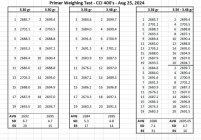
I did shoot 40 rounds, comparing 20 of those that weighed the least to 20 that weighed the most and there was notable difference in velocities. (see pic). There's been several other reloaders that have run the same kind of test and got the same kind of results. It's a test that easily done to verify how those primers on the ends of the bell curve can affect SD's and ES's. And such ES's are kind of important when shooting at extreme distances. ;)

Primer Weighing Test - 2024-8-25.jpg
 
Last edited:
Actually, someone has weighed cup and anvil to see how much variation there is. It's not me. It's been some time ago since I read his report and I don't recall who it was or where I read it. But I do remember he found very little variation in the cups and anvils. He didn't weigh the priming compound, since it was just an impossible task to get it out to measure.


I think this guy figured that since the deviation was so little in both these components (the cups and anvils) that the deviation found in the whole primers petty much spelled out that it was the priming compound where there was a significant difference.


I did shoot 40 rounds, comparing 20 of those that weighed the least to 20 that weighed the most and there was notable difference in velocities. (see pic). There's been several other reloaders that have run the same kind of test and got the same kind of results. It's a test that easily done to verify how those primers on the ends of the bell curve can affect SD's and ES's. And such ES's are kind of important when shooting at extreme distances. ;)

View attachment 1714685

Has anyone taken the unfired primers apart and measured a significant number for cup height and depth?
Then the next would be for anvil height...

Are they different, or exactly the same from cup to cup and anvil to anvil?

If, in fact they are the same, then for seating, primer cup depth would mean more than the amount of crush.
If they vary, then what is the correct way to measure their weight, and how do you decide on seating depth from primer to primer?


Since winter is near, this is just some more food for thought to throw into the weighing and testing side of things.
 
Has anyone taken the unfired primers apart and measured a significant number for cup height and depth?
Then the next would be for anvil height...

Are they different, or exactly the same from cup to cup and anvil to anvil?
Being very curious person, yes. . . I've taken some unfired primers apart to weigh and measure; mainly to see how the height measurements compared to a chart that's floated around with measurement info for various primers (see pic below). I looked at some CCI 400's and some Federal 210's. The cups and anvils I had did not vary at all in cup height, though the overall heights did vary due to how the anvil is seated in the cups. Note too that there's 4 components to a primer, the foil being one that tend to be overlooked.

That foil tends to attribute some variance in over all primer height. For example, when I looked at the CCI 400's, the over all height being at .122". The cup height was .110 (instead of the chart's .109"). When I pulled the anvils, the foil was stuck to them along with a very thin layer of primer compound, which resulted in a heights of .910". After removing the foil from the anvils, the anvils measured consistently at .900". With primer height at .122" and the cup at .110", the anvil was above the cup by .012" and .078" into the cup. That foil being ~.008" thick (being felt with some expansion, having absorbed some of the moist primer compound when installed) probably isn't normally that thick.

Sample size was only a few primers and I know using my caliper for these measurements is not, what I'd call, very accurate, but it's good enough for me. :)

CCI 400 disassembly.jpg

If, in fact they are the same, then for seating, primer cup depth would mean more than the amount of crush.
If they vary, then what is the correct way to measure their weight, and how do you decide on seating depth from primer to primer?
In the example above, the overall height and that anvil at .012" above the cup is what tells me how deep I want to seat my primers when I know how deep the primer pockets are to get ~.004 "crush" that I'm after.

I do measure a good sample size from a brick of primers to find the variance, which can be ~.003". I'll use the shortest measurement to determine my seating depth, as measured below the case base. That means when I seat to the same distance below flush, I'm getting a little more crush on the thicker primers, which is ok since, like on the example above with .012" of anvil above the cup) there's plenty of room and that difference in crush has no measurable affect.

Since winter is near, this is just some more food for thought to throw into the weighing and testing side of things.
And being retired with plenty of time on hand helps too. ;)

Primer cup heights.jpg
 
Last edited:
Awesome info.
I was having this discussion on Friday with a buddy of mine.
My observations mirror yours with regards to depth and crush.
This really goes back to consistent primer pocket depth + seating to the bottom of the pocket and having a consistent seat amount below the base of the brass. This gives consistent anvil position, consistent cup depth and consistent gap from cup to anvil.

The only thing left is primer compound weight and possibly the foil.
And bullets, and brass, and powder charge, and humidity, and temperature, and, and, and...
 
If you want to see the impact that 26fps has on a projectile, run a ballistic calculator with any cartridge and data set of your choice. Make note of bullet drop at various distances out to 1000 yds. Then run the exact same calculation again with the only change being an increase or decrease in velocity of 26fps and make note of bullet drop at the same distances out to 1000 yds. When comparing your notes, the impact of 26fps becomes very obvious at distance. Go ahead, don't sort primers, I'm always happy to compete with shooters who leave this element of consistency on the table :)

There's why different disciplines call for different tactics.
 
012" above the cup is what tells me how deep I want to seat my primers when I know how deep the primer pockets are to get ~.004 "crush" that I'm after.
Have you performed a crush test on paper with sorted primers to determine the ideal crush for your receiver ?
Just curious as to your findings.
Thx
 
Have you performed a crush test on paper with sorted primers to determine the ideal crush for your receiver ?
Just curious as to your findings.
Thx
No, I haven't performed any controlled/formal like testing to see just what works best. I felt the amount of testing need to be done to see what variations produce was just too much for seeing very small effects. So, I've just pretty much gone by what manufacturers recommend in terms of crush. Though I have inadvertently overly crushed a few primers and gone ahead and fired them to see the results look like on paper and the velocity (not good!). With all my reloading, I try to get everything as consistent as possible since consistency is what's really important. Though there's apparently plenty of room for variations in crush that all work just fine (e.g. those who seat by feel and get good results).

I like the approaches Keith does in his testing and I found this one interesting:

 
For those who sort primers. It seems even BR2 match primers need sorting. So if you sort regular CCI 200 primers they'd be more consistent than unsorted BR2 primers?
 

Upgrades & Donations

This Forum's expenses are primarily paid by member contributions. You can upgrade your Forum membership in seconds. Gold and Silver members get unlimited FREE classifieds for one year. Gold members can upload custom avatars.


Click Upgrade Membership Button ABOVE to get Gold or Silver Status.

You can also donate any amount, large or small, with the button below. Include your Forum Name in the PayPal Notes field.


To DONATE by CHECK, or make a recurring donation, CLICK HERE to learn how.

Forum statistics

Threads
167,905
Messages
2,242,900
Members
80,861
Latest member
ronaldrgrant
Back
Top