Yes. Clean brass is happy brass!Recently I have read some people saying they don’t clean brass every time they reload. Is this common? How often do you clean brass?
Thanks.

Yes. Clean brass is happy brass!Recently I have read some people saying they don’t clean brass every time they reload. Is this common? How often do you clean brass?
Thanks.
Anyone remember "never dull"? I use it on the case necks on BR guns to clean the residue off, brush the necks and load. If the reload count is high (# of pieces of brass) I may tumble in media to get the resize lube off.
Every single piece of brass is hand cleaned before every putting in one of the custom dies! Good advise.Answers to this will vary and be Discipline specific , so there will be a very wide spectrum of information on this . As a F class competitor ; I fully clean my brass after every firing . Primer pockets , too . And anneal after every firing . The cost of custom dies , bushings , and even the brass itself warrant such labor , in my mind . And my bank account . Why would I want to spend nearly $200.00 for a custom F/L Bushing Die ; to jam a filthy case into it , coated with carbon , destroying the chance to have concentric , L/R Brass come out ? Damaging the ground and polished surfaces of the die and Bushings . When you consider the average F shooter fires around 2,500 to 3,000 rounds , or more a year , you'd have to have several custom dies sitting on the shelf , to facilitate such absurd waste of precision equipment . That's a lot of unnecessary abuse . Not to mention the amount of brass you would have to have on hand , at nearly a $1.00 per case . And how many rounds jammed into your $450 - $500 receiver and barrel sliding in and out , dragging that carbon across the surfaces , before you're complaining about not knowing if your chamber is going bad , or bolt lift issues , or you don't even know the cause of a myriad of problems . Just the tool & Diemaker in me , talkin here . Yep ! I'm severe OCD , but I got 5,600 rounds out of my last TR barrel . Go figger .![]()
Step number one is to brush the inside of the neck. Wipe the necks off with a small rag with a bit of the same stuff with which I clean the bore. My reasoning for that step is that I don’t care to stick a cruddy neck into an expensive die. Then I lube the outside of the neck with Carmex Lip Balm and size the case and decap it. Then clean out the primer pocket and wipe the neck again.
I shoot bench rest only and we bench resters are an odd bunch.
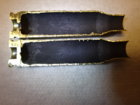
I’ve looked at the soot on the necks both before and after wiping it off with a paper towel with both a 10x loupe and pocket microscope. It looks more like ash or powder residue to me. It looks like a stain when you wipe it with a paper towel. Even if I don’t wipe the black stuff away and size it, it’s really smooth where the TiN bushing sizes. I don’t see any scratches anywhere below the point the bushing sizes or down to the body/shoulder junction. That’s why I stated I don’t believe it’s carbon.eric n ; Carbon is highly abrasive . If it will scratch brass , it will also scratch hardened Die steel . I made cold header dies for about five years , and they work by pushing a piece of clean , lubed brass wire cut-off into the die to form a small bolt or screw blank . Most dies had to be re-made after 10-15,000 blank runs . And they were carbide dies . Diamonds come from carbon under pressure , and carbide is formed from carbon with alloys and other things added .