• This Forum is for adults 18 years of age or over. By continuing to use this Forum you are confirming that you are 18 or older. No content shall be viewed by any person under 18 in California.

NAS3 cases

kelbro

Silver $$ Contributor
I love it when I learn something new before noon on a Monday!

I just read a post where a shooter is using NAS3 stainless cases in 308 and is able to reach much higher velocities (and of course pressure) without traditional pressure signs.

I'm not sure how the stainless cases would work where the pressure traces are installed on rifle chambers to determine max psi/cup for safety. Seems like the stainless cases create a new vessel that would alter the standard pressure readings.


Sounds like new ground being charted but I'm not an internal ballistics expert and I'm wondering where the failure point would manifest since the vessel is being 'enhanced'.

Do they install pressure traces ahead of the chamber on proof barrels or just at the chamber?
 
The military is playing with 5.56 ammo loaded +90k psi. There is one major lesson that the bill come due… the price for 30%-50% increase in performance is significant reduction in barrel life (conventional barrels) as well as additional wear/strain on receivers.

Higher operating pressures appear to be the next evolution of cartridges. This is recent video with Seekins Precision’s new barrel technology. Enjoy

 
Are the new 308 cases reloadable?

The 300 Blackout and 5.56 were not. Only the pistol case were and required special dies.

  • Shell Shock Technologies NAS³ Stainless steel casing provides strength, power, alignment, and less weight.
  • Flies fast, flat, accurate, and with less recoil for smoother target re-acquisition.
  • Increased efficiency and cycle rate.
  • Reduced bore fouling and corrosion.
  • Lead-free for compliance at ranges.
  • Magnetically retrievable case.
Made In United States of America

Ultra Precision Cases and Non-Reloadabl

Can I reload NAS³ rifle cases?

No, Shell Tech’s rifle cases are precision-engineered, military-grade ammunition cases and are not designed to be reloaded. Reloading these cases can compromise their performance and safety, so we do not recommend or support reloading them.
 
This was a concern as I started contemplating the cases for a project. There is conflicting information as to whether they are reloadable. Not trying to be contrarian...
Shell Shock’s Website states:
  • Reloadable for Versatility: Designed for repeated use without compromising integrity.
Shell Shock Tecnology - Product Description


Even if reloadable it’s a steel case so there are some questions…
How will conventional dies hold up?
How easy will case size and reset “neck tension”?
Does the case require annealing? If so the is an induction annealer the only annealer that is effective?

I decided not to go down this rabbit hole. I’ll let it percolate in the shooting community and see how it shakes out amongst other users and reloaders before I start daydreaming about a new project.

Edit: I accidentally bump post before I finished typing my thoughts :)
 
Last edited:
Their own information is confusing at best, misleading at worse. Most of the time they are careful to say reloadable only applies to pistol cases an here is why, special dies. Maybe it’s because they have not developed rifle dies.


Why do I need a set of special reloading dies for NAS³ pistol cases?

S3 Reload dies are required for reloading the Shell Tech’s pistol cases.

Shell Tech’s NAS³ pistol cases are made in 2 pieces; a nickel-alloy cylinder and an aluminum base. In addition to being manufactured from different materials than brass cases, the NAS³ cases also perform differently once fired. For example, the NAS³ cylinder has a much higher tensile strength than brass, meaning that it returns to virtually its original size when fired.

As the NAS³ cases return to virtually their original size when fired and require no trimming, the S3 Reload dies (combined with the use of lubricant) are designed to prolong the case life and maximize the number of reloads. Part of how this is achieved is by having a spring inside the die that pushes the case out of the die, instead of pulling from the base rim (as with conventional brass cases). This spring-assisted mechanism avoids placing unnecessary stress on the joint between the two pieces and reduces damage to the base rim. The S3 Reload dies are threaded to fit all popular bench-top reloading equipment. More details on the S3 Reload dies can be found here along with instructions and instructional videos.

This is their press release from ‘26 shot show.

IMG_0132.jpeg

I would certainly want clarification before buying. I will note the the declaration of non reloadable is missing from the 308 ammo description I posted earlier. But the description of how the pistol die works clearly indicates the design does not tolerate a pull from the rim.
 
Totally Agree - I was confused enough that I put a call into Shell Shock to get some clarification a few months ago. They called back a few days later, but I missed their call. By that point I had decided to put this on a back burner and didn’t return the call….

What impressed me was the consistency of their 300BO subsonic ammo. As I recall from videos their ammo was achieving single digit SD and ES. This is all about the precision/uniformity of their cases. The price for new high pressure cases was surprisingly reasonable (300BO - 250 cases for $110).

There are a number of cartridges that could benefit by increasing pressure… Vortex Nation Podcadt did an interesting episode on this topic.

 
What impressed me was the consistency of their 300BO subsonic ammo. As I recall from videos their ammo was achieving single digit SD and ES. This is all about the precision/uniformity of their cases.

Low SDs and ESs are great in long range ammo, but 300 BO, especially in sub sonic doesn't seem like it would be as important as it is in conventional rifle rounds.

Don't get me wrong, I like it when my pistol practica ammo loads have good SDs, but it doesn't really make a practical difference over a load with a 20 fps SD.
 
Low SDs and ESs are great in long range ammo, but 300 BO, especially in sub sonic doesn't seem like it would be as important as it is in conventional rifle rounds.

Don't get me wrong, I like it when my pistol practica ammo loads have good SDs, but it doesn't really make a practical difference over a load with a 20 fps SD.
You’re right at close range. However, at longer distances (100-300 yards) it will make a difference. The idea of watching a slow moving 175gr-240gr projectile arc in like a golden bumble bee at 300 yards makes me smile. Lazy day shooting!
 
The problem 300 Blackout isn’t he cartridge, it’s the shooters. If they shoot subsonic, they are even more of a problem. It’s really simple. If you want match quality results, use match quality components, and load to match quality tolerances. Apparently the people at NAS3 figured out how to produce an off shelf case that needs little or no prep. At least for one shot. I’m also not sure the internet is capable of handling the arguments over the best way to anneal a stainless steel neck.

What subsonic shooting provides is a way to have all the headaches of 1000 yard shooting in your own back yard. One difference that actually makes sub sonic interesting is that many of the bullets designed for 1000 yards, don’t work. The bullet needs to be stable through the trans-sonic range. Not all, maybe not most, are.

If they can eliminate case prep, probably a whole lot of people will improve their scores at the range. It does seem to come at a price tho.
 
  • Like
Reactions: Oso
You’re right at close range. However, at longer distances (100-300 yards) it will make a difference. The idea of watching a slow moving 175gr-240gr projectile arc in like a golden bumble bee at 300 yards makes me smile. Lazy day shooting!
I get it. I like the occasional 308 175gr subsonic lobs to 200-300 yards.
 
I have some of their 223. Currently have 25 that are loaded for their 3rd firing. In my experience so far, they reload fine with a good lube. Your experience may vary, their recommdation to not reload them is their lawyers speaking IMO.
 
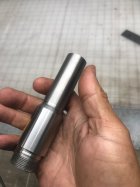
Received my order of Shell Shock .308 cases a week ago. They're a two piece case with both the base and the body being stainless steel. When measuring the case volumes, it was very consistent at 57.6 grs H2O. Cases are very light weight and very consistent at 115.0 grs (compare that to Lapua at 177 grs and Alpha at 180 grs. I really noticed that the flash holes are substantially larger the what you typically get with LRP cases. Apparently they say the larger flash hole produces more consistent ignition, according to them. Primer pocket depths measure .122 to .124" Base to shoulder datum measured 1.593 - 1.5975" (yeah, pretty short :eek:). In measuring the neck wall thickness, I got a range from .013" to .015" on a single case and that held true when measuring several cases. I don't understand that neck thickness variation given how these are manufactured from sheets of sheet metal and that thickness is uniform down the case as opposed regular brass that has a taper. Can't compare the web thickness due to the design having the "shock wave" on top of the base.

Shell Shock case iagram.jpg

Loaded 10 cases up with 43.5 grs H4895 pushing 190 SMK's. The load is, what I'd characterize as, just a random educated guess just to get a feel for them, with a little help from QuickLoad, and got an average velocity of 2,637 fps, an SD of 5.9 and ES of 17 fps. As far as the target goes, it was just ok (pretty winding rom 10 o'clock) as I wasn't really expecting anything great for this first load and firing.

Shell Shock target - 43.5 grs H4895 190 SMKs.jpg

After this, I went home and started measuring the cases again. . . like the case volume of the fired cases were still very consistent measuring 60.0 - 60.1 grs H2O. At the 200 mark, the area above the web after firing went from .4670" to .4725". At the body-shoulder junction it went from .4490 to .4550". And that shoulder datum measurement went from the 1.593 - 1.5975" to 1.603"

Shell Shock says "No" to resizing the rifle cases, though I've read some things contrary to this. So, just to see what I might be able do to get these sized after firing, it's been an interesting endeavor. I tried FL sizing just as I would with my regular brass, where I just use a Forster die with not expander button. There was no issue at all in difficulty in the press's cycle, easily removing the case from the die (I made sure to lube well with Imperial Sizing Die Wax). While the case extracted just fine from the die, the case's two parts pulled apart a little and the base could be rotated. Given the design as I see it in the picture I've shown above, that really didn't surprise me much. But, it's not acceptable since that changes the length dimension accordingly. Hmmm??? I had to figure something other way to keep that from happening. I tried just using my Forster Bushing Neck Sizing Die and that did fine, except the body needed sizing. I took the bushing out of that die and just used the die to bump the shoulder on the case that I had FL sized. BINGO. That not only got me the neck bump I was after, it also pressed the body and base back tight where it would turn. Then, as I do with my normal brass, I ran my expander mandrel through it. Inserting the case into the rifle chamber and fit nicely and extracted nicely. Now I'll have to test fire one to see how it works.

The three cases below is a comparison as the one on the right is one that has been run through my FL sizing die and you can easily see that little separation. The one in the middle looked just like the one on the right, only it was necked bumped as I described above and you can compare it to the one of the left, which is a virgin case. BTW: the FL sized one's primer pocket got deeper from .124" to .126" from the sizing as did the center one and the bumping returned the primer pocket of the center case back to .124"

Shel Shock sizing comparison.jpg

Even for those who will not reload these, one and done with them can be very beneficial to a hunter by getting substantially higher velocity out of a short barrel. In other words, you can have the power of a heavier gun in a light gun. :D
 
I have some of their 223. Currently have 25 that are loaded for their 3rd firing. In my experience so far, they reload fine with a good lube. Your experience may vary, their recommdation to not reload them is their lawyers speaking IMO.
How big are the primer holes. The 308s have a flash hole big enough to toss a small animal through. Visibly bigger that 0.1 inches. No pin gages in that size to check real dimensions.
 
How big are the primer holes. The 308s have a flash hole big enough to toss a small animal through. Visibly bigger that 0.1 inches. No pin gages in that size to check real dimensions.
Yeah, the .308's flash hole is huge where my medium grain rice that I use to dry tumble with easily gets in all the flash holes. :eek: That doesn't happen in normal LRP brass.

So. . . I loaded up another 10 and fired them yesterday with a hotter load: 45.5 grs H4895 pushing 190 SMK's with a COAL of 2.904. Two 5 shot groups just a hair under .5" at 100 . . . with just a random load. Previous load of 10 with only 43.5 grs gave me a good SD and here's yesterday's (amazing good SD;s both times). The ES on this load was 13. Looks like I've got room for more powder:D :

1776712247500.jpeg 1776713989277.png

I feel like I've figured out an acceptable technique for sizing them. After returning home yesterday I took some measurements and used just my Forster's Bushing Bump Neck Sizing Die. I run the cases into the die that has a .335 bushing. The necks come out with a ID of .306 (actually a hair less) and the case lengths get longer to ~2.020 and the head space increased from 2.0025 to 2.006. Also the OD on the body at the base-body junction increased from .472 to 4.73. Then I took the bushing out and just bumped the shoulders again, which resulted in their head space being at 2.002 and the case length reduced to 2.012. No other dimensions changed. I'm pleased with that result as the cases chamber just fine, though a little firm, but eject without any resistance. Case volume till measures at 60.1 grs H2O.

Now I'll have to reload them and see how they do. I did load one of those previously fired cases that I had FL sized, which had a slightly loose base that could turn. It fired and ejected with no issue (the base was till slightly loose . . . no apparent gas leakage anywhere).

I might try to find someone to produce a shoulder bump die that fits snuggly around the base (maybe something like Cortina's expander dies) to prevent that additional .001 expansion I'm getting. That should make the cases chamber without that little firmness.
 
Last edited:
You've got more guts than I do with that loose base case.
I wouldn't have done it if I hadn't seen how the base and body were put together.
1776719338632.png

I surmised the pressure actually adds to the holding power of the "nipple" (as they describe it). . .the way the base is held by that flange of the body similar to a rivet. And I only tested one selected case that the base turned in but hadn't pulled out like the example in the picture I posted. I guess you could say it was a "measured" risk that appeared minimal in its design. :rolleyes:
 
Last edited:
  • Like
Reactions: CJ6

Upgrades & Donations

This Forum's expenses are primarily paid by member contributions. You can upgrade your Forum membership in seconds. Gold and Silver members get unlimited FREE classifieds for one year. Gold members can upload custom avatars.


Click Upgrade Membership Button ABOVE to get Gold or Silver Status.

You can also donate any amount, large or small, with the button below. Include your Forum Name in the PayPal Notes field.


To DONATE by CHECK, or make a recurring donation, CLICK HERE to learn how.

Forum statistics

Threads
170,238
Messages
2,291,372
Members
82,728
Latest member
OutriderOne
Back
Top