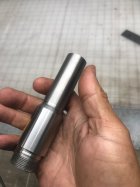
Received my order of Shell Shock .308 cases a week ago. They're a two piece case with both the base and the body being stainless steel. When measuring the case volumes, it was very consistent at 57.6 grs H2O. Cases are very light weight and very consistent at 115.0 grs (compare that to Lapua at 177 grs and Alpha at 180 grs. I really noticed that the flash holes are substantially larger the what you typically get with LRP cases. Apparently they say the larger flash hole produces more consistent ignition, according to them. Primer pocket depths measure .122 to .124" Base to shoulder datum measured 1.593 - 1.5975" (yeah, pretty short

). In measuring the neck wall thickness, I got a range from .013" to .015" on a single case and that held true when measuring several cases. I don't understand that neck thickness variation given how these are manufactured from sheets of sheet metal and that thickness is uniform down the case as opposed regular brass that has a taper. Can't compare the web thickness due to the design having the "shock wave" on top of the base.

Loaded 10 cases up with 43.5 grs H4895 pushing 190 SMK's. The load is, what I'd characterize as, just a random educated guess just to get a feel for them, with a little help from QuickLoad, and got an average velocity of 2,637 fps, an SD of 5.9 and ES of 17 fps. As far as the target goes, it was just ok (pretty winding rom 10 o'clock) as I wasn't really expecting anything great for this first load and firing.

After this, I went home and started measuring the cases again. . . like the case volume of the fired cases were still very consistent measuring 60.0 - 60.1 grs H2O. At the 200 mark, the area above the web after firing went from .4670" to .4725". At the body-shoulder junction it went from .4490 to .4550". And that shoulder datum measurement went from the 1.593 - 1.5975" to 1.603"
Shell Shock says "No" to resizing the rifle cases, though I've read some things contrary to this. So, just to see what I might be able do to get these sized after firing, it's been an interesting endeavor. I tried FL sizing just as I would with my regular brass, where I just use a Forster die with not expander button. There was no issue at all in difficulty in the press's cycle, easily removing the case from the die (I made sure to lube well with Imperial Sizing Die Wax). While the case extracted just fine from the die, the case's two parts pulled apart a little and the base could be rotated. Given the design as I see it in the picture I've shown above, that really didn't surprise me much. But, it's not acceptable since that changes the length dimension accordingly. Hmmm??? I had to figure something other way to keep that from happening. I tried just using my Forster Bushing Neck Sizing Die and that did fine, except the body needed sizing. I took the bushing out of that die and just used the die to bump the shoulder on the case that I had FL sized. BINGO. That not only got me the neck bump I was after, it also pressed the body and base back tight where it would turn. Then, as I do with my normal brass, I ran my expander mandrel through it. Inserting the case into the rifle chamber and fit nicely and extracted nicely. Now I'll have to test fire one to see how it works.
The three cases below is a comparison as the one on the right is one that has been run through my FL sizing die and you can easily see that little separation. The one in the middle looked just like the one on the right, only it was necked bumped as I described above and you can compare it to the one of the left, which is a virgin case. BTW: the FL sized one's primer pocket got deeper from .124" to .126" from the sizing as did the center one and the bumping returned the primer pocket of the center case back to .124"

Even for those who will not reload these, one and done with them can be very beneficial to a hunter by getting substantially higher velocity out of a short barrel. In other words, you can have the power of a heavier gun in a light gun.