
You are using an out of date browser. It may not display this or other websites correctly.
You should upgrade or use an alternative browser.
You should upgrade or use an alternative browser.
March vs NF
- Thread starter Texas Solo
- Start date


rwj
Gold $$ Contributor
At what price point?You would think that it would not be that hard for a scope company to build a scope that holds zero, dials correctly, doesn't have poi shifts and has good glass.

I really thought that everyone knew that SFP zoom riflescopes are subject to line-of-sight shift. That is why March has the 48X52 and the 40-60X52 EPZoom for the benchresters. All SFP zoom riflescopes have that issue, and also, test results for one sample of a riflescope is meaningless.
I reached out to DEON to get their take on this issue because March is the brand that is being mentioned here. I was asked to paste their answer here. I think it's very bold of them to do that and it demonstrates extreme confidence in their products, and it's something you would never see from others.
This is from the chief optical designer at DEON:
"In an SFP scope, the erector lens moves inside the erector tube when changing magnification. In order for this movement to occur, there must be a slight clearance between the lens cell and the inner diameter of the erector tube. This minute clearance inevitably allows some lens displacement, which results in a point-of-aim shift. Achieving absolutely zero displacement is extremely difficult — realistically, it is impossible to make it perfectly zero.
However, at DEON we minimize this shift by preparing multiple erector lens carriers with micron-level dimensional variations that are precisely matched to the inner diameter of each erector tube. We incorporate the most suitable carrier into each individual scope, and then hand-lap the sliding surfaces to ensure smooth movement with no play. The completed scopes are then inspected using a collimator, and only units with less than 0.25 MOA of point-of-aim shift throughout the zoom range pass our quality criteria.
Therefore, if your scope is found to be outside of our specification, please return it and DEON will repair it free of charge."
I reached out to DEON to get their take on this issue because March is the brand that is being mentioned here. I was asked to paste their answer here. I think it's very bold of them to do that and it demonstrates extreme confidence in their products, and it's something you would never see from others.
This is from the chief optical designer at DEON:
"In an SFP scope, the erector lens moves inside the erector tube when changing magnification. In order for this movement to occur, there must be a slight clearance between the lens cell and the inner diameter of the erector tube. This minute clearance inevitably allows some lens displacement, which results in a point-of-aim shift. Achieving absolutely zero displacement is extremely difficult — realistically, it is impossible to make it perfectly zero.
However, at DEON we minimize this shift by preparing multiple erector lens carriers with micron-level dimensional variations that are precisely matched to the inner diameter of each erector tube. We incorporate the most suitable carrier into each individual scope, and then hand-lap the sliding surfaces to ensure smooth movement with no play. The completed scopes are then inspected using a collimator, and only units with less than 0.25 MOA of point-of-aim shift throughout the zoom range pass our quality criteria.
Therefore, if your scope is found to be outside of our specification, please return it and DEON will repair it free of charge."

Ranger188
Silver $$ Contributor
10% price increase. If you want a March, better do it soon.

 marchscopes.com
Announcement of Price Revision from 2026 | Others | MARCH Scopes | DEON Optical Design CorporationMARCH Scopes | DEON Optical Design Corporation
MARCH Scopes Official Site
marchscopes.com

X-Caveman
Gold $$ Contributor
Interesting. Thanks for the response. Can the same thing happen when adjusting the diopter? Sometimes I sober up after the first relay and adjust it before the second because my vision changes. Then, I miss every clay...I really thought that everyone knew that SFP zoom riflescopes are subject to line-of-sight shift. That is why March has the 48X52 and the 40-60X52 EPZoom for the benchresters. All SFP zoom riflescopes have that issue, and also, test results for one sample of a riflescope is meaningless.
I reached out to DEON to get their take on this issue because March is the brand that is being mentioned here. I was asked to paste their answer here. I think it's very bold of them to do that and it demonstrates extreme confidence in their products, and it's something you would never see from others.
This is from the chief optical designer at DEON:
"In an SFP scope, the erector lens moves inside the erector tube when changing magnification. In order for this movement to occur, there must be a slight clearance between the lens cell and the inner diameter of the erector tube. This minute clearance inevitably allows some lens displacement, which results in a point-of-aim shift. Achieving absolutely zero displacement is extremely difficult — realistically, it is impossible to make it perfectly zero.
However, at DEON we minimize this shift by preparing multiple erector lens carriers with micron-level dimensional variations that are precisely matched to the inner diameter of each erector tube. We incorporate the most suitable carrier into each individual scope, and then hand-lap the sliding surfaces to ensure smooth movement with no play. The completed scopes are then inspected using a collimator, and only units with less than 0.25 MOA of point-of-aim shift throughout the zoom range pass our quality criteria.
Therefore, if your scope is found to be outside of our specification, please return it and DEON will repair it free of charge."
Well, I am agog.Interesting. Thanks for the response. Can the same thing happen when adjusting the diopter? Sometimes I sober up after the first relay and adjust it before the second because my vision changes. Then, I miss every clay...
Your vision changes on the fly like that between relay and relay two? How many pairs of prescription glasses or contact lenses do you own? How do you keep track of them since you change them all the time?
I have never, ever, heard of this. Granted, I'm only 71 and I have not seen everything, but this is extraordinary.
The "diopter" setting in the eyepiece is just a small adjustment that is available to refine the view of the reticle in the riflescope. You do realize that you are using your far vision to look through the riflescope, which is why people who wear bifocals and progressives, can use a riflescope simply looking through the top half of their glasses. You might want to look at the thread I started on wearing glasses and riflescopes. It covers all this stuff, EVEN if you don't wear glasses.
Adjusting the "diopter" on the eyepiece should not cause line-of-sight shift because you are looking at the merged image, after the second focal plane.
X-Caveman
Gold $$ Contributor
What can I say, I'm a special guy, even "extraordinary", as you say. All kidding aside, yes. I monkey with the diopter (or, whatever the correct term is) just about every range trip & occasionally throughout the day. This is true on every optic I own (thermals, riflescopes, rangefinders from NF, Tract, Maven, Sightron, Leupold, Vortex, Steiner, IOR, Bering Optics, even March), some with locking oculars, some with fast focus style. If I don't, the reticles/ displays aren't as clear/ sharp as they can be. That set it once and forget thing doesn't work for me. Surely, I'm not alone.
I'm 51 and vision started going to hell in my late 30s. I wear a +1.75 contact lens on my dominant/ shooting eye (right) to correct my far vision. Have to throw readers over the contacts to see anything up close. I don't shoot in the readers, obviously.
I certainly believe your last statement, but I'll test it next time out. It's too easy not to. FWIW, the shift I was suspicious of was on a FFP scope. Again, probably didn't happen.
My apologies to the OP for contributing to the thread derailment.
I'm 51 and vision started going to hell in my late 30s. I wear a +1.75 contact lens on my dominant/ shooting eye (right) to correct my far vision. Have to throw readers over the contacts to see anything up close. I don't shoot in the readers, obviously.
I certainly believe your last statement, but I'll test it next time out. It's too easy not to. FWIW, the shift I was suspicious of was on a FFP scope. Again, probably didn't happen.
My apologies to the OP for contributing to the thread derailment.
I'm not going to presume to tell you how to address your vision correction. At your age, my far vision in my dominant eye was -1.75, completely the reverse from you. If you shoot with your prescription glasses on, you should have the "diopter" set to about -0.5 or 0.0 and go from there. It really should be neutral to your corrected eyesight. But again, whatever works for you. I refined my "diopter" setting after initial setting when I was on the range viewing the target at 1000 yards. I haven't touched it since, and it works for me with or without glasses. My current far vision prescription is -0.25, which is essentially nothing. Now with my Trivex prescription glasses, the IQ is phenomenal.What can I say, I'm a special guy, even "extraordinary", as you say. All kidding aside, yes. I monkey with the diopter (or, whatever the correct term is) just about every range trip & occasionally throughout the day. This is true on every optic I own (thermals, riflescopes, rangefinders from NF, Tract, Maven, Sightron, Leupold, Vortex, Steiner, IOR, Bering Optics, even March), some with locking oculars, some with fast focus style. If I don't, the reticles/ displays aren't as clear/ sharp as they can be. That set it once and forget thing doesn't work for me. Surely, I'm not alone.
I'm 51 and vision started going to hell in my late 30s. I wear a +1.75 contact lens on my dominant/ shooting eye (right) to correct my far vision. Have to throw readers over the contacts to see anything up close. I don't shoot in the readers, obviously.
I certainly believe your last statement, but I'll test it next time out. It's too easy not to. FWIW, the shift I was suspicious of was on a FFP scope. Again, probably didn't happen.
My apologies to the OP for contributing to the thread derailment.
Last edited:

tom
Gold $$ Contributor
I kind of did too, and is why I included that portion in very few scopes tested. It really only matters to me in hunting rifle scopes, and is one of the reasons I do prefer FFP for those. March has very good reticle designs for those as well, as they still make a "duplex" when zoomed out. I don't mind the Kahles zoomed out either, for the same reasons. I do find it neat that the optical engineer stated almost to a tee what my limited data showed, so that's cool i guess.I really thought that everyone knew that SFP zoom riflescopes are subject to line-of-sight shift
Guys, we are talking 1/4 moa on the worst offender I have ever tested, and sounds like that's kind of the "spec"....certainly not a deal breaker since we DON'T switch power within a group.
Tom
Well, I just ordered the March X 10-60x56HM from Lou. $3400 + shipping. 3 - 4 months.
Super ED lenses, temp stable & zero stop. Hope to have it before next season.
Super ED lenses, temp stable & zero stop. Hope to have it before next season.
@tom , I appreciate your reply, and I thought I would add a few comments.I kind of did too, and is why I included that portion in very few scopes tested. It really only matters to me in hunting rifle scopes, and is one of the reasons I do prefer FFP for those. March has very good reticle designs for those as well, as they still make a "duplex" when zoomed out. I don't mind the Kahles zoomed out either, for the same reasons. I do find it neat that the optical engineer stated almost to a tee what my limited data showed, so that's cool i guess.
Guys, we are talking 1/4 moa on the worst offender I have ever tested, and sounds like that's kind of the "spec"....certainly not a deal breaker since we DON'T switch power within a group.
Tom
Please NOTE, the following are my own thoughts and results of my own research. They do not come from DEON and are NOT to be construed as such.
With that gentle reminder stated, let's get to it.
I'm an IT guy. I spent my entire career in IT from writing my first Fortran program on punch cards in 1973 and I'm still writing code for database migrations SQL-databases to writing apps for smartphones and tablets. One thing that I have always relied on throughout my career is something called Standards. We have joked a lot over the decades about "the good thing about standards is that there are so many." So, I went looking with AI. I use Perplexity because I have a free Pro subscription with my Samsung smartphone, and Grok when things get really weird.
I asked PPX (Perplexity,) if there are any ISO standards dealing with line-of-sight shifts in zoom riflescopes. PPX came back with 2 of them. One deals with HOW to measure the deviation of line-of-sight in a variable riflescope. It's called: ISO 14490-3:202 Optics and Photonics – Test methods for telescopic system – Part 3: Test methods for telescopic sights. This standard talks about axial parallax, parallax, reticle tracking and line-of-sight shift due to zooming and line-of-sight shift due to focusing.
There is also ISO 14132-3:2021 Optics and photonics- Vocabulary for telescopic systems – Part 3: Terms for telescopic sights.
It seems that while these standards do not publish a standard recognized variation, they define how to measure point-of-aim shift with zoom. The following is verbatim from PPX:
"In practice, common “good” expectations for quality riflescopes are roughly:
- Premium tactical/precision scopes: aim for no perceptible shift, typically ≤ 0.1–0.2 mrad (≈ 0.3–0.7 MOA) over the full zoom range.
- Mid‑grade hunting/“good” scopes: often considered acceptable if total shift over the zoom range is ≤ 0.5–1.0 MOA.
- Cheap scopes: can show several MOA of shift with magnification changes, which most serious shooters consider unacceptable, even if it technically passes an internal factory spec.
Now, I then asked about the difference between SFP and FFP and here is the answer from PPX:
"Perfection (literally zero shift) is effectively impossible in any practical variable‑power scope, and that’s especially true for second focal plane (SFP) designs.
Why some shift is inevitable
- In an SFP scope, the reticle sits behind the zoom/erector group, so any tiny mechanical or optical misalignment as elements move with magnification changes shows up as a small shift between the reticle and the image. Even very high‑end mechanics and tight tolerances can’t make that shift mathematically zero over the entire zoom travel.
- Premium scopes are engineered so the total shift over the full zoom range stays very small—on the order of 0.1–0.2 mrad (≈0.3–0.7 MOA) or less, which is essentially invisible in normal field use, but it’s still not literally zero.
SFP vs FFP in this context
- In FFP scopes, the reticle is in the same focal plane as the image that’s being magnified, so some sources of shift are naturally reduced, but any misalignment in the zoom group or turrets can still cause residual movement.
- In SFP scopes, the reticle is fixed at the rear focal plane, so zoom‑induced image motion in the erector group appears directly as a change in apparent point of aim. That makes ultra‑low shift more challenging, though well‑designed SFP scopes can still stay under that ~0.3–0.7 MOA band across the zoom range.
Back to me:
The standards to which DEON adheres (less than 0.25MOA over the entire range for SFP) is higher than the accepted industry "standard" for premium riflescopes.
This has been a fun thread and great discussion. I am not going to be drawn into a sterile argument about what my AI says versus your AI. I did the digging, I showed my work, it matches empirical observations and statements from the manufacturer.
I learned a lot; I love digging into stuff and expanding my ignorance.
I also have a far greater appreciation the accomplishments of DEON with their DUAL RETICLE riflescopes in a 1-20X24 and a 1.5-15X42, I love looking through these scopes and see the two reticles stay in harmony throughout the 10X zoom range.
Last edited:
And you would be wrong.You would think that it would not be that hard for a scope company to build a scope that holds zero, dials correctly, doesn't have poi shifts and has good glass.


I ordered one as well today. Ordered from Europtics and paid slightly less than you did. The model I ordered is back ordered but they indicated it should be 30-60 days.Well, I just ordered the March X 10-60x56HM from Lou. $3400 + shipping. 3 - 4 months.
Super ED lenses, temp stable & zero stop. Hope to have it before next season.
ELR LVR
Silver $$ Contributor
Nice info,I really thought that everyone knew that SFP zoom riflescopes are subject to line-of-sight shift. That is why March has the 48X52 and the 40-60X52 EPZoom for the benchresters. All SFP zoom riflescopes have that issue, and also, test results for one sample of a riflescope is meaningless.
I reached out to DEON to get their take on this issue because March is the brand that is being mentioned here. I was asked to paste their answer here. I think it's very bold of them to do that and it demonstrates extreme confidence in their products, and it's something you would never see from others.
This is from the chief optical designer at DEON:
"In an SFP scope, the erector lens moves inside the erector tube when changing magnification. In order for this movement to occur, there must be a slight clearance between the lens cell and the inner diameter of the erector tube. This minute clearance inevitably allows some lens displacement, which results in a point-of-aim shift. Achieving absolutely zero displacement is extremely difficult — realistically, it is impossible to make it perfectly zero.
However, at DEON we minimize this shift by preparing multiple erector lens carriers with micron-level dimensional variations that are precisely matched to the inner diameter of each erector tube. We incorporate the most suitable carrier into each individual scope, and then hand-lap the sliding surfaces to ensure smooth movement with no play. The completed scopes are then inspected using a collimator, and only units with less than 0.25 MOA of point-of-aim shift throughout the zoom range pass our quality criteria.
Therefore, if your scope is found to be outside of our specification, please return it and DEON will repair it free of charge."
As I was reading I was thinking, Why not lap the surfaces to each other like some of us do for perfect threads?
And then I read they do
Awesome! Thats high quality stuff there
as it is time consuming
Many people do not get that simply manufacturing, machining to tight tolerances is not enough
there will ALWAYS be some form of play, even if your Machine or tooling is perfect, temp differences affect the bearing in the machine itself which will then result in differences in tolerances
Some of the parts I use to make, we could only run the machine for about an hour in the morning until the bearings warmed up, then the machine could no longer hold the tight tolerances required
or we might start getting a reject part 1 out of 10 or something.
and had to wait again until next morning
That fine lapping step is where it's at and puts in a lot of extra Mfg time which most people do not get
try to machine 2 perfectly fitting threads without play, AND, without having to lap them to one another
it wont happen
then if they use brass internals, how many peole have had there brass doorknob wear out?
Brass is not a material for the long haul, ball detents wear and can become mushy or less precise
---
People expect quality or perfection, but do not understand the price paid to get there
High priced top teir scopes are a very precision instrument,
and then to expect them to tolerate being thrown around, bumped, tolerate High G's of recoil etc
as opposed to babied like a microscope, adds in some challenges as well.
---
Reading what you just posted was like music to my eyes as a machinist
Last edited:

Alex Wheeler
Site $$ Sponsor
Some food for thought on scope movement. Not that all scopes will have the same problem. On the comp specifically, I drilled and tapped a hole behind the leaf spring of the erector tube and used a nylon thumb screw as a posi lock. All it did was apply pressure to the back of the leaf spring. Essentially just adding more spring force. On the scope checker it tested perfect, loosen the screw and the reticle moved tighten the screw it didnt. So at least in the comp, I think its only a good coil spring assembly away from being a great scope. A one piece tube would be nice too just to eliminate that possible joint movement. I did over a dozen comps that way.
rwj
Gold $$ Contributor
Bingo! Any adjustable scope by definition has multiple degrees of freedom to permit internal movement. Each one being a potential source of POI variation - the “price” one pays for the associated functionality.Some food for thought on scope movement. Not that all scopes will have the same problem.
I tip my hat to @Alex Wheeler for identifying, and most impressively, creating a solution for the NF Comp! Hopefully; such solutions find their way back to the manufacturer and are integrated into the product (like his Bix Comp trigger fix)!
I’ve not heard of any problems with the newer NF Comps and haven’t noticed any shifting on my two scopes but that’s why we test stuff, any scope can have issues even the highest dollar models.
we’re trying to get together for some testing this winter.
It should be very informative to say the least.
we’re trying to get together for some testing this winter.
It should be very informative to say the least.
tom
Gold $$ Contributor
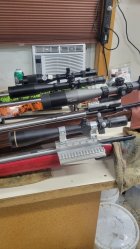
Cleaning up "my AI" now, as I will be needing to make some fresh brass this winter. LolI’ve not heard of any problems with the newer NF Comps and haven’t noticed any shifting on my two scopes but that’s why we test stuff, any scope can have issues even the highest dollar models.
we’re trying to get together for some testing this winter.
It should be very informative to say the least.
rwj
Gold $$ Contributor
I’ve also not noted any POI shift on the NF Comp I bought last year. But I do not have access to a scope checker and hope you’ll post the results of your planned tests.I’ve not heard of any problems with the newer NF Comps and haven’t noticed any shifting on my two scopes but that’s why we test stuff, any scope can have issues even the highest dollar models.
we’re trying to get together for some testing this winter.
It should be very informative to say the least.
We have to wait until the weather gets really shitty before the tests results are meaningful. LolI’ve also not noted any POI shift on the NF Comp I bought last year. But I do not have access to a scope checker and hope you’ll post the results of your planned tests.
Attachments
Similar threads
- Replies
- 3
- Views
- 373

- Replies
- 58
- Views
- 8,260
- Replies
- 19
- Views
- 792

Upgrades & Donations
This Forum's expenses are primarily paid by member contributions. You can upgrade your Forum membership in seconds. Gold and Silver members get unlimited FREE classifieds for one year. Gold members can upload custom avatars.

Click Upgrade Membership Button ABOVE to get Gold or Silver Status.
You can also donate any amount, large or small, with the button below. Include your Forum Name in the PayPal Notes field.
To DONATE by CHECK, or make a recurring donation, CLICK HERE to learn how.
Click Upgrade Membership Button ABOVE to get Gold or Silver Status.
You can also donate any amount, large or small, with the button below. Include your Forum Name in the PayPal Notes field.
To DONATE by CHECK, or make a recurring donation, CLICK HERE to learn how.