• This Forum is for adults 18 years of age or over. By continuing to use this Forum you are confirming that you are 18 or older. No content shall be viewed by any person under 18 in California.

Time to make the donuts....

I cannot resist to reply to this, I probably have 20 different bills signed by Ron, almost all ones but a couple of fives. Some of them I have also have nasty words on them.
George, Ron's dies were likely gone about the time you showed up at our range. There was a 3 way partnership with Rich, Ron and a 3rd person that had bulletmaking knowledge and that is why the partnership was formed. There were some actions by the 3rd person that did not work out with the other two. So the 3rd person sold the dies.
 
George, didn't Rich Griffin make Ron's bullets?
Ron, Rich and Larry Engelbrecht, were co-owners of a set of Rorschach 6mm dies. The dies would be shared between the three of them at various times, to make their own bullets with. I would guess that the last time Ron made bullets would have been in the 80's. I finished my medical training in 1990 and he did not make bullets after I moved back there.
 
Just my opinion, but I do not do anything to my Benchrest Bullets but clean them and shoot them.

However, the idea of leaving the lube on untill Match Time might be a good idea. But then, I will have to make sure I have something with which to clean them, which odds are I will forget.

The lube is just pure lanolin. Does anybody have a study what on what lanolin does when subjected to 65,000 psi and 1500 degrees?
 
how are you Tim how is retirement
I am well and assume you are too. I talk with Bill occasionally. I ran across this thread way too late in the game to contribute, but I have read some of it and recall a lot of time hanging on the end of a press handle. I was fortunate to be at the side of Walt when he lived in the Kansas City area. He taught me much of what I know about bullet making. Nobody knew more than he did about the subject. Come pay a visit to Montana and I'll take you fishing or shooting prairie dogs.
 
Last edited:
Just my opinion, but I do not do anything to my Benchrest Bullets but clean them and shoot them.

However, the idea of leaving the lube on untill Match Time might be a good idea. But then, I will have to make sure I have something with which to clean them, which odds are I will forget.

The lube is just pure lanolin. Does anybody have a study what on what lanolin does when subjected to 65,000 psi and 1500 degrees?
Jackie, that might be the next bullet coating? ;) -Al
 
Last edited:
On the topic of coated bullets...anyone care to share thoughts and experiences? Moly, Danzac/WS2 (tungsten disulfide), HBN (boron nitride), etc. -Al
 
I cannot resist to reply to this, I probably have 20 different bills signed by Ron, almost all ones but a couple of fives. Some of them I have also have nasty words on them.
George, Ron's dies were likely gone about the time you showed up at our range. There was a 3 way partnership with Rich, Ron and a 3rd person that had bulletmaking knowledge and that is why the partnership was formed. There were some actions by the 3rd person that did not work out with the other two. So the 3rd person sold the dies.
Wayne, I first met Ron at Van Dyne. A bunch of shooters ended up at an ice cream place one evening and he and I ended up across from each other at the same picnic table. He looked at a guy in line to order and said to me "I'll bet you a dollar he orders two scoops". And he was serious! Cracks me up to this day. :cool:
 
On the topic of coated bullets...anyone care to share thoughts and experiences? Moly, Danzac/WS2 (tungsten disulfide), HBN (boron nitride), etc. -Al
Al, I’m sure you were around when the big coating craze hit back in the lat 1990’s. Just about every other post on Benchrest.com was something about coatings. Was it good, bad, which was best, etc.
One bullet maker, Jeff Fowler, even told his buyers that if he caught them coating his bullets, he would’ve sell them any more.
Back then, Moly and Danzac seemed to be the coating of choice. Some people played around with that white stuff, (can’t remember the name), that scorers hated because it didn’t leave that classic black border around the bullet hole.

The big winners were the manufacturers who pushed it, Berger in particular. If you bought that yellow box with 100 bullets, they would get $1 extra if you wanted them coated. Since it cost Pennie’s to coat 100 bullets, that was a big money maker.

The biggest selling point was you could skip cleaning as often. However, the tune was different. If you did clean, it took four or five coated rounds to get the barrel back. A local here in Houston was set up to coat with moly, I drank the cool aid, until Jeff said to cease.

I think it ran its course, because I cannot name one shooter around here that uses coated bullets. Maybe it is big in F class, Precision Rifle, or ELR, or some other disciplines where shooters do not have the opportunity to clean as often as Short Range Competitors.

In the end, I think coatings are a clever solution to a non existent problem.
 
Al, I've shot a lot of moly coated bullets over the years still do in some of my guns. I've never seen it do anything other than extend cleaning intervals. I still use it mainly on the 6mm stuff as they seem to need cleaning more.
 
I did the moly thing for quite some time. Used a fair number of Berger 6mm coated because that was convenient BR wise. Everything else I did via a NECO kit and a Sidewinder tumbler at home. After about a decade or so I was tired of the extra work and time spent coating bullets and one day just up and quit. I don’t miss anything about it at all. :)
 
Last edited:
Since I'll be making both .925" and 1.00" jacket length bullets on the Robinett die, I wanted and easy way to come back to the die adjustments for each length. With the .925's set up, another lock ring was run down on top of the adjuster lock ring and locked into place. Then, the die was backed up and adjusted for the 1.00" jackets. Once that was done, the distance between the lock rings was verified with feeler gauges. I have gone back and forth with these adjustments and they repeat each time.

Randy made this easy for my pea brain :eek: by using six flats on the bronze ejector cap and 14 tpi threads. 1 divided by 14 is .071. So each 'flat' is roughly .012 (.0118). One full turn (6 flats) gives .071 of change. With .075" difference in jacket length, six flats puts you right in the ball park. After a little tweaking, the feeler gauge shows .068"...so the math works out.
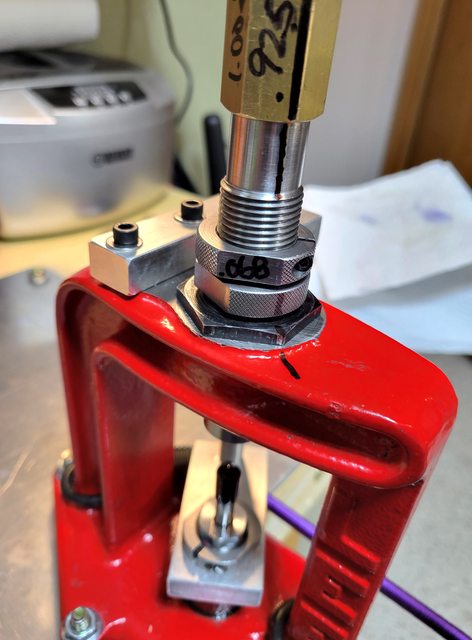
Everyone has their own way of doing this. If you've got a bullet previously made in a particular die, it's super easy to hit the adjustment, obviously. There seems to a lot of interest in bullet making by new people so this may be helpful to those starting out or thinking about getting into it.

For what it's worth....

pUtKBHEl.jpg
 
Since I'll be making both .925" and 1.00" jacket length bullets on the Robinett die, I wanted and easy way to come back to the die adjustments for each length. With the .925's set up, another lock ring was run down on top of the adjuster lock ring and locked into place. Then, the die was backed up and adjusted for the 1.00" jackets. Once that was done, the distance between the lock rings was verified with feeler gauges. I have gone back and forth with these adjustments and they repeat each time.

Randy made this easy for my pea brain :eek: by using six flats on the bronze ejector cap and 14 tpi threads. 1 divided by 14 is .071. So each 'flat' is roughly .012 (.0118). One full turn (6 flats) gives .071 of change. With .075" difference in jacket length, six flats puts you right in the ball park. After a little tweaking, the feeler gauge shows .068"...so the math works out.

Everyone has their own way of doing this. If you've got a bullet previously made in a particular die, it's super easy to hit the adjustment, obviously. There seems to a lot of interest in bullet making by new people so this may be helpful to those starting out or thinking about getting into it.

For what it's worth....

pUtKBHEl.jpg
One thing of note,
I did this some time ago and it ended up biting me. Make double sure all of your die lock rings are GROUND FLAT!
Do not assume a die lock ring from whichever company is flat.
Kind Regards
CW
 
One thing of note,
I did this some time ago and it ended up biting me. Make double sure all of your die lock rings are GROUND FLAT!
Do not assume a die lock ring from whichever company is flat.
Kind Regards
CW
You can't see it in the pics but there are rubber 'o' rings on the bottom of the die lock ring and between the die bushing and the press. When going back the .925 setting, I back the upper lock ring up so there's no contact between it and the adjustment lock ring.

Totally agree on lock rings...some are truly evil things! :mad:
 
I’m new to bullet making with in the last 4 months. So I have a lot to learn.
I noticed my point up die worked lose. I only hand tighten it.
Does anyone torque the lock ring down to a certain inch pounds or to certain ft pounds ?

Or does the oring keep the die from moving if hand tight ?
 
Last edited:

Upgrades & Donations

This Forum's expenses are primarily paid by member contributions. You can upgrade your Forum membership in seconds. Gold and Silver members get unlimited FREE classifieds for one year. Gold members can upload custom avatars.


Click Upgrade Membership Button ABOVE to get Gold or Silver Status.

You can also donate any amount, large or small, with the button below. Include your Forum Name in the PayPal Notes field.


To DONATE by CHECK, or make a recurring donation, CLICK HERE to learn how.

Forum statistics

Threads
167,959
Messages
2,244,204
Members
80,914
Latest member
gmarth
Back
Top