Follow along with the video below to see how to install our site as a web app on your home screen.
Note: This feature may not be available in some browsers.
This Forum is for adults 18 years of age or over. By continuing to use this Forum you are confirming that you are 18 or older. No content shall be viewed by any person under 18 in California.
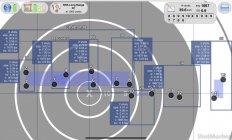
I'm not sure you can really state that there is a "big change" between any of the seating depths when only two shots were used at each, and all of them effectively generated X-ring vertical (or less) at 1000 yd, which would be considered outstanding by most F-Class shooters. Only testing a larger sample size could provide evidence as to whether the differences in group spread at various seating depths observed in the original test were actually reproducible. In any event, it's not uncommon for Berger Hybrid bullets across a range of different calibers to exhibit seating depth optima somewhere between "touching" and about .020" off.
I was only looking at the numbers. Most increments are .005" at a time. That increment is .021". I started looking at group shapes and didn't see what I was looking for in that area after he posted those seating depths. Sure, there are some small 2 shot groups. I'm not arguing that or anything. Just asking why he skipped that area. I also see what appears to be very wide seating areas.
I was only looking at the numbers. Most increments are .005" at a time. That increment is .021". I started looking at group shapes and didn't see what I was looking for in that area after he posted those seating depths. Sure, there are some small 2 shot groups. I'm not arguing that or anything. Just asking why he skipped that area.
I see. Maybe it was just so as not to be anywhere near "touching". I just wish I could observe X-ring vertical with my F-TR rifles over a seating depth range that wide. LOL
That is a 1,000 yard target, any of those jumped lengths would most likely be acceptable. Next step would be to shoot a larger sample at .010” ish and .030”ish.
The point is with a well tuned powder charge and the 180 hybrids seating depth nodes are very wide at long range.
The interesting part is if I shot it traditionally at 100 yards with different aim points it would produce the typical sine wave pattern.
I see. Maybe it was just so as not to be anywhere near "touching". I just wish I could observe X-ring vertical with my F-TR rifles over a seating depth range that wide. LOL
Simple, he wins, it works for him. All that matters.But I am confused a bit at the point of it. 7, 8, 10, 11, and 12, forgetting 9 as an anomaly, show the area of promise (If repeatable) for a good load. Maybe the fact that none of the groups are terrible with vertical shows its a good 1000 yd bullet. If that is the point, I get it. If it's something else I do not get it. I do get that I want Mr Hendricks on my team!
When Tod shares some of his expertise like this....It should be like one of those E.F. Hutton commercials where everyone stops in their tracks and listens.
I appreciate him posting this!
The overriding point is the 180H has the potential for extremely wide seating depth nodes that might not be obvious at shorter distances and repeated testing in narrow spreads might not be necessary.
Or you could look at it as though there are smaller nodes that just get lost in the noise at longer distances.
I guess I should admit that I have seen this with the 140 Hybrid target bullets as well. I start testing at 20 thou off and when I find a powder node I start playing with seating depth. I've tried 20 thou jammed to 60 thou off and do not see a real advantage to any of the depths. I left it at 20 thou off. I'm usually testing at 200 yards.
Now if I had started this conversation, it would have gone an entirely different direction. Do you win: rarely. You are talking about a 6.5 creedmoor? yes, then man bun slipped over your eyes and blinded you. Could have been a very entertaining conversation. Still could be.
I guess I should admit that I have seen this with the 140 Hybrid target bullets as well. I start testing at 20 thou off and when I find a powder node I start playing with seating depth. I've tried 20 thou jammed to 60 thou off and do not see a real advantage to any of the depths. I left it at 20 thou off. I'm usually testing at 200 yards.
Now if I had started this conversation, it would have gone an entirely different direction. Do you win: rarely. You are talking about a 6.5 creedmoor? yes, then man bun slipped over your eyes and blinded you. Could have been a very entertaining conversation. Still could be.
Ok, get that man bun back in place as I have a question. I will assume you have good bench manners, a good rifle, and test in good conditions with flags. Ok that's settled. At what 5 shot group size , back to back of course, are you satisfied and ready to compete at your test distance of 200 yards.
If you win you have a good simple process that works for you. If you don 't win, you might need a better process. If you don't care, it doesn't matter. So the question is....Do you win?
This is a lot like tuners. I do my best to get people to systematically do a test that is essentially their own instruction sheet, fired by them, with their rifle. It works GREAT!
But if you have a system that actually works for you, that involves taking it off and putting it on backward between shots fired...GO FOR IT! As long as it actually works for you and you have confidence, I will say nutting. But I will do my best to get you to a little more sensible and practical approach first, regardless of your shooter status. From there...it's up to you. This ain't tuners and Tod clearly has something that he has confidence in, works for him, regardless of his results, good or bad.
Ok, get that man bun back in place as I have a question. I will assume you have good bench manners, a good rifle, and test in good conditions with flags. Ok that's settled. At what 5 shot group size , back to back of course, are you satisfied and ready to compete at your test distance of 200 yards.
Well I have horrible manors but I do know my way around a bench. That aside, I do most of my testing prone at the local range 200 yard line using a SEB mini and a SEB bigfoot loaded with heavy sand.
The rifle is a BAT action, Krieger barrel (currently), Jewell trigger set in a KRG chassis and a bag rider that I made out of solid barstock that runs back to the action via the spigot port and adds significant rigidity. The scope is a Trijicon 10-50 which I like as well as I like the Nightforce comp on the 6 BRA.
I pick days when the wind is insignificant, as in less than 3 mph when possible. We do have flags at the range but not the volume or locations you would see at a rimfire benchrest match. Enough to know what is going on at a macro level as is the case with most F Class ranges. I rely on those and the mirage when present. When I'm testing however I do not hold off for conditions. I shoot 5 shot groups of each load or seating depth at the same poa and I usually use 100 Benchrest targets at 200 yards in testing. That gives me 6 different loads for each session. My labradar is setup to provide velocities at the same time.
What I'm looking for is powder charge nodes of less than 1/2 MOA. Ideally 1/4 MOA. I have gotten consistent quarter MOA with some barrels. This Krieger seems to be shooting well. I tried a couple of different seating depths with this barrel and did not see a difference. Ran into the same thing with other barrels on this action when using this bullet. Testing seating depth with this particular bullet in this particular action has always been a waste of time. Probably won't even do seating depth tests in the next barrel. And that barrel is already teed up.
I never compete with this gun at 200 yards. I've shot it at 500 yards (in the matches that Tod runs) but mostly use it at 600 to 1000. I will be giving Tod and Praveen (and others) the opportunity spank the mighty creed at the first match of the season in a couple of weeks. I want to test the gun so I'm leaving the BRA home. Experience tells me that they are likely to do just that. Tod always has quality components and significant experience that is difficult to overcome. This is true even when he is testing different loads in his gun. If you ever shoot against him and win then you are justified in patting yourself on the back so hard that you nearly break your arm. Praveen has a new barrel that he chambered on my lathe. The first barrel he ever chambered. He actually chambered two barrels for it then took them back to the west side, screwed one of them on, went and shot a benchrest match at Kenmore and won. If you know benchrest in the Seattle area then you know that there are some of the top benchrest shooters in the nation shooting there. They are using customized benchrest calibers like 30BR and they take it very seriously. Praveen won with the first barrel he ever chambered in 6 Dasher. The mighty creed is facing an uphill battle.
P.S. I should add that I am using the Hornady gauge to measure the location of the lands. I know there are other methods some prefer but this has worked for me across multiple rifles in multiple calibers in multiple barrels.
Should also add that Tod is the one who got me pointed in the right direction and answered questions I had when I started chambering barrels. This info was passed on to Praveen who also has Tod to show him how to do it first hand and how to do it correctly. Correctly as in building guns that win at a national level.
I stopped chasing lands a long time ago. Although my long range scores don’t necessarily reflect what my rifles can shoot because you know the whole ‘indian not arrow’ thing (pun intended). However, I remember a few years ago while on a practice day with Tod, he showed me almost identical results with different seating depths. These days, for my dasher, I still shoot the same load I had found years ago and my barrels are basically chambered with the same reamer so I never even change the brass or anything else, never chasing the lands. Heck I haven’t touched my seating die in years. Still seems to work.
The overriding point is the 180H has the potential for extremely wide seating depth nodes that might not be obvious at shorter distances and repeated testing in narrow spreads might not be necessary.
Or you could look at it as though there are smaller nodes that just get lost in the noise at longer distances.
Berger's 230 Hybrid performs similarly in .300 WSM. It behaves well in a broad range of powder charge and seating depth. Unfortunately and unlike the 180, it brings some baggage with it.
"missed the trolly to the pits", like that I'm with Praveen. I don't chase the lands or recut barrels unless I'm using the barrel for another cartridge and I delude myself into believing that there is enough life left in it to be worthwhile. That is actually the barrel I'm currently shooting in 6.5. It started life as a 6.5 PRC but I decided to move another direction.
The overriding point is the 180H has the potential for extremely wide seating depth nodes that might not be obvious at shorter distances and repeated testing in narrow spreads might not be necessary.
Or you could look at it as though there are smaller nodes that just get lost in the noise at longer distances.
I would add that in additon to the obvious value of your observations and conclusions about the 180 Hybrid, I really appreciate the manner in which you took advantage of the electronic target system to carry out the testing. I recently started using my ShotMarker for carrying out ladder tests, and it greatly facilitated the process. Clearly, the two-shot process outlined here could easily be used to carry out seating depth testing at whatever maximum shooting distance might be available to someone; i.e. up to 1000 yd. But I can also envision that it could be adapted to other purposes, such as setting a tuner. Obviously, the need for having low and/or stable wind conditions becomes more important as the test distance increases, which is why many of us do a certain amount of testing at 100 yds. Nonetheless, I think the potential value of electronic targets in the load development process may be under-appreciated.
I would add that in additon to the obvious value of your observations and conclusions about the 180 Hybrid, I really appreciate the manner in which you took advantage of the electronic target system to carry out the testing. I recently started using my ShotMarker for carrying out ladder tests, and it greatly facilitated the process. Clearly, the two-shot process outlined here could easily be used to carry out seating depth testing at whatever maximum shooting distance might be available to someone; i.e. up to 1000 yd. But I can also envision that it could be adapted to other purposes, such as setting a tuner. Obviously, the need for having low and/or stable wind conditions becomes more important as the test distance increases, which is why many of us do a certain amount of testing at 100 yds. Nonetheless, I think the potential value of electronic targets in the load development process may be under-appreciated.
That’s a great point! My Shotmarkers are almost indispensable. I run two on the same target, accuracy consistency between them is very good.
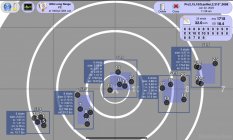
Since you mentioned it I’ll post a tuner test. My tuner use and testing is pretty limited. The second pic is how I do powder ladders utilizing the Shotmarker. Every barrel has a tab in a 3 ring binder, every target gets printed and filed in a binder, the bad targets are just as important as the good ones.
This Forum's expenses are primarily paid by member contributions. You can upgrade your Forum membership in seconds. Gold and Silver members get unlimited FREE classifieds for one year. Gold members can upload custom avatars.
This site uses cookies to help personalise content, tailor your experience and to keep you logged in if you register.
By continuing to use this site, you are consenting to our use of cookies.