Follow along with the video below to see how to install our site as a web app on your home screen.
Note: This feature may not be available in some browsers.
This Forum is for adults 18 years of age or over. By continuing to use this Forum you are confirming that you are 18 or older. No content shall be viewed by any person under 18 in California.
I use Lapua 6BR to make 6BRA cases and use CCI450s exclusively, with no issues. Yes, initially they are tight, but not "too" tight. I use a Lee Bench Prime tool to seat them.
Just did a Google search. A few guys report slightly tight pockets. Nothing on the Lapua website about pockets. Apparaently they get looser after a couple firings.
Guys talk about Lapua brown cardboard boxes. The website shows blue carrdboard boxes. I shoot nothing but plastic blue box for many years without a problem.
Is there a primer a little smaller in cup diameter so you can use the cases? Cases are getting expensive to toss.
I got a cardboard boxed 100 pcs. 6GT Lapua not long ago. The first 25 I loaded had primer pockets so tight I had great difficulty getting primers seated. After firing those I primed another 25 (same box) and the primers went in with what I would consider normal effort.
Guys talk about Lapua brown cardboard boxes. The website shows blue carrdboard boxes. I shoot nothing but plastic blue box for many years without a problem.
Before the blue plastic box there was the gold cardboard box. No dividers at all, just a box with brass. These go back to the late 80s or maybe earlier when Lapua started becoming popular in this country. The gold are often referred to as brown box for some reason.
I did get some truly brown box Lapua 30-06 a few years ago. No company logo, just a white label. Think of the color of grocery bags from days gone by or Amazon boxes from last week. Unsure of manufacture date or if a military overrun or what the story is with them. The brass is very heavy with a significantly smaller internal capacity than gold or blue box 30-06. Wish the camera worked.
Just got some new BR brass. Haven't opened the box yet. Hoping there's no problems with them.
Priming new brass always feels a little off to me as well. Had a few lots from several makers and several calibers that felt tight on the first seating. You may consider tumbling them in walnut or pecan. The new pockets can be too clean and give a less that desirable feel. My opinion the small radius in the bottom of the primer pocket adds to the poor feel. Just some ideas.
I really like the new lapua cardboard boxes. The necks are way better than anything from the brown box or plastic box era.
I use Lapua 6BR to make 6BRA cases and use CCI450s exclusively, with no issues. Yes, initially they are tight, but not "too" tight. I use a Lee Bench Prime tool to seat them.
One step in my new brass prep is to square the base in a CH trimmer, that uses chamber holders, so the brass can be reversed. Once the base is squared, I re-cut every primer pocket for diameter and depth. Then I trim the cases using a RCBS Trim Pro, with a 3 way cutter and motor.
In my BR guns I prefer bushing dies. On my 6.5 BR, I start with 6 BR brass.
I agree completely! My only real complaint with it is that the primers don't feed very well, often requiring some tapping or banging the board it is mounted on. Otherwise I love it. Also, very easy on old hands, yet still a lot of "feel".
I grabbed a new piece of Lapua from an unopened box.
K&M uniformer in the pocket as far as it will go. Notice the gap:
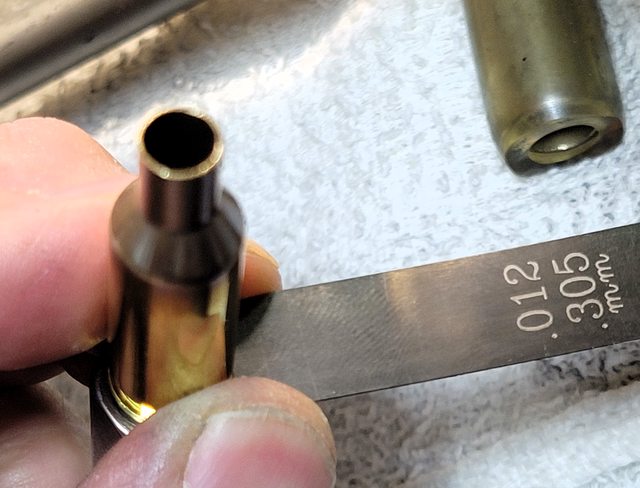
Pushing the case against the uniformer as hard as I could, a .012 feeler gauge slips in the gap:
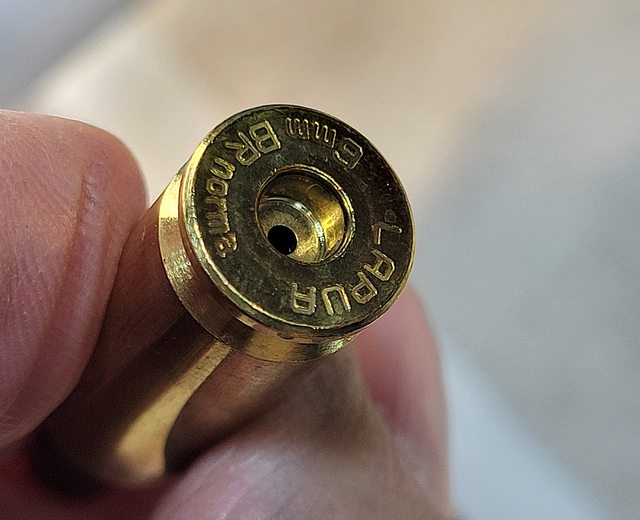
Gave the uniformer one full turn by hand. You can clearly see where it's cutting the radius between the side and the floor. That's the .012 gap seen earlier:
I grabbed a new piece of Lapua from an unopened box.
K&M uniformer in the pocket as far as it will go. Notice the gap:
Pushing the case against the uniformer as hard as I could, a .012 feeler gauge slips in the gap:
Gave the uniformer one full turn by hand. You can clearly see where it's cutting the radius between the side and the floor. That's the .012 gap seen earlier:
Nice pix. No-one mention the pockets are not machined into the case head. They are swaged in by driving a rod into the case head. The flash hole is also punchhed in.The rod probably has a radius on the end. I think AMPS shows a cross-section of the head with all the grain flowing around the pocket.
Nice pix. No-one mention the pockets are not machined into the case head. They are swaged in by driving a rod into the case head. The flash hole is also punchhed in.The rod probably has a radius on the end. I think AMPS shows a cross-section of the head with all the grain flowing around the pocket.
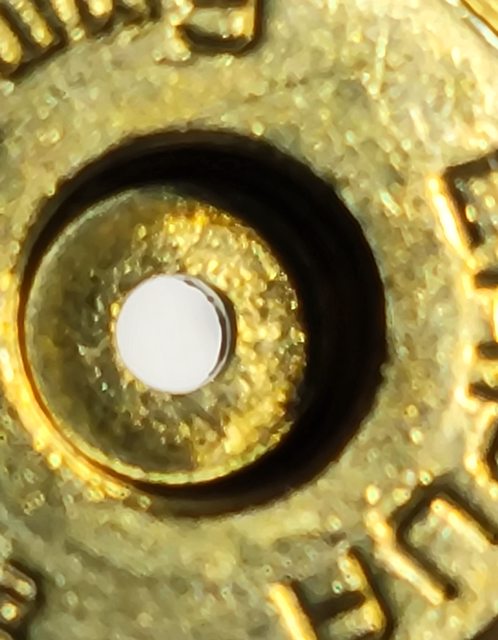
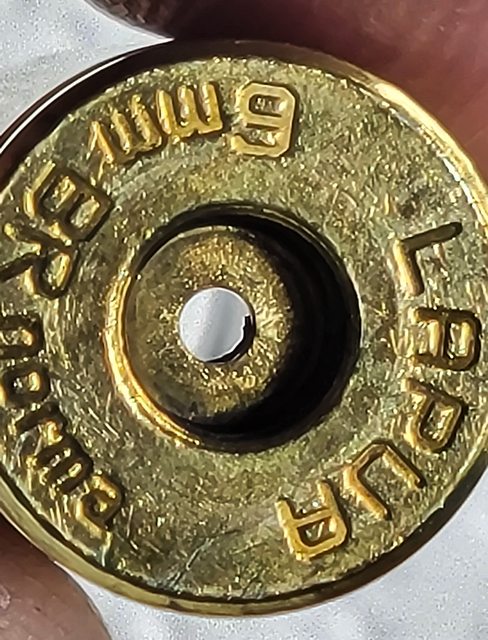
Also, equalizing the flash holes is something that should be done as part of routine case prep. You'll be surprised at how inconsistent they are out of the box. That's no knock on Lapua...these things are mass produced and the flash holes are punched...it's impossible for them to be perfect. Making them .0625 with a light internal chamfer works well.
Also, equalizing the flash holes is someting that should be done as part of routine case prep. You'll be surprised at how inconsistent they are out of the box. That's no knock on Lapua...these things are mass produced and the flash holes are punched...it's impossible for them to be perfect. Making them .0625 with a light internal chamfer works well.
For what it is worth, I just measured a case of 6BR brass everyway I can imagine, the batch was very uniform. I am not finished with all my fiddling yet, so no reports on how they form up groups until later in the summer (Still turning necks).
CW
was out of shooting for about five years but recently got back into it. bought some new Lapua 6BR cases. i am used to having to uniform the depths of Lapua 6BR brass, but with the latest 100 bought (what the hell happened to the plastic boxes!!!) the width of the pockets on some are so tight that some will not accept a Federal 205M primer without destroying it. i have loaded many, many thousands of Lapua 6BR brass pieces but never have had an issue with this before. is this issue more common now? do i have to ream out the diameter of the pockets? is Lapua brass quality control slipping? time to go to to Peterson?
This has been going on for years as I bought and noticed this with a batch of brass I bought many years ago. I'm going to guess about 2005. I have a K&M pocket uniformer set up specifically for Lapua 6BR Norma brass pocket diameter and depth. I uniform pockets to .122" depth which gives me a primer seating depth of .007". You can stone the sides of your pocket uniformer cutter to fit the Lapua brass. It's about 8 ten thousandths smaller. The smallest primer cup diameter is on Federal 205M at .1075" with the largest primer cup diameter being CCI 450 magnum primer at .113". There is a primer dimension chart on the front page of this forum. The K&M pocket uniformer cutter depth can be set for cutting depth by loosening the outside set screw and the inside set screw under the tool drive nut. I suggest using a depth micrometer to set cutter and checking primer pocket depth. An aside I bought 6GT brass recently in the new cardboard box it's the same tight pocket.
Yes, out of the box Lapua 6BR primer pockets can definitely be 'tight'. There can also be a radius at the bottom that makes the primer feel even tighter and can prevent the primer from seating fully to the bottom. I've posted on this before and included pics.
I consider primer pocket uniforming as standard proceedure, no matter what brand of brass it is. Same goes for equalizing the flash holes.
If you're not doing those steps, you'll be surprised what you'll find...no matter what brand of brass it is.
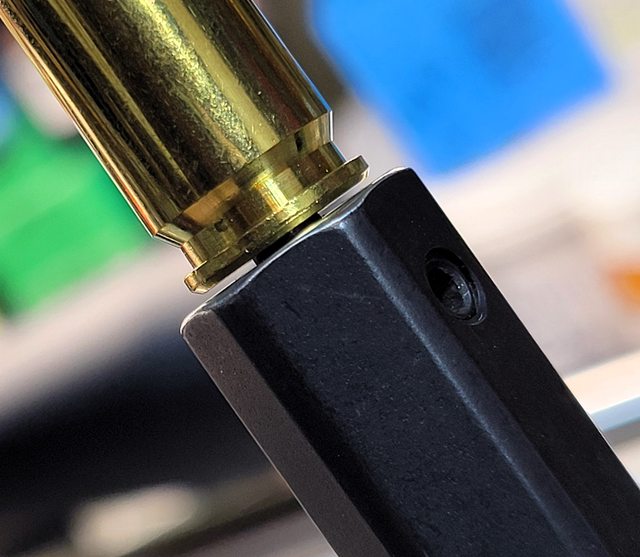
I grabbed a new piece of Lapua from an unopened box.
K&M uniformer in the pocket as far as it will go. Notice the gap:
Pushing the case against the uniformer as hard as I could, a .012 feeler gauge slips in the gap:
Gave the uniformer one full turn by hand. You can clearly see where it's cutting the radius between the side and the floor. That's the .012 gap seen earlier:
This Forum's expenses are primarily paid by member contributions. You can upgrade your Forum membership in seconds. Gold and Silver members get unlimited FREE classifieds for one year. Gold members can upload custom avatars.
This site uses cookies to help personalise content, tailor your experience and to keep you logged in if you register.
By continuing to use this site, you are consenting to our use of cookies.







 -Al
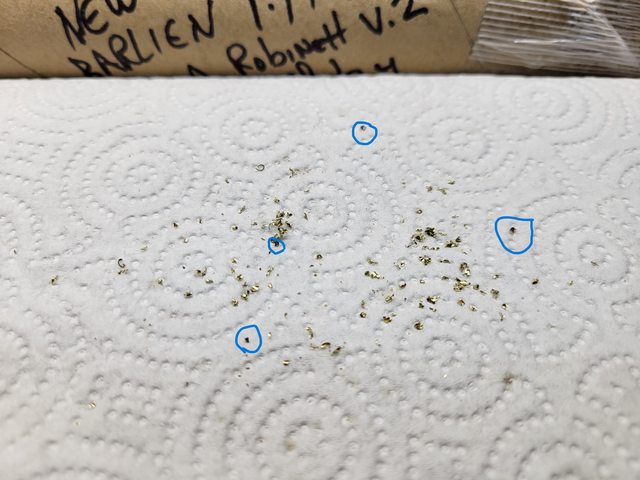
-Al This flash hole swarf is from 50 cases.