Follow along with the video below to see how to install our site as a web app on your home screen.
Note: This feature may not be available in some browsers.
This Forum is for adults 18 years of age or over. By continuing to use this Forum you are confirming that you are 18 or older. No content shall be viewed by any person under 18 in California.
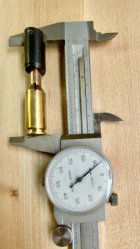
I use the Frankfort Arsenal tool method which produces consistent ogive contact with the lands.
However, due to variations in bullet ogives, operator consistency in using the tool and caliper, I have never been able get a group of measurements that are identical. So, my approach is to measure 5 bullet per lot and use the average unless I encounter an extreme outliner in which case I reject.
Since I never seat bullets into or touching the lands, this is no big deal. I typically seat about .010 to 020" off the lands taking into account magazine fit. My goal is to assure that I do not touch or jam into the lands thus this procedure works quite well for my purposes.
With that said, seating depth can make a difference if you are seeking the best groups for your rifle. At least this has been my experience. But in my experience, the improvement, while measurable on target, pales in comparison to the bullet and powder selected.
I gave up on that tool. Now i use the speedy method where you pull off the barrel and drop a case in. Or I just ignore where they are and use the cortina method to find jam by loading a bullet long, coating it with sizing wax, and let it seat the bullet. Some sharpie on the bullet can also show you if you are in the lands.
Where it shoots best, is the number that matters. Write that number down, and if you need to adjust later, seat them out a bit longer. Then ultimately who cares if it’s touching, jamming, jumping, hard jamming etc.
I like how Cortina approaches it.
Fiddling around with some janky tool or a cleaning rod trying to measure something consistently to the third decimal point?
I stopped using the Hornady L & L tool and went to the Wheeler Method. I get good results with using the close bolt method. It is repeatable but the firing pin assembly and ejector must be removed from the bolt in order to use it.
I like the barrel stub, spin the bullet till it hits the grooves then measure, then back off .002 at a time or a coat of sharpie then look st the fine line but I just spin seat spin seat till it quits touching the lands, I know then I'm with in .005 I think
I know! Use whatever method, get it somewhere in the neighborhood. Who doesn’t go in/out 30-50 thou from that arbitrary number anyway while testing? Someplace in the seating testing it shoots best, who gives a crap if it’s in out or otherwise.
If you just have to know what the true touch is, strip the bolt and sneak up on the seating until the bolt falls. But then whatcha got? You’re going to test both long and short? How exact does it need to be?
Besides everyone’s “touch” is different. You can’t feel 5-10 thou on a Hornady tool.
My gunsmith chambers to my dummy round and he’s insanely close. So I already know “touch”.
I prefer to obsess over dead nuts shoulder bump, neck id, seating length, consistency. Making identical rounds.
Watch Erik’s videos for a more gooder take on this.
Works fine for me. I put a cleaning rod in the bore, and put some pressure on the bullet. Once you have the measurement there's no need to revisit it with that particular bullet. If you plan on doing it to keep track of your throat moving... be sure you use that exact same bullet again.
The Hornady gauge works good for me also. It's just a point of reference like a shoulder set back gauge. I just jam the bullet into the lands hard enough so that is will stick in the lands so that when I remove the gauge, the bullet remains in the bore. After awhile it is easy to feel how much pressure it takes to do that. I use different bullets from that lot# then take an average and save that bullet also from that lot# to keep track of throat wear too. different lots of bullets can be way off from one another. And the ogive gauge to confirm. I check each one as I reload. More important if you use a magazine.
I put a sharpie mark on the rod about 1/4 inch from where the over all touch length would be. I drop a bullet into the chamber, then carefully inset the tool with the case over the bullet. my rod is backed out to my mark, I loosen the nut, let the rod drop onto the bullet holding the case tight in the chamber. re-tighten the nut, invert the rifle and let the tool with the bullet come out. I get pretty consistent measurements using this method. of course it varies a thousand or so but i get a good idea where im at touch. all this in in a ar upper, or semi auto, i use the wheeler method for bolt guns.
The Hornady gauge works good for me also. It's just a point of reference like a shoulder set back gauge. I just jam the bullet into the lands hard enough so that is will stick in the lands so that when I remove the gauge, the bullet remains in the bore. After awhile it is easy to feel how much pressure it takes to do that. I use different bullets from that lot# then take an average and save that bullet also from that lot# to keep track of throat wear too. different lots of bullets can be way off from one another. And the ogive gauge to confirm. I check each one as I reload.
I try it til I get readings I know I can pretty much trust, usually get 4 out of 10 that are within a thou, close enough. Hard push is "about this much", soft one is "about this much", subtract 15-20thou from soft and good enough. Were I wanting to jam, I'd maybe get more fussy about it and use another method. And a person has to allow for the difference in length of the Horny case body too
Use the wheeler method. Or use a fireformed piece of brass and make your own dummy case. Those factory cases are so sloppy it probably causes allot of runout which would cause inconsistent readings. Wheeler method much more reliable.
The Hornady tool just gives you a number that you write down. You load powder and bullets and test them to find an accuracy recipe. The Hornady tool just established a point in the barrel where the bullet sets into the rifling. You may find it important that your accuracy load is 0.003 or 0.022 from that number but it’s just a reference. The important number is consistency seating your bullets to the found accuracy load and to consistency prep the cases and measure in the powder. The number the tool created was just a reference, it’s useless for predicting the accuracy load except that secant ogive bullets generally like to be close to the lands but it’s not an absolute certainty.
We're dealing with soft metals here, copper and brass... it's kinda like pushing a rubber bullet into a foam case. Good luck getting them EXACTLY the same
On one hand, I understand the desire for consistency. Particularly if you have any background with precision measuring tools, such as a machinist.
On the other hand, we're working with essentially two angles meeting. That situation is not conducive to repeatability, and particularly when one of the 2 angles (bullet) is constantly being replaced and the other angle (barrel throat) is subjected to wear and/or deposits.
It's a comparative measurement. It'll never be absolutely consistent.
And this expectation of perfect repeatability is the source of the dissatisfaction.
This Forum's expenses are primarily paid by member contributions. You can upgrade your Forum membership in seconds. Gold and Silver members get unlimited FREE classifieds for one year. Gold members can upload custom avatars.