Follow along with the video below to see how to install our site as a web app on your home screen.
Note: This feature may not be available in some browsers.
This Forum is for adults 18 years of age or over. By continuing to use this Forum you are confirming that you are 18 or older. No content shall be viewed by any person under 18 in California.
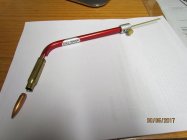
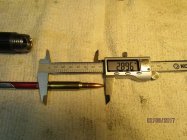
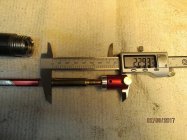
When using the Hornady OAL guage I rarely get the same measurements two times in a row. Depending on when I take the measurements, they vary quite a bit. I try to clean the barrel before measuring. It’s frustrating.
I don’t think you will ever get the same number time after time, with that tool. A lot depends upon how hard you are pushing on the bullet. If you don’t push with the exact same force every time, you’ll rarely, if ever get the same results twice. I used to do it several times then just take the average. Many years ago I abandoned the Hornady for other methods to get this number. If you search on YouTube, you’ll find a number of them.
When using the Hornady OAL guage I rarely get the same measurements two times in a row. Depending on when I take the measurements, they vary quite a bit. I try to clean the barrel before measuring. It’s frustrating.
For me the biggest thing to do is practice, practice until you develop a feel for how much pressure to use where you can do the same (over very very close to the same) pressure each time.
For the most part I can get a pretty consistent reading using that gauge and even if one of the readings I get is off by .001 or 002, it's not an issue for me. It's not an issue for me because I the jump of my bullets are no closer than .010". It might be a different story if I were loading my cartridges to touch or jam. I've found that when I have that kind of jump, it's simply not very important, as evidence by the ever increasing throat erosion that doesn't really affect my results.
My technique it to lightly lock down the sliding plunger with the screw and with the bullet recessed some and push the case firmly in before loosening the lock screw. I hold the case firmly in contact while loosening the screw and lightly tape the plunger until I feel the bullet make contact. Then I hold light pressure on the plunger (the tricky part for consistent pressure) while I tighten the lock screw. I remove the tool and and then bump the bullet out with a cleaning rod. This method has worked pretty well for me.
I do this process often using exactly the same bullet (so there's no variance there) . . . every time I clean my barrel as I keep track of my throat erosion.
Thanks, I’m taking all of this end. I use the light lands touch, then tighten with sensitive fingers. I also do the average method. Maybe I am overthinking this whole process. Thanks again for your help.
Like any tool, it takes a bit of getting used to and then " trusting" you measurements. I use the curved Hornady gauge pretty much daily and find it quite accurate for my purposes. Whatta Hobby!
Thanks, I’m taking all of this end. I use the light lands touch, then tighten with sensitive fingers. I also do the average method. Maybe I am overthinking this whole process. Thanks again for your help.
Trying to find light touch with the L&L is very difficult and why the gentle stop/ stick is more repeatable IME.
The difference between barrel off touch and S/S is about .009 in the lands on my stuff.
I agree. Maybe I haven't learned the tool yet, but can not get readings as consistent as my cleaning rod/two stop collar system I have used for decades.
After you get your best/avgerage COAL, load up a couple of dummy rounds with bullet seated just a touch longer than COAL measurement and see if bolt closes. Gradually seat bullet further until bolt closes with minimal resistance. Use a fresh dummy round and seat bullet to this new established seating depth… test and confirm bolt closure. Set this cartridge to side and write a Note on blue tape stuck to case with the COAL and Brand/Model/Wght of Bullet and Rifle it goes to and save this for future reference … or stick it in little sample bag with a post-it note.
For the dummy round use a case that has already been fired through rifle. Deprime case and then only resize a section of case neck so it can hold the bullet. If you have the bolt disassembly tool then remove the ejector so that it isn’t putting any force on base of dummy round.
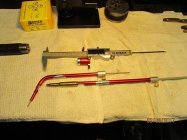
I have an old green gauge I got from Hornady years ago that is about 3 inches long. It was not a Hornady manufactured unit but manufactured by a company Hornady bought (I think it was made by Stoney Point). The newer red Hornady gauge manufactured by Hornady is a lot shorter. My buddy has the shorter red version.
When we both got 1:7 twist .223 barrels, we started shooting 80, 85.5, 88 and 90 grain bullets.
My gauge measured the base to ogive and chamber depth easily and repeatedly with the long, heavy .223 bullets
His gauge measured the same bullets with a lot shorter BBTO measurements and, of course, with his chamber measurements.
We got together with both gauges and found that his newer, shorter red gauge wasn't drilled deep enough to handle the more modern heavy .223 bullets. The long Ogive to Tip lengths for the heavy bullets with hybrid or secant ogives were touching the back of the gauge and producing measurements that were too short.
It may have been a singe unit manufacturing error, but the shorter length of his new red gauge seemed to make it harder to accommodate the extra length of the newer heavy bullets.
He is a machinist and is now considering drilling his red gauge deeper so it provides more area for the bullet tips so it can measure accurately. He is currently using the measurements from my longer green gauge for his reloading purposes.
I get very repeatable measurements. I found a mistake I was making many years ago and it changed everything. The bullet sticks ever so slightly when I push it in and I was taking a cleaning rod and bumping the bullet and tool out together. Wrong! Take the tool out, then bump the bullet out. I discovered what was happening when leaving the tool and bullet together was the bump was moving the plastic rod as well as tapping the bullet out of the lands. My measurements got very consistent after that.
Not a fan of the tool, but you could average measurements. It should help get to a reasonably close answer to what your trying to measure.
I prefer seating a bullet in an empty case to slight jam. It gives me a reference to come back to for throat erosion. Easy to repeat when you have a starting point.
A common problem to check for, is the neck of the modified case being too tight. If the bullet does not move freely, fall out of the case on it own, it makes feeling when the bullet stops difficult.
I get very repeatable measurements. I found a mistake I was making many years ago and it changed everything. The bullet sticks ever so slightly when I push it in and I was taking a cleaning rod and bumping the bullet and tool out together. Wrong! Take the tool out, then bump the bullet out. I discovered what was happening when leaving the tool and bullet together was the bump was moving the plastic rod as well as tapping the bullet out of the lands. My measurements got very consistent after that.
I tried many different ways to achieve this number but this was the best with the most repeatable results. Remove the firing pin, spring, ejector pin and spring from your bolt. Seat a bullet very long. Chamber the bullet by pushing the bolt in. Once the bolt stops it’s forward progressing, released the bolt handle. With the bullet seated too long and the bullet jammed into the lands, the bolt handle will not drop freely. Keep re-seating the bullet shorter by a small amount and re-chambering the round then releasing the bolt handle until the bolt handle just begins to drop freely. Then seat the bullet just a tad shorter until the bolt handle drops freely. At that point you are just touching the lands. To check your results, put a piece of scotch tape on the base of the cartridge and re-chamber it. The bolt handle should not drop freely at this point. With this check, you are sure you are just touching the lands.
When using the Hornady OAL guage I rarely get the same measurements two times in a row. Depending on when I take the measurements, they vary quite a bit. I try to clean the barrel before measuring. It’s frustrating.
I gave up on my Hornady Gauge. I tried hard to make t work. The neck tension has a lot to do with how far the bullet gets pushed in. If you have erosion of the rifling it no longer has sharp edges. I came up with a new method that is very accurate but it seems to be useless if you don't get some exact neck tension. It involves a split neck. After a few tries the neck tension changes and you get goofy numbers. You cannot go wrong just trying different OAL and see what works at the target. If you get too long you have tight bolt closure. You can still fire it to get rid of it.
Where it shoots best, is the number that matters. Write that number down, and if you need to adjust later, seat them out a bit longer. Then ultimately who cares if it’s touching, jamming, jumping, hard jamming etc.
I like how Cortina approaches it.
Fiddling around with some janky tool or a cleaning rod trying to measure something consistently to the third decimal point?
This Forum's expenses are primarily paid by member contributions. You can upgrade your Forum membership in seconds. Gold and Silver members get unlimited FREE classifieds for one year. Gold members can upload custom avatars.