Follow along with the video below to see how to install our site as a web app on your home screen.
Note: This feature may not be available in some browsers.
This Forum is for adults 18 years of age or over. By continuing to use this Forum you are confirming that you are 18 or older. No content shall be viewed by any person under 18 in California.
Oh yeah, If you measure at mid-neck, and then measure closer to neck-shoulder junction, you'll see taper in thickness. It's important (to me) to do so, as taper rate can vary as well (which goes all the way to web).
I feel like I opened a pandoras box. Of course, every time I go to checkout at one of our vendors, I swear this should be all I finally need. Uh huh......cheaper than a booby bar I guess. And my bride is less apt to make me sleep on the couch.
I feel like I opened a pandoras box. Of course, every time I go to checkout at one of our vendors, I swear this should be all I finally need. Uh huh......cheaper than a booby bar I guess. And my bride is less apt to make me sleep on the couch.
Funny, when I was younger I would get pissed over the couch. Now I don't give a rip, except I can't walk the next day. I think I will stay in graces with her.
the picture on the right is common...even with the best of brass...wouldnt a pressure ring form at the weakest point first? The thin side...sure seems to me it would. I will stay with my ball mics...multiplying by 2 and adding the bullet diameter isnt that difficult.
The problem is if the body of the case also has a thicker side the case can warp when fired. Also, the base of the case can be tilted due to uneven expansion on the thinner side.
An interesting experiment also revealed that neck turning of brass that was intentionally sorted as non-uniform, showed little or no concentricity improvement when used in standard S.A.A.M.I. spec chambers. Conversely brass that was sorted and selected for uniformity remained uniform and concentric with or without a neck turning operation.
Just purchased this from a fellow forum member and upon arrival realized it will not work for my needs. The mandrel is .250” in diameter and will not work with 6mm cases. That is the only reason I’m selling it and I’m asking what I paid (shipping costs at my expense). $100 shipped
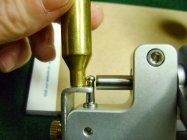
So... as I jump down this rabbit hole of turning necks, a question arises. Is it important to actually know the neck thickness of our brass, or know what the variance is we see when measuring different points around the neck? What brings this thought to mind, can we establish variation with conventional micrometer or does it have to be a ball micrometer? My knee jerk reaction is as long as we can establish variation, we can obtain out goal. Obviously the accuracy obtained with a regular micrometer is at play here, but is it any easier or more difficult than with a ball micrometer?
Any help is appreciated.
Well....I have been seeing just enough fluctuation in velocity to make me wonder if this might help a little. And no, I'm not running a tight neck chamber.
Funny, when I was younger I would get pissed over the couch. Now I don't give a rip, except I can't walk the next day. I think I will stay in graces with her.
Well....I have been seeing just enough fluctuation in velocity to make me wonder if this might help a little. And no, I'm not running a tight neck chamber.
Variation in neck wall thickness may effect accuracy but not extreme spread. Neck tension, among other things, can effect velocity. If you are shooting a standard SAAMI chamber and you are doing anything other than cutting off the high spots to uniform thickness the best you can you will be creating other problems. Try buying some better brass depending on what caliber you are working with.
Variation in neck wall thickness may effect accuracy but not extreme spread. Neck tension, among other things, can effect velocity. If you are shooting a standard SAAMI chamber and you are doing anything other than cutting off the high spots to uniform thickness the best you can you will be creating other problems. Try buying some better brass depending on what caliber you are working with.
A ball mic is a prerequisite to measure correctly and consistently. In addition, knowing how and where and then measuring consistently will provide the necessary results.
DJ
DJ's Brass Service
I'm gonna play with this also. What i plan on doing is finding the thinnest neck in the bunch and set the cutter at that, then proceed.
First I'll clean them (used brass), size them on a mandrel. Then start my search for thinnest spot. I'm gonna use calipers.
Just gonna skim the high spots.
Then I'll have to decide what bushing to use now that they are thinner.
So... as I jump down this rabbit hole of turning necks, a question arises. Is it important to actually know the neck thickness of our brass, or know what the variance is we see when measuring different points around the neck? What brings this thought to mind, can we establish variation with conventional micrometer or does it have to be a ball micrometer? My knee jerk reaction is as long as we can establish variation, we can obtain out goal. Obviously the accuracy obtained with a regular micrometer is at play here, but is it any easier or more difficult than with a ball micrometer?
Any help is appreciated.
This Forum's expenses are primarily paid by member contributions. You can upgrade your Forum membership in seconds. Gold and Silver members get unlimited FREE classifieds for one year. Gold members can upload custom avatars.