Follow along with the video below to see how to install our site as a web app on your home screen.
Note: This feature may not be available in some browsers.
This Forum is for adults 18 years of age or over. By continuing to use this Forum you are confirming that you are 18 or older. No content shall be viewed by any person under 18 in California.
Oh Man…! Off centre flash holes were a major source of pain in the Patootie for me and I used up all my spare de-priming pins for my RCBS die…
Range scavenged brass or mixed lots are worth just what you pay for them.
I hand de-prime any new military brass {sorts out any that have off center flash holes} then spin up a de-crimping RCBS case station tool head in a hand held electric screwdriver.
That brass now becomes “Who cares if I loose a case in the field” brass for my AR-180 coyote killer…
My bolt gun gets the Lapua…
I'd try to segregate by years if you have a large quantity to work with. If I end up with a batch that is of multiple years, I weight sort it, do a light turn on the necks and ream the flash holes. Doing these three things will go a long way towards making them uniform to one another. Because there will have been many batches of brass utilized between years (and likely during the same year), they will not all anneal the same and you will see differences in case stretch when shooting in an A/R, despite utilizing the same headspace and in annealing them all at the same settings. All that said, and despite the minute differences, once the brass is prepped as noted, it will shoot surprisingly well.
One thing about years that is readily evident just from looking at the brass is the difference in the way the primers are staked into the primer pocket. One year (years prior to around 2014?) will show a circle around the primer, while later years will show four or so "jab" marks around the primer. When handloading, I prefer the circular primer staking, though it depends on what your method of reaming or cutting the pocket prior to primer seating. Since I switched from a reamer to a cutter for the pocket work, I look at them equally. When using a reamer such as the Dillon or RCBS models, primer insertion can still occasionally be tricky. This is not noticeable when they are cut.
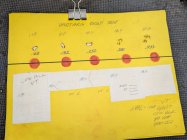
This is 20 VT load development with new barrel and 4000 rounds later after set back.....brass was LC mixed years but neck turned. 40 VM on top and 32 VM bottom.
I don't think year sorting would have done any better.....sure is GTG for PDn.
Another way to test case capacity is to load up 3 rounds with cases from each year. Color each bullet with a different colored sharpie.
Then shoot them all to the same POA - a small dot on a white piece of paper. The sharpie color will leave enough color behind so you can identify which year the case was from.
If all shots have the same POI - you know it won't make a difference.
"One piece could be made in January and the next made in December." Very good point and one that I have considered. Some LC head stamps look different even from the same year. So what am I supposed to think about that?
LC brass is formed and stored without a headstamp, which is applied in the loading process and may happen years later. There are changes in the contractor who runs the plant every decade or so, recently switching back and forth between Remington and Winchester; those changes are reflected in the brass. I group brass made by the same contractor irrespective of year, and sort by weight for my high-precision loads (1000 yd). I've long retired my LC brass after 12+ firings so I don't remember what years the transitions occurred, but that's public record. I'm now using a single lot of Winchester brass that I bought once fired my a Highpower competitor who bought it new - he bought primed brass in large lots, loaded them up and sold true once-fired brass to other competitors/
I wouldn’t waste the time sorting if you’re just loading for high volume varmint shooting. My AR 223 ammo I use for gophers and PD’s is mixed. Not just mixed years, but mixed head stamp as well! It is mostly made up of a bunch of once fired Lake City I bought probably 15 years ago, but it has other head stamps mixed in.
Some guys can really run those Bear Creek AR’s down. I have a couple of 20 inch uppers that shoot just fine. TAC and either 55 Vmax or 55 Nosler tipped Varmageddon work great in the 8 twist and are good medicine for the big dogs!
Yes , back in the 80s and early 90s , I ran taper on 7.62 . Sometimes heading. If they didnt have a headstamp when they left the case area the lot was lost. I dont know how it works now havent been there since 94. Everything is different. We ran it the way they ran 30 cal. in WW2. Doug
I would assume that by early 2010-2015, that majority of existing surplus of ammo and unloaded brass cases had been utilized/consumed in Middle East. This is just my guess that any headstamps after 2020 are current year production so sorting by year may be more reliable.
I could be totally wrong … Ukraine & Palestine eating up a bunch of recent production.
Your BearCreek barrel will hold you back more than mixed head stamp LC brass. I have an old high mileage 20” Bushmaster Hart or Douglas ( I can’t remember who they used ) air gauged match barrel that still hammers sub MOA with 52-77 gr loads of mixed everything ( brass, primers, powders bullets ) at 100 yards. It opens up at 600 but if you are shooting 300 or less, it still shoots. If your BearCreek doesn’t shoot to your liking PM me. I’d sell that barrel or the whole upper
For what it’s worth here is my experience with LC brass in 556\223
Many years ago my FIL gave me a 5 gallon bucket of processed LC and some WCC range brass. Almost all of it oversized about 10thou. It is all from the late 80s and early 90s.
For my 223 FTR loads I shoot 90 vlds jammed about 5 thou. Considering the pressures we shoot FTR stuff it wasn’t going to last but a few loading anyway. For matches that meant something (regional/state etc) I did try to use “once fired in my rifle” brass because my shoulders would be correctly bumped.
Shooting this brass unsorted I made F class HM at mid range, won the TN state MR championship at least once, and won at least one match at the StL BR club beating the Open rifles too, not to mention a bunch of cleans with silly high X count at 600 yds.
If you need more precision than that then by all means sort to your hearts content, but for any kind of High Power shooting category out to 600 yards my experience says it’s a waste of time.
The ES matters much more than the average, and it takes at least 100 samples to get a good idea of ES. You could get a reasonable SD from 20 samples, but since the distribution is rarely a bell curve (usually bimodal and asymmetric) you can't just use 6xSD as you would for a Normal distribution.
It always looked to me like you would be better off buying a neck concentricity guage and forget about the weight of the case. You could get variation from the case cups from the vendor before they went to first draw. I ight be wrong but I thought accuracy came from a straight neck lining up with the bore. The rest is up to the barrel. Doug
This Forum's expenses are primarily paid by member contributions. You can upgrade your Forum membership in seconds. Gold and Silver members get unlimited FREE classifieds for one year. Gold members can upload custom avatars.