• This Forum is for adults 18 years of age or over. By continuing to use this Forum you are confirming that you are 18 or older. No content shall be viewed by any person under 18 in California.

How Much Precision in a Scale is Required for Precise Weight-Sorting?

This is all hand-waving, if F-Class was that much easier than BR, the BR shooters could show up at F-Class matches and clean up. That isn't happening, and here's the reason, which is very pertinent to the whole tenor of this thread: the limiting sources of error are not the same in the two disciplines. Let me state that again, the limiting sources of error are not the same in the two disciplines.

In a 20-shot F-Class match, one might observe changes in the wind conditions that are worth anywhere from 1-2 MOA increased dispersion in relatively benign conditions, up to as much 4-5 MOA, or even more, when the conditions are challenging. Thus, wind-reading becomes the major source of error. The difference between a load that will shoot 0.25 MOA and one that will shoot 0.10 MOA are pretty much meaningless when the wind condition is capable of putting shots out in the 7-, or 6-ring, or even off the target at 1000 yd. In other words, the inherent precision of the load is often no longer the limiting source of error in an F-Class match that is fired over a time limit of 20+ minutes, where the wind conditions can change many times. BR shooters don't generally take 10-20 minutes to get their shots off, hence the difference between the two disciplines. None of that means one is easier or harder than the other, they're just different. Shooters in both disciplines strive for obtaining the utmost precision from their equipment, regardless of what the relative final precision at the target under match conditions may be.

The reason this is pertinent to the OP's original question pertains to actually identifying the limiting source(s) of error, so that they can be dealt with, if possible. For example, identification of a charge weight window that puts velocity within an acceptable window across a specific temperature range, identification of an optimal seating depth window, etc., etc., etc. All reloaders go through this, but some are even more concerned with sorting out the details at the finest possible level or increment. For those individuals, in order to understand when a limit has been reached past which no further appreciable effect on precision can be obtained via a given operation, one must have some knowledge of the limiting source(s) of error involved.

One example of this concept based on the OP's question of "how much precision is required in a scale to be used for precise weight sorting?" would be the sorting of brass cases by weight as a surrogate for internal volume. In order to define the limits of each sorted weight group, one has to know how much brass weight variance corresponds to an internal capacity variance that is sufficiently large to alter velocity to such an extent that it will result in reduced precision. This can only be determined by weighing many pieces of brass AND determining their internal (water) volume. Only then can one get a feel for the relative size and number of weight sorting groups necessary that will provide some benefit to precision, but not go so far that one is simply wasting time sorting to an increment so small that the effect cannot realistically ever be observed. Having done this for many years, I can tell you that in general, there is a pretty good correlation between case weight and case volume. It is not surprising given that the case will expand to the limits of the a given chamber upon firing. Thus, the only major places on a cartridge where weight can vary without affecting internal volume are in the primer pocket and the extractor groove. I personally have never found that variance in the size of either of those two features is sufficient to introduce significant variance into the correlation between case weight and case volume. If I was using a brand of brass where the width or depth of the extractor groove or primer pocket was markedly non-uniform, I would be looking for a different brand of brass. Nonetheless, I have observed that the relationship between case weight and case volume is not the same among different brands of brass. In some, the correlation is much better than others. Further, there will always be a few "outliers", even with the best brass available. As I stated above, the only way to know this is to determine weight and water volume for a number of cases, make a scatter plot out the data, and let the software determine the correlation coefficient of the best straight line through the data points. Having done this for many years, I sort cases by weight into three groups, "light", "medium", and "heavy". Although it is certainly still possible that a "low" and "high" volume outlier could happened to fall within just one of those sorting groups, in general, I am stacking the odds in my favor that case volume will be more uniform in cases sorted by weight. I do not claim it is a perfect solution. However, the good news is that the overall volume range of any of the individual weight-sorting groups will never be higher than the total range for an entire batch of un-sorted cases. So I deem the practice to be worthwhile because it takes only a modest effort.

Another example of how identifying a limiting source of error can be used would be weighing powder. Reloaders commonly test charge weight in intervals ranging from about 0.1 gr to 0.5 gr, in part dependent on the case capacity. Is there any reason to ever test charge weights using a finer increment than 0.1 gr? IMO, no. A change in charge weight of less than 0.1 gr across a pretty wide range of case capacities is unlikely to generate a change in velocity that can even be measured accurately by most chronographs, on the order of less than 5 fps velocity variance, in some cases, even less than 1 fps. Do some reloaders use charge weight increments of less than 0.1 gr? I'm sure there are. However, regardless of the perceived result of doing so, it would be next to impossible to ever prove that it actually made any difference, when current chronograph technology is incapable of detecting such a small effect on velocity. Nonetheless, I have no doubt that those that do it are convinced that it does make a difference. Note that I am specifically referring to charge weight testing increments, not weighing precision of a set charge weight in rounds loaded for competition. In the latter event, I would suggest weighing individual charges to the best precision you can generate. I typically strive for charge weight variance of less than +/- one kernel. Why? Because with a good setup it takes little more effort than does weighing to lesser precision, and then you never, ever have to worry about charge weight variance as a possible source of error when behind the rifle at a match. In other words, for a very minimal effort, I am generating precision in charge weights that is far below any other limiting source of error, so that in effect, charge weight variance ceases to be a source of error. So I weigh charges to +/- one kernel or less for a developed match load, but I typically do the charge weight testing during load development in 0.1 to 0.3 gr increments, depending on what I'm doing. This might seem like dichotomy, but it is not. It is based on my understanding of limiting sources of error as viewed through the lens of how much effort a given reloading step or process might involve. Testing charge weights in increments of 0.05 gr (or less) would require significantly more time, effort, reloading components, and barrel life. Weighing charges for a match to +/- one kernel requires hardly any extra effort at all with the right setup.

So to finally get to the meat of it in what I'm sure has already been an excruciating reading experience for some, how does one actually learn to identify and quantify limiting sources of error in the shooting/reloading process? Obviously, having a background in science, engineering, statistics, or mathematics would be beneficial. However, such a background is not necessarily "essential", and simple experience can be more than sufficient. For example, anyone can look at their charge weight test data and correlate a change in average velocity with a change in charge weight. In my hands, an increase of 0.1 gr charge weight is usually good for somewhere between about 5-10 fps difference in average velocity. Thus, I would be looking at a velocity variance of only 2.5-5 fps if I conducted charge weight testing in .05 gr increments. I'm not going to use my time testing using an increment so small that the resultant velocity change is at, or even below the limit of accuracy with most chronographs. Likewise, one can use a reloading program such as QuickLoad or GRT to predict the effect of a 0.1 gr difference in case volume on velocity with a given charge weight. Although such predictions are not "written in stone", they can provide a rough guide as to whether some given parameter might be a limiting source of error, in which case it might be addressed by tools readily available to the individual. One has to start by learning to identify the [major] limiting sources of error, which can vary widely depending on the cartridge/powder/bullet used. Only then can they determine the minimum resolution necessary for a balance that will be used to sort cases or bullets by weight, or to weigh powder to +/- one kernel, or measure seating depth t0 +/- .001" or less. Sure, someone can list their own specific results at a shooting forum such as A.S. For example, my Lapua .223 Rem and .308 Win brass weight groups end up with a range (per group) in the neighborhood of around 0.5 gr range. So a balance accurate to about 0.1 gr would be probably be sufficient for my purpose of sorting brass. However, someone else's results may differ markedly if they are using a different cartridge/bullet/powder. In fact, a balance that weighs to +/- 0.001 g should be sufficient for most of what we do, if not everything. That is getting very close to the point (if not past) where other features of the balance may be more important than the resolution. In any event, it is always a good idea IMO to learn to make these estimates for yourself. In the long run, you will benefit from being able to do so.
PURE BS NED
it is two different games.
br shooters are not silly enough to crawl on the ground, we sit like civilized adults at shooting benches.
i wish this site had user tags iding the type of shooting the poster participates in.
attempting to compare the two is like apples and potatoes..not really close
 
Thanks, Ned. As always a thorough and lucid explanation stated in understandable terms. Can you answer one more question for me: If we have a scale that is .02 grains readable, what is the probable range of true weights across a number of powder weighings? In other words, if I'm loading a large number of cases and trying for charge weights of precisely 31.0 grains and have all the weights on my .02-readable balance showing exactly 31.0 grains, what does that translate into in terms of the range I might expect in true actual weights across the large number of cases processed?

If the likely true range is something on the order of .08 grains, then that might be seen as significant. On the other hand, if the true range is more like .04 grains, we might be wise to regard that as negligible and not likely to be accompanied by non-negligible velocity differences.
Readability is what the scale can display… the smallest amount of change that it can show… 31.00, 31.02, 31.04… for a 0.02 readable scale. It will never read/display 31.01 or 31.03…

Repeatability is the potential variation of a part measured over and over. If you were to measure a part over and over again, the mean of your measurements would approach the true value for a sufficient number of samples… the distribution of your readings should be normally distributed, centered on the true value and cover an extreme spread of two times the repeatability…
 
According to QL for 6.5CM with a case capacity of roughly 54grains... a 0.1 increase in case capacity would result in about 2fps (for a charge of 42g IMR4451, HDY140ELD)... a 0.5grain increase would result in a 10fps change in velocity.

For a 300WinM with a capacity of ~92grains the results are about the same... 0.6grains results in about 10fps.

So, a scale resolving +/-0.1g would be able to sort brass capacity to a degree that the effect would be about 4fps.
and a scale capable of .02 is with a tolerance is .03 is 1.3 fps.....
 
and a scale capable of .02 is with a tolerance is .03 is 1.3 fps.....
Wrong...

This reminds me of a quote: It is easier to fool someone than it is to convince him that he has been fooled.

Within 0.03 equals plus or minus 0.03 for a total spread of 0.06. But since the scale rounds to even numbers it is actually plus or minus 0.04 grains for a total weight spread of 0.08 grains. Face it, the FX120 is one of the best CHEAP scales, but it is not a particularly good scale. It is not more precise than it is. It is affordable for a reason.

Never mind percentage projections that hide the reality if the change... Lets looks at simple load data.

According to Nosler, one grain in charge weight affects velocity for the 223 about 100 FPS... so statistically a 0.08 grain charge weight variance equals about 8 FPS.

Using a scale that is accurate to 0.008 grains, we can get statistical velocity spreads of .8 FPS with a 223 as an example.

Keep in mind that powder weight variance is not the only cause of velocity variance.

Now a 223 having a small case capacity requires a higher level of load precision than say... a 308. Obviously the larger the charge weight, the less we need to be concerned with charge weight accuracy. In this context an error of 0.08 grains on 25 grains of powder is twice the percentage error of 50 grains of powder.

1651708470527.png

But the conversation regarding scale accuracy started in the context of sorting primers, not powder. And since a small variance in the primer charge has a disproportionate affect on velocity, one can quickly deduce that if you are to sort primers, you will get best results by using a more accurate scale.
 
Last edited:
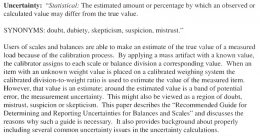
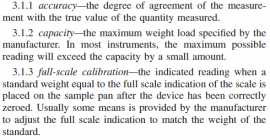
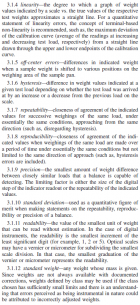
We're starting to see some terms thrown around here, and perhaps we should define them precisely. We have:

Readability
Tolerance
Repeatability
Linearity

Readability is easily understood and has been nicely explained above by cdgaydos. 6bra1k has mentioned "tolerance." How is this to be understood? And what about repeatability and linearity?

While we're defining measurement terms, it might be a good idea to dispense with the term "variance" when discussing the range of measurements. I know I've been guilty of using that term, but "variance" has a precise statistical meaning--the square of the standard deviation. Range is the correct term for the difference between the heaviest and lightest measurements--Max weight minus Min weight.

I'd still like to get an answer to the question I raised above:

If your scale has readability of .02 grains (as does the A&D FX-120i, for example), how much of a range in true weights will result in a number of charges all showing, say, 31.0 gr. on the scale? The answer is obviously not .02 grains, and I expect that it is larger than .03 grains. Is it the .08 grains mentioned above by PracticalTactical?
 
Last edited:
and a scale capable of .02 is with a tolerance is .03 is 1.3 fps.....

According to QL for 6.5CM with a case capacity of roughly 54grains... a 0.1 increase in case capacity would result in about 2fps (for a charge of 42g IMR4451, HDY140ELD)... a 0.5grain increase would result in a 10fps change in velocity.

For a 300WinM with a capacity of ~92grains the results are about the same... 0.6grains results in about 10fps.

So, a scale resolving +/-0.1g would be able to sort brass capacity to a degree that the effect would be about 4fps.
You seem to be using 2 x .1 gr. readability as the range in weight that might be experienced to get your result of 4 fps. But, I think that is too fine a range. I suspect that the true value is more like 3x or 4x the readability, and so in your scenario, the velocity range might be closer to 8 fps.

Your relating changes in case capacity to velocity might help resolve the question of changes in case weight. Since weighing case capacity is much more work (and is susceptible to measurement error due to the meniscus and other factors) than weighing actual cases, it's the latter that interests me the most, and was my original focus in starting this thread. If we could know the relationship between the change of X units in case weight and the corresponding change in case capacity, we might be able to nail down the effects of varying case weights on velocity. In other words, how much change in case capacity accompanies a 2-grain change, for example, in case weight? Obviously this will depend to some extent on the size of the case--a .223 Rem. case vs. a 300 WM case as an example. When you think about it, it seems obvious that a one unit change in case weight would be accompanied by a smaller change in case capacity--undoubtedly much smaller.

It has been pretty well established--by Ned Ludd and others--that case weight and case capacity are strongly linearly related. The correlation coefficient is high and negative, with values like −.80 often being found. To me, this puts to rest the issue of whether weighing cases is giving us information about case capacity. It is.
 
Last edited:
PURE BS NED
it is two different games.
br shooters are not silly enough to crawl on the ground, we sit like civilized adults at shooting benches.
i wish this site had user tags iding the type of shooting the poster participates in.
attempting to compare the two is like apples and potatoes..not really close
And yet that is exactly what YOU were attempting to do when making ludicrous arguments about the precision requirements for each. There is no comparison, exactly like I stated, for the exact reasons that I stated. Do you ever get tired of listening to yourself blow smoke?
 
Thanks, Ned. As always a thorough and lucid explanation stated in understandable terms. Can you answer one more question for me: If we have a scale that is .02 grains readable, what is the probable range of true weights across a number of powder weighings? In other words, if I'm loading a large number of cases and trying for charge weights of precisely 31.0 grains and have all the weights on my .02-readable balance showing exactly 31.0 grains, what does that translate into in terms of the range I might expect in true actual weights across the large number of cases processed?

If the likely true range is something on the order of .08 grains, then that might be seen as significant. On the other hand, if the true range is more like .04 grains, we might be wise to regard that as negligible and not likely to be accompanied by non-negligible velocity differences.
You'd need to see the specs on the balance to know with certainty. Readability as it relates to accuracy and precision can differ between balances from different manufacturers. If there is an "industry standard", I can't tell you what it is. I would simply recommend finding the exact specs online for a given model, or speaking with a technical rep from the manufacturer.
 
If there is an "industry standard", I can't tell you what it is.

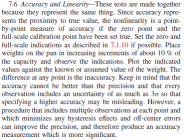
NIST covers the terminology and how to measure the performance of weight scales. For example, the uncertainty.

1651720231301.png
The flow from NIST goes over to ASTM E Committe and produces standard practices such as:
https://www.astm.org/e0898-20.html

I'm not allowed to post those documents due to copyright and having been an ASTM Chairman in my previous life.
 
Last edited:
OK. I finally got around to doing what I should have done before starting this thread; I checked into the specifications of the FX-120i. So, for those of you who actually passed Measurement and Inspection 101,
perhaps you can explain what some of this means. The scale has readability of .02 grains as we've already noted. However, it also has the following:

Repeatability: .02 grains (given as .001 grams), (Actually the .001 grams converts to .0154 grains, but I've rounded it up to .02 grains.)

Linearity: .03 grains (given as .002 grams).

Can someone explain repeatability and linearity?
 
You seem to be using 2 x .1 gr. readability as the range in weight that might be experienced to get your result of 4 fps. But, I think that is too fine a range. I suspect that the true value is more like 3x or 4x the readability, and so in your scenario, the velocity range might be closer to 8 fps.

Your relating changes in case capacity to velocity might help resolve the question of changes in case weight. Since weighing case capacity is much more work (and is susceptible to measurement error due to the meniscus and other factors) than weighing actual cases, it's the latter that interests me the most, and was my original focus in starting this thread. If we could know the relationship between the change of X units in case weight and the corresponding change in case capacity, we might be able to nail down the effects of varying case weights on velocity. In other words, how much change in case capacity accompanies a 2-grain change, for example, in case weight? Obviously this will depend to some extent on the size of the case--a .223 Rem. case vs. a 300 WM case as an example. When you think about it, it seems obvious that a one unit change in case weight would be accompanied by a smaller change in case capacity--undoubtedly much smaller.

It has been pretty well established--by Ned Ludd and others--that case weight and case capacity are strongly linearly related. The correlation coefficient is high and negative, with values like −.80 often being found. To me, this puts to rest the issue of whether weighing cases is giving us information about case capacity. It is.
I was simply trying to quantify the impact of variation in case capacity to velocity - using QL to model. If the variation in velocity from a capacity difference of 0.1gns is practically significant to you, then sorting into “buckets” of 0.1gns is important…Generally, the rule of thumb is that to differentiate parts your measurement system should be capable of discerning 1/10 of the difference… if you want to reliably discern cases to differences of 0.1gn, your scale should discern to 0.01gn - that is a 0.0001gm scale (actually, 0.0005)… the Gempro250 gets you to 0.02gn and is more than adequate. A 0.0001gm scale will drive you crazy and you will cuss that last decimal point… the ones I use are in hoods, have windscreen doors on the balance and they are on 6” thick marble slabs.

A 0.1gn scale would still work, but your actual weights may be off by as much as 0.2gns (worse case). But, that is still only 2-4fps…. A common solution to a less than perfect measurement system is to take multiple readings and average the results… power and sample size.

Regarding case weight to capacity… is the given correlation for cases from the same manufacturer/lot? I’ve seen cited that the majority of case mass variation comes from the head/extractor groove… and does not necessarily correlate with capacity. However, I have no data to support that claim nor can I recall where I saw it…

If you are of the mindset that cases should be weight sorted, then weighing on a 0.1gn scale would probably get you 80% of the benefit. A 0.02gn scale would get you the other 20%. For “quality” brass that benefit might or might not make a difference…
 
OK. I finally got around to doing what I should have done before starting this thread; I checked into the specifications of the FX-120i. So, for those of you who actually passed Measurement and Inspection 101,
perhaps you can explain what some of this means. The scale has readability of .02 grains as we've already noted. However, it also has the following:

Repeatability: .02 grains (given as .001 grams),

Linearity: .04 grains (given as .002 grams).

Can someone explain repeatability and linearity?
Repeatability- the variation expected if a part were measured over and over again. A 30gn part read over and over again would have every measurement be between 29.98 and 30.02gns. To get a better estimate of the true value one would take multiple readings and average the result… or not and accept that the actual value is within 0.02gn…

Linearity- the error over the range of the scale… is the error the same through the range of the scale.
 
Regarding case weight to capacity… is the given correlation for cases from the same manufacturer/lot? I’ve seen cited that the majority of case mass variation comes from the head/extractor groove… and does not necessarily correlate with capacity. However, I have no data to support that claim nor can I recall where I saw it…
Ned Ludd has gone into this in the past and has opined that primer-pocket and extractor groove produce very little variation in case weight.
 
Repeatability- the variation expected if a part were measured over and over again. A 30gn part read over and over again would have every measurement be between 29.98 and 30.02gns. To get a better estimate of the true value one would take multiple readings and average the result… or not and accept that the actual value is within 0.02gn…
So with a scale with .02 gr. readability, we can expect--from the repeatability spec--that any reading of 30.0 grains could in actuality be as low as 29.98 gr. or as high as 30.02 gr. If this is true, it would seem to suggest that, in, say, 20 different powder weighings, the range or maximum difference between heaviest and lightest of the 20 separate charges weighed might be .04 gr. For some reason that I can't explain, this seems too low.
 
So what I have learned here is that if you shoot 1000y BR you can beat anyone at any game no matter where you end up in the 1000y BR comp but where I'm still a bit hazy is the primers. Did we decided to weigh them now or not?
 
more comments :)
Linearity is the error between the zero and cal points not attributed to calibration error, zero error, or repeatability.
Cal at 10, 20 and 50 grams on a 100 gram scale and the max linearity error would "probably" be right in the middle of two adjacent cal points. Powder charges of 2 or 3 grams are close to zero on a 100 gram scale.
Linearity error is what you would expect by calibrating @ 50 grams and weighting 10, 20, 30 grams.

With 0.02 readability digital roll over could indicate 29.98 grains with 29.97 grains on the pan.
29.99 grains in the pan could also indicate 29.98 grains. That's with NO actual scale error.
Just a feature of digital devices. One half of the least indicated interval, +/-
Note that this rollover applies to a zero, a weighed value and the closest calibration point.


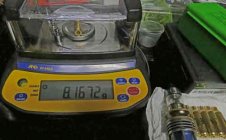
Here's a test in progress with my EJ-54D2
I bought my EJ-54D2 for $355 shipped, it is now $426 plus shipping.
I'm going to go anal on a few cases for my next 600 F-Class shoot.
More anal than normal, just to evaluate scale error.
I'll track the cases, new, sized and trimmed, primers, primed cases, charges, charged cases, bullets, and loaded rounds. Probably take a few days in my spare time :)
6mm HAGAR CASE PREP
10G (ASTM Class 1) WITH 20G CAL
10.0000 9.9998 9.9998 10.0000 9.9998

NEW CASES weight in grams
1 8.1826 1826 1826 1826 1824 avg 8.18256 grams
2 8.1826 1828 1828 1826 1826 avg 8.18268 grams
3 8.1828 1830 1830 1830 1830 avg 8.18296 grams
----------------------------
4 8.1838 1840 1840 1840 1840 avg 8.18396 grams
5 8.1840 1840 1840 1842 1842 avg 8.18408 grams
6 8.1844 1844 1842 1844 1842 avg 8.18432 grams

10G
9.9998 9.9998 10.0000 9.9998 10.0000

I now have them sized to 22 NOSGAR and trimmed to 1.765".
Enough for tonight.

P1050642.jpg

Well, here's case #1, after trim and chamfer. I'll let it rest overnight.
P1050643.jpg
10G
9.9998 9.9998 10.0000 9.9998 10.0000
SIZED AND TRIMMED TO 22 NOSGAR 1.765"
1 8.1672 .1674 .1674 .1672 .1672 avg 8.16728
2 8.1694* .1692 .1692 .1690* .1692 .1692 avg 8.16920
3 8.1702 .1704 .1702 .1704 .1704 avg 8.17032
----------------------------
4 8.1704 .1702 .1704 .1702 .1706* .1702 avg 8.17033
5 8.1722* .1720 .1720 .1718 .1718 .1720 avg 8.17197
6 8.1720* .1718 .1716* .1718 .1718 .1718 avg 8.17180
I took an extra reading when range exceeded 0.0002g
10G
10.0000 10.0000 10.0000 9.9998 10.0000
Total range of the 6 cases is 126.040grains to 126.113 grains (0.073 grains)
Case #1 will be a sighter. Avg of #2 thru #6 is 126.092 grains (a range of 0.043 grains)


Just don't bother weighing CCI primers :)
 
Last edited:

Upgrades & Donations

This Forum's expenses are primarily paid by member contributions. You can upgrade your Forum membership in seconds. Gold and Silver members get unlimited FREE classifieds for one year. Gold members can upload custom avatars.


Click Upgrade Membership Button ABOVE to get Gold or Silver Status.

You can also donate any amount, large or small, with the button below. Include your Forum Name in the PayPal Notes field.


To DONATE by CHECK, or make a recurring donation, CLICK HERE to learn how.

Forum statistics

Threads
169,917
Messages
2,284,047
Members
82,407
Latest member
tyler1524
Back
Top