Sheldon N said:
Quickload modeling indicates the relationship between charge weight and velocity is linear as you increase charges, all the way from 85% case fill up through 115% fill overpressure loads. (At least with Varget and 175 SMK's)
If you can load it to 115% and not have serious overpressure it would seem that the powder is too slow.
I have not used Quickload so I don't know how it works.
Can you post data?
SteveOak said:
Sheldon N said:
Quickload modeling indicates the relationship between charge weight and velocity is linear as you increase charges, all the way from 85% case fill up through 115% fill overpressure loads. (At least with Varget and 175 SMK's)
If you can load it to 115% and not have serious overpressure it would seem that the powder is too slow.
I have not used Quickload so I don't know how it works.
Can you post data?
I have and use QL and the best load I have is 107.5 % full and my SD it under 5 on 10 shots . But I do a internal case capacity check on all my cases. When one shoots over 5 it is put in the practice rounds. Larry
I just ran the data dump from Quickload based on 175 SMK's and Varget, using 43.5g as the target load, 2.80 OAL and 55.6g case capacity which is what I measure with my Lapua brass. Raw data is:
Cartridge : .308 Win. (SAAMI)
Bullet : .308, 175, Sierra HPBT MatchK 2275
Useable Case Capaci: 47.410 grain H2O = 3.078 cm³
Cartridge O.A.L. L6: 2.800 inch = 71.12 mm
Barrel Length : 23.0 inch = 584.2 mm
Powder : Hodgdon VARGET
Predicted data by increasing and decreasing the given charge,
incremented in steps of 2.0% of nominal charge.
CAUTION: Figures exceed maximum and minimum recommended loads !
Step Fill. Charge Vel. Energy Pmax Pmuz Prop.Burnt B_Time
% % Grains fps ft.lbs psi psi % ms
-20.0 82 34.80 2127 1758 30808 6045 90.9 1.508
-18.0 84 35.67 2176 1841 32782 6227 91.9 1.471
-16.0 86 36.54 2226 1925 34882 6404 92.9 1.436
-14.0 88 37.41 2275 2011 37114 6576 93.8 1.401
-12.0 91 38.28 2324 2100 39488 6742 94.7 1.362
-10.0 93 39.15 2374 2189 42008 6902 95.5 1.324
-08.0 95 40.02 2423 2281 44669 7055 96.3 1.288
-06.0 97 40.89 2472 2374 47488 7200 97.0 1.253
-04.0 99 41.76 2521 2469 50491 7338 97.6 1.219
-02.0 101 42.63 2570 2566 53689 7467 98.1 1.187 ! Near Maximum !
+00.0 103 43.50 2618 2664 57099 7587 98.6 1.155 ! Near Maximum !
+02.0 105 44.37 2667 2763 60737 7698 99.0 1.125 ! Near Maximum !
+04.0 107 45.24 2715 2864 64622 7798 99.3 1.096 !DANGEROUS LOAD-DO NOT USE!
+06.0 109 46.11 2763 2967 68775 7889 99.6 1.067 !DANGEROUS LOAD-DO NOT USE!
+08.0 111 46.98 2811 3070 73221 7968 99.8 1.040 !DANGEROUS LOAD-DO NOT USE!
+10.0 113 47.85 2859 3176 77985 8037 99.9 1.013 !DANGEROUS LOAD-DO NOT USE
If you dump the powder vs velocity into an excel graph, it looks like this:
-

Untitled-1.jpg
26.2 KB
· Views: 22
Sheldon N said:
..... snip..............
If you dump the powder vs velocity into an excel graph, it looks like this:
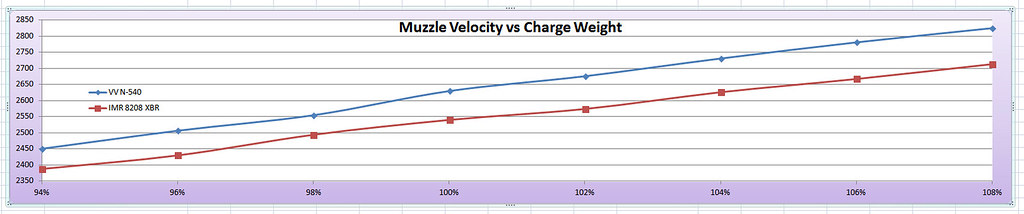
As a coincidence I ran a powder test yesterday involving VV N-540 and IMR 8208 XBR at charge weights ranging from 94% to 108% of the manufacturers maximum recommended load in my .223 F/TR gun. The VV was pushing 90gr SMKs and the IMR was behind Berger VLD 80gr bullets.
The real world results aren't quite as tidy as the theoretical data you present but pretty darn close to linear, as you would expect. If you click on the graph, you can see a larger version.
 MV vs Weight
rchouser, you're still outside your accuracy node and that's why you're seeing high SD numbers. How long is your barrel?
When i run the numbers on a 24" barrel with 56.0gr H20 case capacity i come up with close to what Sheldon has 43.9gr.
Mozella: could be that quickload's burn rates are fairly off for those powders. I use VV N135 in my .223 loads (80gr SMK) and it's pretty close. Not to hijack the thread but how do those 90gr SMKs do?
waldo1979 said:
.... snip.............
Mozella: could be that quickload's burn rates are fairly off for those powders. I use VV N135 in my .223 loads (80gr SMK) and it's pretty close. Not to hijack the thread but how do those 90gr SMKs do?
Can't comment because I don't have Quickload. My intent was to demonstrate that MV vs Charge Weight is pretty linear, contrary to one posters opinion. I did not intend to compare my data with a Quickload prediction.
I"m just beginning load development for this brand new gun (Shilen 26" 1:7 twist) and I'll have to say the 90gr SMKs were a bit of a disappointment first time out. MOA ranged from .301 to .844, Mean Radius from .159 to .304 while Group Height was .373" to .635", depending on charge weight; 5 shot groups at 100 yards. Berger 80gr VLDs (using different powder) shot much better that day with the best 5 shot group below 1/4 MOA.
Unfortunately, the most accurate charge weight for the 90gr SMKs was 94% of max recommended producing a MV of only 2450fps; kinda' slow. I'm sure more load development will reveal something usable for F/TR and I'll find the perfect recipe just about the time the barrel is worn out

.
Waldo, I am running a 22" 6 groove 10 twist stainless heavy match barrel with a brake. I am not used to reading quick load charts. What data places a node at 43.9. I am not saying 43.9 is not the best node, I am saying help me understand what on the chart shows that it is.
Thanks to all that are involved and answering here. I am over 65 and clearly still learning here.
rch
Good loads are worked up on the bench shooting over windflags and learning that part not on a computer. Sd/es numbers have never been listed on the target.
Thanks for the data.
"Without data you're just another person with an opinion".
The velocity looks to be quite linear but not the pressure which looks to increase arithmetically.
I misspoke previously. I have observed a non-linear increase in pressure as the powder charge approximates case capacity and assumed that velocity would increase correspondingly. I did not have ready access to a chrono at the time so when I said "pressure and velocity" I should have said pressure. I failed to account for the squaring function.
Does the QL calculations correlate to real world data?
-

Velocity and Pressure chart.png
8.9 KB
· Views: 34
Shooting when I can
Silver $$ Contributor
rchouser said:
Waldo, I am running a 22" 6 groove 10 twist stainless heavy match barrel with a brake. I am not used to reading quick load charts. What data places a node at 43.9. I am not saying 43.9 is not the best node, I am saying help me understand what on the chart shows that it is.
Thanks to all that are involved and answering here. I am over 65 and clearly still learning here.
rch
for your specific barrel length the barrel times look like this
22" 0.7502 0.8235 0.9386 1.0126 1.1270 1.2018 1.3153
link to paper
http://www.the-long-family.com/OBT%20Table.pdf
zipollini said:
Some things that can improve sd/es
1. Powder weighing. Even though I use an analytical balance and weigh to +/- 1 kernel I think this is somewhat over kill.
2. Case preparation. I think this is where the most improvement can come from. (annealing, trimming, control inside neck chamfering depth and angle, uniform primer pockets, chamfer and deburr flash hole, polish inside neck chamfer, FL size and use neck bushing followed by polished expander mandril, control neck tension to a knats *** by measuring neck thickness and maybe skim turning necks
3. Bullet sorting by weight, bearing surface, base to ogive, etc.
4. Bullet lubrication in seating process (mica, graphite, dry moly or Hbn bullet coating). All my bullets are Hbn coated.
5. Choice of primers. I use Wolf large rifle primers for my 6XC.
6. Sort primers by weight
7. Measure seating pressure by using a 21st Century hydro press and sort finished cartridges by seating pressure.
8. Measure finished cartridge case base to bullet ogive and adjust and uniform if necessary.
9. Make sure your chronograph is reliable.
I shot 50 rounds of 6XC yesterday and my SD = 4.6 and my ES = 10.
Sort primers....really? does anyone do this?
SG4247 said:
zipollini said:
Some things that can improve sd/es
1. Powder weighing. Even though I use an analytical balance and weigh to +/- 1 kernel I think this is somewhat over kill.
2. Case preparation. I think this is where the most improvement can come from. (annealing, trimming, control inside neck chamfering depth and angle, uniform primer pockets, chamfer and deburr flash hole, polish inside neck chamfer, FL size and use neck bushing followed by polished expander mandril, control neck tension to a knats *** by measuring neck thickness and maybe skim turning necks
3. Bullet sorting by weight, bearing surface, base to ogive, etc.
4. Bullet lubrication in seating process (mica, graphite, dry moly or Hbn bullet coating). All my bullets are Hbn coated.
5. Choice of primers. I use Wolf large rifle primers for my 6XC.
6. Sort primers by weight
7. Measure seating pressure by using a 21st Century hydro press and sort finished cartridges by seating pressure.
8. Measure finished cartridge case base to bullet ogive and adjust and uniform if necessary.
9. Make sure your chronograph is reliable.
I shot 50 rounds of 6XC yesterday and my SD = 4.6 and my ES = 10.
Sort primers....really? does anyone do this?
I have this at the end of my loading bench to inspect my primers

http://generalinspection.com/ammunition/ammunition-sorting/gi-100dt-ammunition/
After I do that inspection I usually run a few more tests
http://www.btgresearch.org/High-speed%20measurement%20of%20rifle%20primer%20blast%20waves.pdf
"These results suggest that sorting the Federal 210M primer by mass will reduce variations in peak blast pressure. To test this idea, we sorted 100 Fed210M primers to obtain 10 measuring within a 1 mg range centered at 355 mg. These primers exhibited an average peak blast pressure of 440.7 psi and a standard deviation of 18.3 psi. Mass sorting to within 1 mg reduced the SD significantly from 32.4 psi to 18.3 psi. Since the slope of peak pressure vs. mass is 10.5 psi/mg, the best we would expect is a variation of 10.5 psi for a group of mass sorted primers with 1 mg variation if peak pressure variations were due to mass variations alone; however, variations in other factors increase the pressure variations somewhat. It seems there is even more room to reduce peak pressure variations if by sorting by mass even more finely, but this would require a more precise scale.
Table 2 shows that, of the primers tested, peak blast pressure is well-correlated with the total primer mass in all cases, except for the CCI 450 primer. This is highly suggestive that sorting primers by mass will usually be effective at reducing variations in peak primer blast pressure. Mass sorting will likely be more effective at reducing peak primer blast variations for primers with a higher correlation coefficient, and primers with a larger dependence of pressure on primer mass (slope)."
I sort and test all my primers. Everytime I find a bad one its always too late though. Its going to be a long winter im afraid.
Thanks for the clairification!
SG4247
Dusty Stevens said:
Good loads are worked up on the bench shooting over windflags and learning that part not on a computer. Sd/es numbers have never been listed on the target.
Working up good loads is a continuous process of testing and refinement. Shooting over windflags is just the quality-control stage. The reloader/shooter still has to pay attention to every detail that can affect accuracy. If anything that can affect accuracy is allowed to get too far off, nothing the shooter can do over a sandbag will help.
In this case the OP mentioned pretty unusually large spreads in velocity. Even though his groups are rather decent, he could probably do better by making rounds that are more consistent. He'll have to shoot some paper to be sure, however. Barrel/load tuning can take care of some spread in velocity but there are limits.
Most of what a shooter/reloader does to improve accuracy is to eliminate something from the process that reduces repeatability. The computer is a wonderful device to take human error out of the process. There's no better way to find an average or to measure standard deviation than a computer. Humans are just too prone to error. Humans are also lazy. That's why folks consider extreme spread in groups or extreme spread in velocity instead of what really matters, standard deviation. The behaviour of a bullet in getting into a group is the sum of a large number of variables, some of which we can control more or less and some we can't (wind, bumble-bees, raindrops). Such results should be "normally distributed", that is the probability of a particular value should go as exp((x - average)^2). Coefficients are factors containing sigma, the standard deviation. So, standard deviation is a real measure of what we care about, the dispersion of the bullets. Most humans are just too lazy to calculate S.D. but computers are not. They are our friends. When I want to study a group, I record the horizontal and vertical position of each hole and compute the centre and deviations from the centre. It's easy with a camera/scanner, a bit of image-processing software and a spreadsheet. It allows one to compare groups even with identical extreme spreads but with say holes on the circumference of a circle and holes scattered from the centre outward. The latter is a better group and what one did to get it is a better load than the other.
One question:
when you measure your ES/SD, does your chronograph have a comparable "half kernel" or "sorted primer" accuracy?
rchouser said:
I have a 308 Win load that I am shooting at 1000 with good results (clay pigeons at 1000, not match shooting).
What's the problem exactly? What do you expect to achieve by changing anything?
The only way I can think of is load one case 5 time with each with different primer. make sure your powder drop is exact and seating is the same. That is a good base line. Take the primer that gives the best SD and ES. Then add 5 or more cases. IF you get larger ES and SD with no changes other the adding more cases.
I would assume you have a internal case capacity difference. If that is the case you know where to look
Larry



