The 308W was all but phased out by the time I became involved with HBR shooting...most opting for a shortened version (30X47 variants). My first effort was with a 308W shortened .165" with no other changes. It shot well. As I remember it, most competitors shooting the 308W in HBR 'in the day' would use the 135-150 gr. bullets in barrels twisted 1:13 or 1:14. based on the 1.080" or 1.150" long jackets. Some of the long time shooters can add to or correct this.
With your barrel, the throat length is going to be the wild card as to whether some of the more commonly available BR quality bullets will reach the lands while still in the case neck...hard to say what reamer was used. Have you had a chance to check that with any of the bullets you've shot so far?
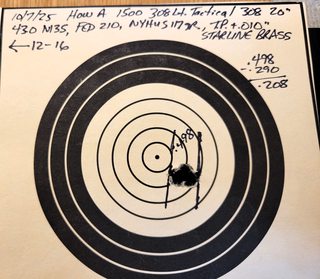
Anyway, I have worked with a couple of vintage full length HBR-type 308's using the 118-125-ish bullets on the 1.00" jackets. Both would shoot .250" five shot groups in good conditions with 748 Winchester and N135 powder. I've used this recipe in well tuned factory guns and it's shoots very well. Hopefully some of the others will chime in with some of their recommendations.
If your free bore length will allow it and you're interested in trying some of the shorter/lighter bullets, let me know and I'll send you some to try.
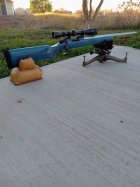
Yep...that's a Kelbly's stock. Good looking rig!

Per Al's hint (red above), presuming that you can reach the lands and maintain a grip on the bullet - say, bullet base
>0.125" into the case-neck - despite the 1:11" twist, it is likely that the contemporary (short/light) bullets will shoot tighter than the longer heavier offerings. I began shooting NBRSA registered Hunter tournaments in 1977, at Missoula, MT: everyone but yours truly was shooting full-length .308 (as I recall, that day, I made the 18,Th or, 19Th body).
The lions share of rifles were custom builds, with a few
Bob Pease "SPECIALS" (modified Rem.700 Varmint), which featured slabbed (laminated) fore-end and pillar bedding. Of the custom rifles, all but one rig featured pillar bedded WOOD stocks. Before long, I had a
BPS, which was used until about 1983. Gene Streits (Sp?) had a 'spanking new' Fred Sinclair built rig nestled in a fiberglass stock (probably a Lee Six/Brown). On that day, Mr. Streits, '
kicked ass'!
Virtually all of the custom rifles featured 1:14", or, 1:15" twist barrels, while the
BPS retained the Remington 700 Varmint Special's 1:12" twist. THE bullet of choice was the Sierra 168 Gr. International
Boat-tail Hollow-point. The Sierra 168 remained the primary bullet until 1986, when Clark Green (Sp?) won the NBRSA Hunter Nationals (Austin, TX) using Guy Chism's 150 Gr. FB: within two years, the Sierra offering disappeared from equipment lists, replaced by bullets from Guy, Bob Cauterucio, and Ralph Council.
Also, by then, the full-length .308 was falling, rapidly, from favor, as people were experimenting with shorter,
more efficient capacity .30 caliber cases. I believe Mr. Green used a shortened .308 (1.75, or, 1.8" long), and probably Win. 748. The .308 retained a cult, but, after 1986, it was largely 'on life support'. Especially with the light bullets, the shorter cases produce very near the velocity of the full-length .308.
The most popular .308 Win. powders were Win. 748, Win. 760, H-4895, H-380, and later, when the
VV became available, N-135 & N-140 were the 'go to' offerings. Today, there are several more suitable powders which may produce the requisite precision.
Even via the relatively 'fast twist' barrel, presuming equal jacket quality (center-of-gravity offset), so long as the jackets hold together (via .308 they will) the lighter bullets are very likely to shoot tighter groups, as there is markedly less offset mass, at not significantly increased RPM due to velocity.
During the late 1980's, or, early 90's, John Bunch, of Texas, conducted a series of experiments related to thirty caliber bullet weight to case capacity: his results were published in
PRECISION SHOOTING.
His results provided strong evidence that as case capacity decreased, lighter bullets out performed heavier weights, and vice-versa. Following Mr. Bunch's lead, my own experimenting correlated nicely with his findings: he was, "
ahead of his times". There are a LOT of, "somethings to keep in mind".

The fun will be in the FINDING OUT! Your rifle may well shoot GREAT - it's cool 'ol rig!!
Keep 'em
ON the
X! RG



 -Al
-Al
 RAF is much easier to follow.