Follow along with the video below to see how to install our site as a web app on your home screen.
Note: This feature may not be available in some browsers.
This Forum is for adults 18 years of age or over. By continuing to use this Forum you are confirming that you are 18 or older. No content shall be viewed by any person under 18 in California.
I recently purchased a Redding concentricity gauge and started checking some of my handloads. For my 280 rem loads, I am finding a wide variation in run out. Anywhere from 0.002 TIR to 0.010 +. Running them back through my seating die did not seem to make any difference on those with large TIR. Since I have about 200 loaded, I really don't want to waste them. Is there any way to correct the bullet alignment on these rounds or is it a lost cause and I just need to start over with new dies and empty cases?
Have you checked the brass case for banana shape or runout due to your die? If the case necks are straight my suggestion would be a good seater die, redding comp or Forster ultra seater or Wilson inline if you arent't already using one. If you are there should not be that much delta in your loaded round runout.
I did a lot of research on this with the M14 in the early 1990s and did stastically significant testing at 600 yards with Master class scores and there was no correlation between runout and scores. I have posted this several times with more detail and some of it was published in Precision Shooting magazine. Give me the choice between straight ammo and crooked ammo and I will take the straight ammo but it really does not mater on the target for most applications. You can shoot out a barrel testing for yourself but my recommendation is to shoot the ammo and sell the gauge.
If you're a 1 hole 5 shot group guy making every round perfect OK most humans behind the trigger perfect bullets wouldn't matter , just another excuse for lousing up a group , that bullet wasn't concentric. I went down that rabbit , now I like shooting again.
You can straighten the necks if you have a drill index and a piece of hardwood. Something really hard like oak works best. Just drill a hole that allows the neck to fit snugly inside and bend your ammo straight. The Neco tool is the same concept that looks nicer and costs more.
I agree with the others for the most part. Finding the source of your problem and correcting it before it happens is the best solution.
Some follow up. I have also tested 50 loaded rounds in .308. These are R-P cases with Sierra 168 Gr. HPBT seated with a Hornaday seating die. Of the 50, 9 exceeded a TIR of 0.006 with some as high as 0.011. 8 were 0.0025 to0.004, the remainder were under 0.0025. Of the 9 that exceeded .006, all of the necks except 1 measured a TIR of 0.002 or under. That suggests that the bullets are not concentric or symetrical, but that the cases are ok. Am I reading this correctly, has anyone else seen this?
I recently purchased a Redding concentricity gauge and started checking some of my handloads. For my 280 rem loads, I am finding a wide variation in run out. Anywhere from 0.002 TIR to 0.010 +. Running them back through my seating die did not seem to make any difference on those with large TIR. Since I have about 200 loaded, I really don't want to waste them. Is there any way to correct the bullet alignment on these rounds or is it a lost cause and I just need to start over with new dies and empty cases?
small caliber neck thickness and uniformity, or in any instance where my tubing mic anvils are too large (or too wide) for the short necks. also lets me measure up and down the neck.
I assume you mean 'A non-bushing FL die will have less runout than a bushing FL die' (body-bushing die).
You might run into that with non-custom diess, and depending on the chamber & cartridge.
But bushing neck sizing only, generally produces lower TIR than FL sizing(bushing or not).
And while this may not be in your sizing plan, it does show there is no problem with bushing sizing itself.
What's your opinion. If you send a few fired cases to a die maker and have a FL die made with the proper neck diam. in the die. Can you make the cases any staighter than that. I'm talking about sizing with an arbor press like the short range BR shooters do. Seems like a full size press with dies held in place by wobbly threads, bushings and mandrels is just setting up problems due to the stack up of tolerances between parts.
Do short range competitors have dies made from fired cases or can you make a good die from just running the reaming that you chabered with into a barrel stub?
What's your opinion on making straight ammo? Which will make the straighter cartridges? Sending a fe fired cases to a die maker or having a FL die made to use with small arbor press. I have been to the Super Shoot many times as a spectator. Looks like all of the short range competitors use a FL die with a small arbor press. Are these dies made from fired case dimensions? I believe my die was made with the same reamer as the rifle was chambered with? Used to have one for my 6PPC many years ago. You can have the die made for the neck clearance you want.
It would seem like a custom die with an arbor press would give the straighter cartridges. The only tolerances are reaming the die. A full size press has many components each having it's own tolerances
You could take any brand non-bushing full length die with the expander removed and the resized case will be as concentric as it ever will be. Meaning the resized case will have very little to no case neck runout.
It is the uniformity of the case neck and the method used to expand the case neck that affects neck runout.
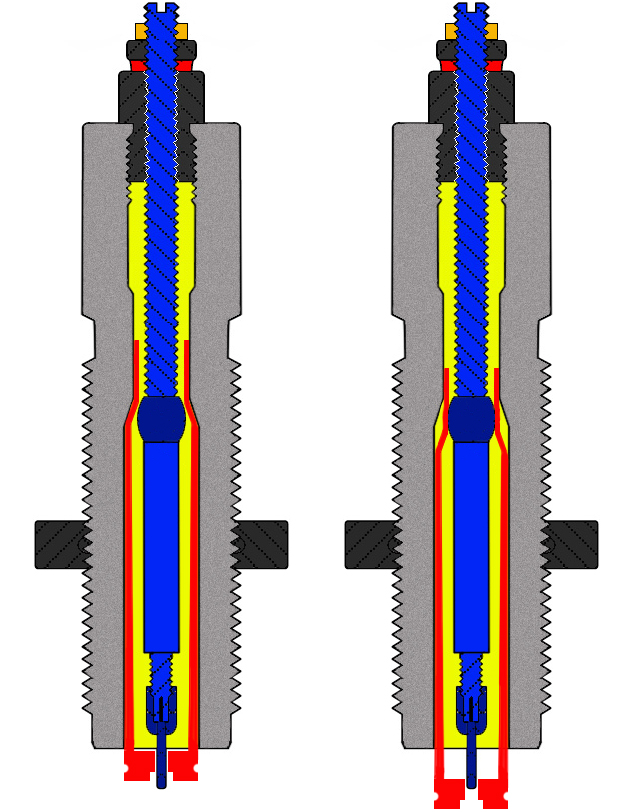
The bushing die is a different animal, the bushing can move from side to side and even tilt when sizing the neck. Meaning the bushing doesn't always hold the case body and case neck in alignment during sizing.
With a standard resizing die the expander can be locked down off center and induce neck runout. This is where the Forster full length dies have the advantage. The design of the Forster die prevents the neck from being pulled off center.
I use the Lee die lock rings that allow the die to float and self center in the press. I also use the Redding competition shell holders with the die making hard contact with the shell holders. This eliminates any slop in the press and ensures uniform sizing of the case.
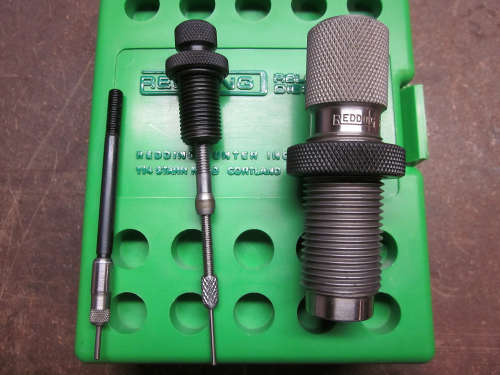
I replaced my Redding expanders with the Forster expander and spindle assemblies. This greatly reduces case neck runout, why drag the low mounted Redding expander through the case neck.
Below the Forster expander has less surface area and less drag than the Forster expander. And the self-centering Forster expander can not pull the neck off-center and induce neck runout.
I replaced my Redding expanders with the Forster expander and spindle assemblies. This greatly reduces case neck runout, why drag the low mounted Redding expander through the case neck.
Below the Forster expander has less surface area and less drag than the Forster expander. And the self-centering Forster expander can not pull the neck off-center and induce neck runout.
I assume you mean 'A non-bushing FL die will have less runout than a bushing FL die' (body-bushing die).
You might run into that with non-custom diess, and depending on the chamber & cartridge.
But bushing neck sizing only, generally produces lower TIR than FL sizing(bushing or not).
And while this may not be in your sizing plan, it does show there is no problem with bushing sizing itself.
My Redding FL die (unmodified) produces less than .0005" T.I.R. runout.
My Forster FL die honed to .245 dia. neck produces .001" T.I.R. runout.
My Redding Type S FL bushing die produces .002" T.I.R. runout.
Some follow up. I have also tested 50 loaded rounds in .308. These are R-P cases with Sierra 168 Gr. HPBT seated with a Hornaday seating die. Of the 50, 9 exceeded a TIR of 0.006 with some as high as 0.011. 8 were 0.0025 to0.004, the remainder were under 0.0025. Of the 9 that exceeded .006, all of the necks except 1 measured a TIR of 0.002 or under. That suggests that the bullets are not concentric or symetrical, but that the cases are ok. Am I reading this correctly, has anyone else seen this?
Only in factory ammo. The first thing I would do, would be, ditch the hornady die and go with Forster micro seaters or Sinclair/Wilson Micro meter chamber dies. 2) Be sure to anneal your cases. 3) FLS, (Forster) minus the expander ball. Set it to bump the shoulder back .0020 4) Expand with an expander mandrel.( Go with lighter neck tension by .0005, and .0010, than you have been using.) You should see your concentricity improve considerably. JM2CW
There are folks seeing high runout sizing, and just opposite, regardless of die type.
And this tells me there are no problems with die types, nor brands.
It's just local abstracts otherwise. Different chamber clearances, different cartridges, and loads, and brass lots, and presses, and die tolerances, etc.
IMO, with each issue worked out, any sizing method can produce very low runout.
I'm a bushing sizing person, non-FL-sizer. Never had a problem with either plan.
I know that isn't right for everyone, but I also know their problems are not use of bushings in method.
What bullets are you shooting, is it a VLD type with a long tapered ogive? If so are you using a standard seating stem, this would allow the meplat to bottom out in the seating stem rather than pushing the bullet by contacting the ogive.
This Forum's expenses are primarily paid by member contributions. You can upgrade your Forum membership in seconds. Gold and Silver members get unlimited FREE classifieds for one year. Gold members can upload custom avatars.
This site uses cookies to help personalise content, tailor your experience and to keep you logged in if you register.
By continuing to use this site, you are consenting to our use of cookies.