


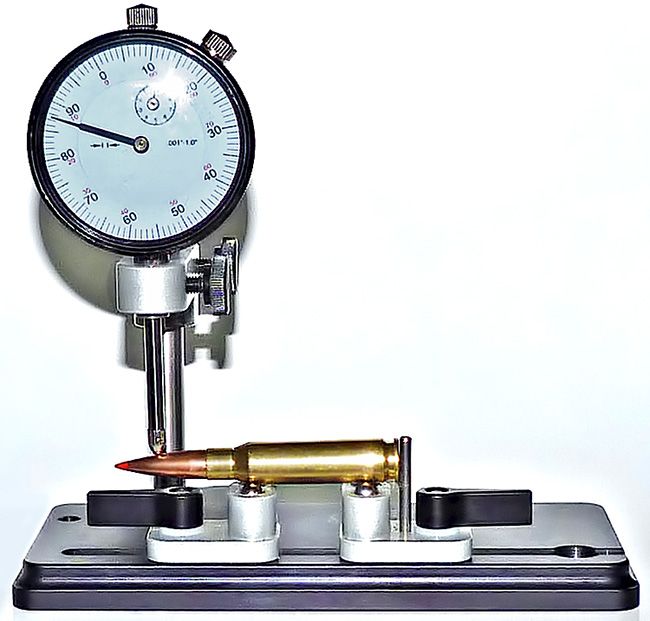
I think if you expect any kind of accuracy, you need to pay attention to all the small details. It may not help but it can't hurt. I measure runout using a Sinclair gauge. In the picture is a 208 grain Hornady A-Max (a .308 round). I measure 1/2 way out to the tip. My better rounds have .001" total runout or less. I also keep anything .002" but over that gets pulled or used for fouling shots.I know this topic has been beaten to death but i haven't seen this question answered.
I have several different types of concetricity gauges. Basicly they either index off the bullet tip like my forster case inspector or the hornady. Ot they index off the case like my 21st century. They both give very different readings off of the same loaded rounds. Seems strange to me.
Can someone explain it? Which is the more correct?
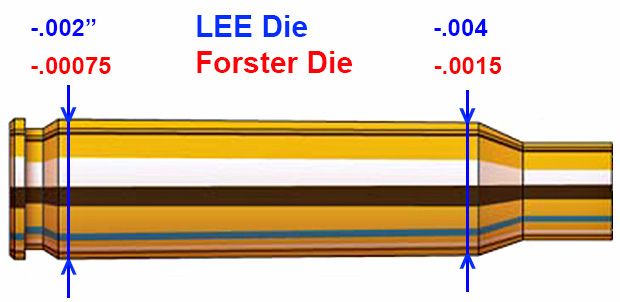
As far as sizing the cases, my rifle is cheap and has a lot of neck clearance. I set the shoulders back no more than .001" and figure they center there in the front. I had a Forster full length benchrest die modified and this is how close the resized cases are to a fired one (and compared to a Lee die). The only micrometer I have has flat surfaces so I center it over the edges on the case the best I can. I know it reads off the largest diameter. I do use a sizing ball which leaves a .002" interference fit. The ball floats and does not add any runout.
I use a Redding Competition seating die with a micrometer dial. I seat the depth based on measuring the headspace in the chamber and using a Hornady bullet comparator on a dial caliper, not from the tip, and try to keep them to within .001". It would be better if the tool insert matched the actual chamber contour.


