Follow along with the video below to see how to install our site as a web app on your home screen.
Note: This feature may not be available in some browsers.
This Forum is for adults 18 years of age or over. By continuing to use this Forum you are confirming that you are 18 or older. No content shall be viewed by any person under 18 in California.
My recent thread on digital calipers got me to thinking about verifying their accuracy. I have a set of weights that I use periodically to check the calibration of my powder scales, and am wondering what you guys use (if anything) to check accuracy/calibration of calipers and micrometers. Do you think that this is necessary as a once-in-a-while task, and, if so, what is a low-cost product for this?
Some micrometers come with a standard which can be used to check the 1" (or 2") mark. These should be used regularly. And you can set the zero point and align the vernier lines, but there is no way to absolutely check the accuracy at other points. Inaccuracies in between o and full range are related to thread wear on the mic. Gage pins can be used to check intermediate points but you should have something that is 10X more accurate than the mic to check against.
So, in general, check zero each time you use the device, and check full range occasionally.
If you are measuring to .0001, then you are more likely to introduce errors due to holding the mic too long and heating it up, or holding the object too long, or measuring when it and the mic are at different temperatures.
Errors of the device are unlikely in mid range, except on dial calipers which occasionally will jump a tooth, or have a piece of dirt on the rack.
Thanks to all for your responses. I've run across references to "1-2-3 Gauge Blocks." Would one of these be sufficient for checking calipers? I guess I'd need something smaller in dimension for micrometers.
And for calipers, keep them closed and use the thinnest feeler gauge on both the inside arms and the outside arms. One may be perfect and the other way off. It happened to me with a General cheapie pair of calipers.
If all your doing is reloading and measuring to .001 a standard is fine .
If measuring to .0005 then a set of gauge blocks a chamois, cotton gloves and clean paper are in order and learn to wring gauge blocks.
If to .0001, add a temp controlled room
For 1" mic. I clean the faces (Closed gently between clean paper)slide paper out...
Now close mic. should read "0000"
Measure with 1in standard should read 1.0000 if it does your good to go. John
Half thousandth digital calipers are ballpark measuring instruments. I close them and set them to zero and every measurement I use them for is only for a reference. As others have posted, if you want precision use good quality micrometers and a standard to check them.
Gage rooms are a controlled environment. Checking measuring instruments in your garage at 45° or in your reloading room at 70° is an exercise in well, nothing. Taking it one step further, gage blocks and other types of gauges are supposed to be calibrated/checked at a set interval, usually a few years.
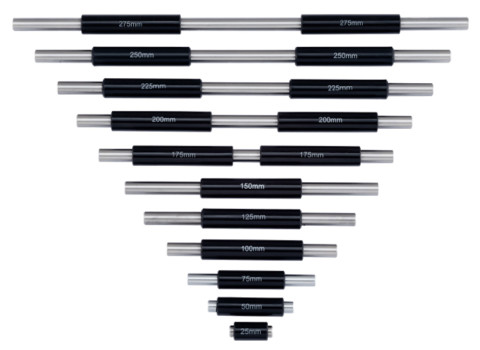
Standards to check your mics and anything else you need to check.
If you buy a micrometer it will come with one exept the 1" inch
You can find a good set of 0-3" mics for a decent price.
Something like spi or sharrs will work great and they will come with a 1" and 2" standards.
My recent thread on digital calipers got me to thinking about verifying their accuracy. I have a set of weights that I use periodically to check the calibration of my powder scales, and am wondering what you guys use (if anything) to check accuracy/calibration of calipers and micrometers. Do you think that this is necessary as a once-in-a-while task, and, if so, what is a low-cost product for this?
You will very quickly learn memorize the exact lengths of your caliper inserts to 4 digits because every time you use the calipers, that is the first number you should see after installing the caliper insert, but prior to re-zeroing. If you have to, write these numbers down, but either way, they provide an internal calibration every time you use the caliper inserts.
This Forum's expenses are primarily paid by member contributions. You can upgrade your Forum membership in seconds. Gold and Silver members get unlimited FREE classifieds for one year. Gold members can upload custom avatars.