• This Forum is for adults 18 years of age or over. By continuing to use this Forum you are confirming that you are 18 or older. No content shall be viewed by any person under 18 in California.

casting bullets

Comment #1 - is total BS. Lead is used in x-ray vaults to block x-rays, x-rays can't penetrate lead. Must be confused with a mass spectrometer, that's what you need to determine metal chemistry.

Comment #2 - I agree with this in general, a hardness tester lets you know if you have enough antimony.

Comment #3 - Yes, you have to run them through a sizer but not all bullets require gas checks, most pistol bullets are good examples. Velocity and hardness will dictate the need for gas checks.

X-rays do pentrate lead. It depends on how thick it is and the KV energy of the x-rays. How thick is a vault?
 
After casting bullets for 35 years I would give you this one piece of advice... sell the lead and buy some bullets.

I cast bullets when I had to do because I couldn't afford factory ammo. I got pretty good with it.

These days, the equipment required and the cost of materials make it quite expensive to get started and not as cool as it once was.

I was able to get wheel weights just for hauling them off from the tire shops. Zero $$. Molds and lead pots lasted forever.

The final straw was when my job required me to move across the country and I had over 2500# of metals that the movers refused to load. It took me years to accumulate all of that and I had to sell it all off. A guy in Phoenix got a GREAT deal on a huge casting/foundry setup.

It's just a different environment now. I wouldn't advise anybody to start casting these days.
After a couple years of having fun casting bullets and shooting I quit casting because I couldn't use cast bullets for GH hunting at any distance.
 
After casting bullets for 35 years I would give you this one piece of advice... sell the lead and buy some bullets....
LOL
I also started casting just to save money. Wheel weights back then (late 70's) were a good alloy and free. Just melt and cast. Electric pot, ladle and mold. Pie tin and 'cookie cutter' for lube.

The cost of lead and alloy material has become fairly expensive these days. At the same time the cost of commercial coated and plated bullets have stayed fairly low.

Which route you take depends a lot on you. Do you shoot so much you need to save money in the long run? Are you ready for the large increase in time to produce the bullets on top of the reloading time?

If you want another hobby, then casting can be a great addition to a shooting hobby. It can also be another expensive rabbit hole :)
--------

Advice. Do as some mentioned and get the Lyman Cast Bullet Handbook. The go to the Cast Boolits forum and gather data. Ask some questions. Look at what others are doing.

Which area are you interested in? Pistol, black powder (muzzle loader or cartridge), rifle? Is this for plinking, hunting or competition. FWIW, there is a cast bullet shooting competition group.

https://castbulletassoc.org/benchrest-rules

Whatever you decide, have fun.
 
I started casting using just the pure lead i was given and a Lee mold for 158 grain bullets and the Lee electric furnace. The bullets I made were wrinkled pretty bad, I loaded and shot some of the better ones. The guys at Cast Bollits told me I needed to add tin to make the mold fill out better. I was explaining this to a friend and he told me that pewter was mostly tin and he has some pewter scrap I could have. I cast 20-1 scrounged lead/pewter and my bullets look much better. If you have followed my posts you may have seen that I have had a batch of primers fail. So I have disassembled a little over 1000 loaded cartridges, that had my cast bullets in them. When they are crimped well they are hard to remove without damaging the bullets. So I will be recasting them at sometime in the future. All of my lead from the first days was a mix of everything I had. Now I separate the clip-on wheel weights from the stick-on wheel weights. The stick-on are dead soft and the clip-on are much harder. I have a set of stamps and label the clip-on weights so at some point my alloy can be a choice instead of a chance. I hate to waste anything and casting is one of my weirdness's.
 
I get all of my lead at the range. I mine the backstops. I usually get about 100lbs every time I do it. I throw all the dirt back up on the berms so they can not say I am damaging them. I use screen classifiers. The dirt mostly falls right through them.

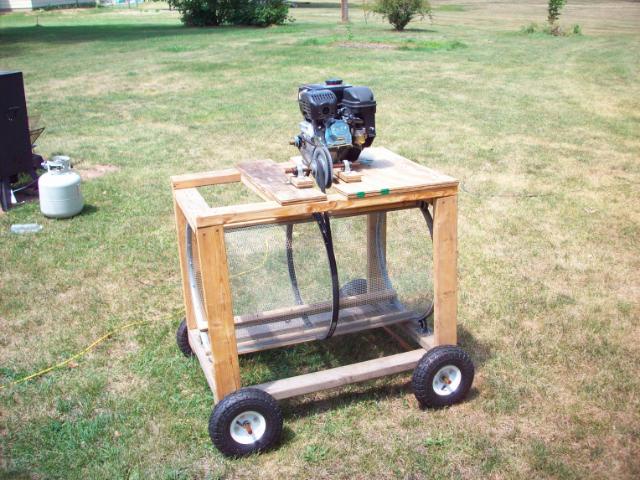
Back at the old public range I used to get the lead at I built a small trommel. I use to get around 1000lbs every time I went. I was told I can not use this at the new range. But the handheld screens are fine. They said they were afraid of the berm getting damaged from digging too much. Thing is you are just scraping the top.

FY3qonE.jpg
 
There are times and conditions where casting yer own bullets and slicks are either advantageous or a necessary requirement.

I cast "pure" lead balls for flintlock muskets and fowlers (.690" and .600" balls), and alloy tin:lead slicks and bullets for black powder paper patched cartridges and lubed bullets for smokeless cartridges used for a variety of .45 caliber falling block, rolling block and lever action rifles.

Paper patched slicks (bullets without lube grooves) will almost always require custom casting molds, no matter whether bore riders or groove runners - can't buy these kind of custom sized projectiles for the very most part. Is what it is.

Over the years/decades I've accumulated more free "pure" lead than I'll ever need, and I buy tin nuggets for creating tin:lead alloy, usually from RotoMetals.

Other than the above conditions, I wouldn't need to cast lead or tin:lead projectiles.

I have a casting station set up in my basement shop. There's a large exhaust fan directly over whatever furnace I'm using at the moment that sucks all casting fumes outdoors. I have 20lb Lee dipper furnaces for "pure" lead, 1:20 tin:lead alloy, and 1:16 tin:lead alloy. I do not want or need bottom pour furnaces as ladle dipping allows for compression casting, which I prefer, that yields better projectiles than a bottom pour furnace or ladle pouring over and into a mold - at least for me.

Safety equipment is heavy leather gloves, heavy 100% cotton sweatshirt, heavy 100% cotton apron that's floor length (made from an old pair of jeans), and eye glasses or eye pro (for newbies to casting it might be a good idea to wear a full face shield). Water - or any liquids for that matter - near a casting station is a recipe for disaster.

Molds are preheated on a hot plate, ladle is laid on top of the furnace to heat up.

A thermometer keeps check of the lead or lead alloy temperature. I like running a hot furnace at around 800F. Any lead or lead alloy will require fluxing when fully melted, I use a pea of candle wax or a pinch of saw dust, stirred with a table spoon (take care, flux of any type will almost always flame, just blow it out with breath if need be), then all the dross will float to the surface and can be removed with the spoon. The results when ready for casting is a "lake" of pure shiny silver that's close to 800F. After many casting sessions, I get a feel for temperature and rarely use the thermometer. Preheating the mold is important.

The handles of a mold is kept closed with a #64 rubber band - this relieves pressure on the hand holding the mold when yer casting 100 or more projectiles. I use single cavity molds for the bigger slicks and 3 to 6 gang cavity molds for lube groove bullets.

I use a small hard rubber mallet to pop sprue plates and allow the casting to drop onto a multi folded 100% cotton towel.

All new molds are sprayed with brake cleaner to remove any oils. No mold lubrication used or needed.

If casting with one mold, allow 10 to 20 seconds for a cool down after loading and before unloading. Why? Read on ...

I usually cast with two molds at a time. Load mold #1 and put it down, load mold #2 and put it down, pick up and unload mold #1, load mold #1 and put it down, unload mold #2, load mold #2, and so on --- what's happening here is that yer allowing each loaded mold to cool down just enuf so that popping the sprue plate won't smear lead.

I leave a casting session with a loaded mold, allowed to cool. Doesn't matter if the mold is made of iron, brass or aluminum - I don't want air inside the mold cavity.

Now, all of the above is how/what I do for casting projectiles and there are more than a few good ways to skin the casting cat, mine is but one that has worked well enuf for me, for decades. YMMV.
 
Lots of really good information. Thank you all for your input.

Definitely a lot to learn, and equipment/materials needed.
Seriously, the hardest part about casting bullets is finding a readily available source of lead at a reasonable price.

Otherwise, as I have proven, it can be done with a hot plate, big spoon, Stainless steel saucepan, a dipper and a mold. I have produced many great bullets using just those items.
 
I cast bullets some. There is some good information in this thread, and there is some not so good "information".

Those saying not to cast bullets may or may not be right for their individual needs, but its akin to telling someone not to reload, and for the same reasons.
Bullet casting does NOT need to be an expensive proposition, but just like reloading, you can go down a pretty big rabbit hole if it suits you.

Price out what bullets for a 405 Winchester cost, even cast bullets are pretty expensive. I cast for my 405, nothing fancy, just a 300gr RN bullet. I tumble lube them as cast, no sizing required for that mold. I use lead mined from a public shooting range, its pretty soft. I am not running them fast, around 1500 fps with no leading in the barrel. Even killed a cow elk with one.

Casting is just another facet of the shooting sports, enjoy it or not, but for big or oddball projectiles, it will save money.
 
Those saying not to cast bullets may or may not be right for their individual needs, but its akin to telling someone not to reload, and for the same reasons.
Bullet casting does NOT need to be an expensive proposition, but just like reloading, you can go down a pretty big rabbit hole if it suits you.
There are plenty of cases where people would be better off not reloading or casting their own bullets.

That's why I mentioned it as a great second (or third) hobby for some. It is fun all by itself to me. Just may not be for others.
 
I use lead art pencils to get an idea what the bhn of my lead is. I want to spend my money elsewhere for now. I'm learning than bhn is everything. First, the fit of the bullet to your bore and your load is an important factor. Will it be powder coated and will there be a gas check. Also, depending on the alloy, you might at first have two alloys with the same bhn but after sitting awhile, one will remain stable and the other becomes harder. I experienced this comparing pellet lead alloy and .22lr alloy. The .22lr was a tad harder but became significantly harder after sitting a year. In short, there are a lot of variables.

When I collect my lead range scrap, I separate everything. I save the hard cast bullets to cast hardcase RNFP bullets. I cast the .22lr bullets together to have a more uniform alloy. Same with pellets, FMJ and jacketed bullets. Each has a different hardness and used differently. Pellet lead is the softest and expands will with my HP bullets. That's all I use it for. I'm experimenting with 50/50 WW/.22lr for rifle bullets now.

When I first started casting, I used a Lee bottom pour lead pot. It was fast and great. But, my bullet weights varied. First, I stopped pouring the stream down the hole but onto the sprue plate at an angle to avoid bubbles in the lead. Then, I found out that the mold holes could vary. The weights varied depending on which bullet came from which cavity. Maybe it was the heated mold. So, one day my pot broke. I fell back on using my backup, a Lyman open pot. I used a ladle. I was almost as fast but discovered that the weight variation using my 2 cavity was non-existent. I think it's because the column pressure varies from lead left in the bottom pour pot vs. a ladle lead pressure is always from the same quantity in the ladle and poured. For precise casting, I could use a camp stove and ladle probably. BTW, I use a propane torch to speed up the melting of my lead ingots and heating my molds. Aluminum warms faster. Brass casts beautiful bullets. I've never cast with iron molds. When I initially melt my range lead, I cast ingots and stamp them by it's source such as "p" for pellet, "H" for hard cast, "J" for jacketed, etc.. I use to write the bhn on them with a felt pen.

Be sure you slug your gun's bore before sizing and loading. The standard diameter should be .001" above the bore size.
 

Upgrades & Donations

This Forum's expenses are primarily paid by member contributions. You can upgrade your Forum membership in seconds. Gold and Silver members get unlimited FREE classifieds for one year. Gold members can upload custom avatars.


Click Upgrade Membership Button ABOVE to get Gold or Silver Status.

You can also donate any amount, large or small, with the button below. Include your Forum Name in the PayPal Notes field.


To DONATE by CHECK, or make a recurring donation, CLICK HERE to learn how.

Forum statistics

Threads
170,076
Messages
2,287,056
Members
82,514
Latest member
rileyr.257
Back
Top