• This Forum is for adults 18 years of age or over. By continuing to use this Forum you are confirming that you are 18 or older. No content shall be viewed by any person under 18 in California.

Case Volume

Ya I'm sure. I can't seem to get GRT to download it yet. Not sure why. So I was just starting to learn down this tail-chasing OCD habit.

Try downloading GRT to a USB and run it from there, that's what I do. You'll need a PC not a Mac (unless you want to go extra steps with the Mac).
 
To answer the water density comment made:

H2O Density.JPG
How accurately are you trying to measure water volume of your cases?
Maybe something as accurately as you would charge with powder?
30 grains +/- one tenth is about +/- 0.33 percent. Is that good enough?
Maybe even better at 0.1% ?
Most people assume density of water is 1.0000 grams per CC (Maximum density is at 39.2F), but at 80F it's 0.33% less than that.
Seriously, the difference from 40F to 90F is close to 1/2 percent.

Percentages matter when weighing components.
+/- one tenth grain of a 175 grain empty case is 0.06%,
+/- one tenth grain of a 175 grain projectile is 0.06%,
+/- one tenth grain of a 50 grain powder charge is 0.2%,
+/- 3fps @ 3000fps is 0.1%.

What is the volume difference of a sized vs twice fired case?
How much energy is wasted expanding a sized case when fired that does not contribute to bullet acceleration or muzzle velocity?
 
Last edited:
I got GRT running. Pretty neat. Gordon did a lot of work building that. WOW

Good stuff Rocketvapor. I'll have to reflect on that. I do remember High School physics the 'Liberal' teacher telling us the thermometer tube of H2O would be several stories high. But maybe that's my old memory.
 
If you're using tap water at room temperature to determine case volume, the change you will observe in water density/volume throughout the year is a perhaps couple digits or so in the third decimal place. It's not worth worrying about. Unless, of course, you live in a cabin without heating or air conditioning in Nome, Alaska or Death Valley, CA. The good news is that you will likely have more pressing concerns than the density of water if that is the case.
 
I think many folks forget about percentages when making measurements.
If a charge happens to be about 1000 kernels of powder, measuring to one kernal is 0.1%.
with a 24 grain charge in a 5.56, that's 0.024 grains. Pretty darn good, if repeatable.
Measuring case volume with water and water temperature error is 7 deg F (68 out of the tap and 75 by the time you fill a room temperature case) is also about 0.1%.
With a value like 0.998, a single digit in the third decimal place, is 0.1%.
With care, meniscus errors when filling a case with water are probably about 0.1%.
If you do this with consistency then your measurements are good for you.
Good enough to publish and guide someone else with your results for their cases?

Relative measurements, like measuring sized case volume and fired case volume under the same conditions can eliminate/reduce some errors. Both might be wrong, but wrong by the same amount :)
 
Last edited:
Years ago during a NE Ohio winter and my range was a frozen tundra I got into the whole case volume thing.

Case%20Volume.png


Here is step by step what was done. The cases were selected at random from lots I had. Each case was sized and trimmed to get things as identical as I could get them. The cases were also all cleaned. The water was distilled water at 67.0 Degrees F. Water temperature was accurately measured using liquid in glass mercury thermometer. Cases were filled using a syringe, the type used for glass bedding. The primer pockets were filled using modeling clay represented by the 1.8 grain tare weights. The numbers were based on 1.0 gram per cubic centimeter of water. I could have done that last better.

My goal was to load the cases weighing each charge using CCI BR2 Large Rifle primers and Sierra 168 grain Math King bullets. Unfortunately my wife was diagnosed with cancer so my following summer there was no range for me. She is doing fine today and somewhere in my piles of stuff I still have the cases all numbered waiting to be loaded. I planned to chronograph the cases and note the velocities with my trusty old Oehler 35P chronograph.

Now if anyone with Quick Load wants to run the above using AA2495 with 38.8 grains which is a pet load I like in my Remington 700 please have at it. Interesting was the WCC 10 brass gave the best standard deviation. I had some new Lapua brass but never included it which was a screw up on my part.

I guess the question becomes just how much difference there would be in pressure / performance based on the case volumes posted? Simply put how much would it matter?

Ron
 
That was a lot of work Ron :)
Will be interesting to see how it goes when shot.
You could easily correct your water volume to 67F as water density was less than assumed ( 0.9983 ) :)
It would be a fixed correction factor.
I assume your case measuring resolution is 0.1 grain. For a 170 grain empty case that is about 0.059%.
Your water volume, full case measured to 0.1 grain minus empty case to a tenth gives you net weight, at best, within 0.1 grain of water. One tenth of a grain @ 55 grains of water is 0.18%.
The range of the case weights 1 to 5 were:
1. 1.3%, 2. 2.28%, 3. 0.96%, 4. 3.2%, 5. 0.57%
The range of water weights 1 to 5 were:
1. 1.83%, 2. 1.27%, 3. 1.11%, 4. 3.34%, 5. 1.10%
I bet performance variance will show up with the LC13 brass.
Your powder charge of 38.8 grains to the nearest tenth is 0.258%
Powder to 0.05 grains would be in line with water accuracy.
These percentages could be +/- depending on the scale used.

The accuracy of the Oehler 35P chronograph is 0.25% (about 7fps).
Probably more consistent on a single day.


Glad your wife is better. That had to be tough for both of you.
 
Last edited:
Years ago during a NE Ohio winter and my range was a frozen tundra I got into the whole case volume thing.

Case%20Volume.png


Here is step by step what was done. The cases were selected at random from lots I had. Each case was sized and trimmed to get things as identical as I could get them. The cases were also all cleaned. The water was distilled water at 67.0 Degrees F. Water temperature was accurately measured using liquid in glass mercury thermometer. Cases were filled using a syringe, the type used for glass bedding. The primer pockets were filled using modeling clay represented by the 1.8 grain tare weights. The numbers were based on 1.0 gram per cubic centimeter of water. I could have done that last better.

My goal was to load the cases weighing each charge using CCI BR2 Large Rifle primers and Sierra 168 grain Math King bullets. Unfortunately my wife was diagnosed with cancer so my following summer there was no range for me. She is doing fine today and somewhere in my piles of stuff I still have the cases all numbered waiting to be loaded. I planned to chronograph the cases and note the velocities with my trusty old Oehler 35P chronograph.

Now if anyone with Quick Load wants to run the above using AA2495 with 38.8 grains which is a pet load I like in my Remington 700 please have at it. Interesting was the WCC 10 brass gave the best standard deviation. I had some new Lapua brass but never included it which was a screw up on my part.

I guess the question becomes just how much difference there would be in pressure / performance based on the case volumes posted? Simply put how much would it matter?

Ron
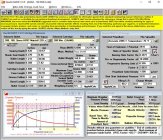
OK, I've run some numbers in QuickLoad for you. But first, I should point out that QL uses fired brass volumes for its calculations. And it appears to me that you've measured those brass volumes on sized cases (e.g. my fired Federal brass is typically averages ~1.0 gr more than your numbers, though my sized Federal brass is pretty much the same as what you show). Below shows QL's calculations for your Federal's average and one that's 1.0 grs more for comparison. That should help give you some idea of what the difference might be for that powder and load you like:

Federal.jpg

Plus 1 gr.jpg
 
2522fps - 2504fps = 18 fps estimated difference. 18/2504 = 0.7% estimated difference.

My guess is it will show up, but just barely and even then it will take very careful work to make sure it isn't swamped by other sources of error.

In for the range report.
 
2522fps - 2504fps = 18 fps estimated difference. 18/2504 = 0.7% estimated difference.

My guess is it will show up, but just barely and even then it will take very careful work to make sure it isn't swamped by other sources of error.

In for the range report.
Interestingly, as the powder charge increases the difference/percentage increases. At 42.68 gr AA2495 QL shows a difference 2738 - 2717 = 21 fps. 21/2717 = .77%. That seems to me to be plenty to show up, particularly at distance???
 
Last edited:
Rocketvapor, many thanks for the input. I should have the Excel file here somewhere so I should be able to add the correction factor for my water. When I did this several years ago that was one consideration I omitted and should not have. :(

Atraightshooter1, many thanks for those QL workups, it was just one of those projects I dropped when more pressing issues came along.

I know somewhere in all my piles of "stuff" I have those cases in order in a case holder. Hopefully before my outdoor range becomes a frozen tundra I can finish what I began several years ago. :)

Thanks Guys
Ron
 
That seems to me to be plenty to show up, particularly at distance???
It will certainly show up with a good quality rig even at short range, but for sure even with most match guns starting at 300 and beyond.

Lets face it, there are lots of talented Palma and F-Class shooters who can certainly show the tiniest differences in brass prep. Most of them do slightly size the body rather than just the necks. The penalty of having difficulty with feed or bolt closure on strings of 15 to 20 rounds will usually outweigh the potential benefit of NS only.

I used to get away with NS only when I was younger, but one or two episodes of nearly getting into trouble in a match will cure you of it. Without a doubt, some energy goes into the small gap between the brass and the chamber, but it is manageable.

On this forum, there is enough talent to root out the finest differences in brass prep from BR to Highpower, to varmint hunting. In for the range report.
 

Upgrades & Donations

This Forum's expenses are primarily paid by member contributions. You can upgrade your Forum membership in seconds. Gold and Silver members get unlimited FREE classifieds for one year. Gold members can upload custom avatars.


Click Upgrade Membership Button ABOVE to get Gold or Silver Status.

You can also donate any amount, large or small, with the button below. Include your Forum Name in the PayPal Notes field.


To DONATE by CHECK, or make a recurring donation, CLICK HERE to learn how.

Forum statistics

Threads
168,097
Messages
2,248,063
Members
81,033
Latest member
Paul641
Back
Top