
• This Forum is for adults 18 years of age or over. By continuing to use this Forum you are confirming that you are 18 or older. No content shall be viewed by any person under 18 in California.

Calibrating (“Truing”) QuickLOAD

Interesting article. My latest sample was a 185 Jug in a 24" 308 about .015 off touching the lands. Adjusting the Varget Ba to 0.66 (very close to Jim's number) made all of my velocities line up without adjusting any more parameters.
 
I’ve documented my methodology to calibrate (“true”) QuickLOAD that gives me predicted velocities that are typically within +/- 5 fps of my measured velocities.

The foundation of this method is, for a given handload (caliber, powder & charge, and bullet), to enter the obvious factors (i.e., actual bullet weight and diameter, cartridge and case length, barrel length, and maximum case capacity) and an improved estimate of the weighing factor. Then adjust the:
  • Powder Burn Factor until the predicted and measured velocities match for large jump handloads, then
  • Shot Start (Initiation) Pressure until the predicted and measured velocities match at different jumps.
I’ve tested this on three rifles (.222 Remington, .22-250 Remington, and .308 Winchester) using two different bullets (52 gr Berger Flat Based Varmint and 168 gr Sierra MatchKing) and two different powders (IMR4198 and two different lots of Varget). Adjustments I needed to make to the Burn Rate Factor and Shot Start (Initiation) Pressure to calibrate (“true”) QuickLOAD were within accepted ranges.

If this interests you, my methodology and results are described in more detail in the attached pdf document.

I’d welcome your thoughts, comments, and suggestions on what bullets and powders to apply this to next.
Your arbitrarily changing two parameters to force the program to give the results you want???
 
Your arbitrarily changing two parameters to force the program to give the results you want???
It's not arbitrary. Both parameters are open to tuning by design in the QL program.....burn rate because powders vary lot-to-lot, and shot start initiation pressure because differences in throats/leade/bullets/jumps will results in different pressures. What I developed is a structured approach to adjust these two parameters that works for me and, based on feedback from others, usually works for them too.
 
Interesting article. My latest sample was a 185 Jug in a 24" 308 about .015 off touching the lands. Adjusting the Varget Ba to 0.66 (very close to Jim's number) made all of my velocities line up without adjusting any more parameters.
Nice to received feedback it works for others. IT's not perfect; one person I was corresponding with just couldn't get things tuned. But most feedback I've received has been positive. Thanks again.
 
I've done the same with H335 and IMR4198. My powder jugs are marked with the Ba number I used to match actual chrono data and temperature. Good enough for my needs.
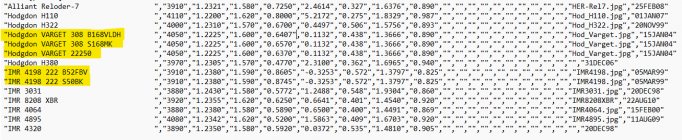
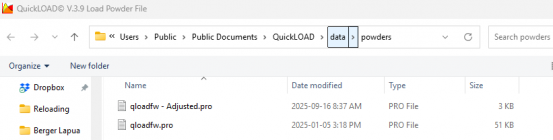
Did you know that QL also allows you to create your own powder files? I copied their file, changed the name of it from "qloadfw" to "qloadfw - Adjusted" and then input my own Ba values. I then name the powders according to the caliber and bullet they were determined for.

A side benefit of this is I could also erase the hundreds of powders I'll never use. I keep the original file "just in case", but it does make my life using QL a little simpler.

1762181425222.png
 
Did you know that QL also allows you to create your own powder files? I copied their file, changed the name of it from "qloadfw" to "qloadfw - Adjusted" and then input my own Ba values. I then name the powders according to the caliber and bullet they were determined for.

A side benefit of this is I could also erase the hundreds of powders I'll never use. I keep the original file "just in case", but it does make my life using QL a little simpler.

View attachment 1708275
I took a look at the qloadfw file but was not able to open it. Could not figure out which format to use to open it. Maybe I will find the answer later but another question.

Let's say I model a cartridge load using the QL qloadfw data (as provided by QL). I compare the actual velocity results to the QL results and adjust the Ba data to match the actual velocity. I now save the file with the manually adjusted Ba value. I am thinking that the saving of the file does not affect the original qlfw file; it only creates a saved input have contains a modified Ba factor. I do not what to do anything that will modify the original qloadfw file. Is my thinking correct?

Thanks in advance,
Pirate69
 
I believe so.

To open, edit, etc. the QL powder file, use Notepad which is an option in Microsoft (if you're on Apple, I've got no idea). I opened the file, then saved a copy in the same location with a different name. Then when I open the powder "folder" in QL I have two files to select from.
1762291370656.png
 
The next test for me will be to run a QL analysis of a new bullet with the tweaked Ba value and see how the numbers line up along with the pressure limit estimates (looking for flattened primers). In the past, I saw flattened primers a few tenths before QL showed that the load was maxed out.
 
Hi Jim, I am a retired PE with a background in reservoir simulation and fracture modeling. That experience lends itself to using Quickload to model internal ballistics. What you've described is essentially where I landed in tuning a cartridge dataset with Quickload.

QL is a good tool but, I do remind myself frequently that "all models are wrong, but some are useful" (A quote attributed to George E. P. Box). I see no problems with your approach. I have definitely seen that burn rate does appear to change with pressure, so I don't attempt to extrapolate results too widely across charge weights.
 
Last edited:
Hi Jim, I am a retired PE with a background in reservoir simulation and fracture modeling. That experience lends itself to using Quickload to model internal ballistics. What you've described is essentially where I landed in tuning a cartridge dataset with Quickload.

QL is a good tool but, I do remind myself frequently that "all models are wrong, but some are useful" (A quote attributed to George E. P. Box). I see no problems with your approach. I have definitely seen that burn rate does appear to change with pressure, so I don't attempt to extrapolate results too widely across charge weights.
I appreciate the feedback.

I'm also a retired PE (P.Eng up here in Canada). My back ground also includes using various models to simulate oil refinery and petrochemical plant operations. In some ways, truing QL reminded me of doing the same for two-phase heat exchanger systems when you're dealing with simultaneous temperature and pressure change and the associated heat/energy flows.
 
I’ve documented my methodology to calibrate (“true”) QuickLOAD that gives me predicted velocities that are typically within +/- 5 fps of my measured velocities.

The foundation of this method is, for a given handload (caliber, powder & charge, and bullet), to enter the obvious factors (i.e., actual bullet weight and diameter, cartridge and case length, barrel length, and maximum case capacity) and an improved estimate of the weighing factor. Then adjust the:
  • Powder Burn Factor until the predicted and measured velocities match for large jump handloads, then
  • Shot Start (Initiation) Pressure until the predicted and measured velocities match at different jumps.
I’ve tested this on three rifles (.222 Remington, .22-250 Remington, and .308 Winchester) using two different bullets (52 gr Berger Flat Based Varmint and 168 gr Sierra MatchKing) and two different powders (IMR4198 and two different lots of Varget). Adjustments I needed to make to the Burn Rate Factor and Shot Start (Initiation) Pressure to calibrate (“true”) QuickLOAD were within accepted ranges.

If this interests you, my methodology and results are described in more detail in the attached pdf document.

I’d welcome your thoughts, comments, and suggestions on what bullets and powders to apply this to next.
Thank you for sharing this!
 
Pressure does change burn rate. I dont have quickload, but use Gordon's reloading tool. It has a graph showing where along the barrel burnout occurs. As you add powder and build pressure, burnout happens earlier. I like that because I strive to achieve burnout just before the bullet exits the muzzle.
 
I also use GRT for finding a charge range to start with. A good tool, and, after reading all this, I suspect is just as good as QL.

I did a bit of work in internal ballistics and explosives decades ago, including help writing the code for an internal ballistics program. My background as a mechanical engineer (PE) was in testing and we frequently had disagreements with the modeling folks. The basic internal ballistic equations are not that complex, just a lot of variables that can muck up the works.

I am surprised no one in here has a pressure measuring setup to help 'tune' QL/GRT. There were a couple guys in the Cast Boolit forum who have extensive pressure data on various cartridges. It is a fairly simple process to set up, especially with the inexpensive oscilloscopes available these days.

As mentioned, anything you can measure should be entered precisely for your gun. Exact bore length and case volume especially but don't forget actual bore diameter measurement. Temperature of powder is also key. FWIW, case water volume is done with the water level even with case neck. As mentioned above a tiny amount of detergent will decrease the water tension enough to get a good measurement.

At one point I did mess with all the variables a bit to see if it could be tweaked better. I had a specific bullet that I was interested in and spend quite a bit of time tweaking the parameters based on measured MV. In the end the simulation was really close to experimental results. BUT, I burned up a LOT more powder than if I just shot ladders and tested seat depth to find the optimum load.
 
I also use GRT for finding a charge range to start with. A good tool, and, after reading all this, I suspect is just as good as QL.

I did a bit of work in internal ballistics and explosives decades ago, including help writing the code for an internal ballistics program. My background as a mechanical engineer (PE) was in testing and we frequently had disagreements with the modeling folks. The basic internal ballistic equations are not that complex, just a lot of variables that can muck up the works.

I am surprised no one in here has a pressure measuring setup to help 'tune' QL/GRT. There were a couple guys in the Cast Boolit forum who have extensive pressure data on various cartridges. It is a fairly simple process to set up, especially with the inexpensive oscilloscopes available these days.

As mentioned, anything you can measure should be entered precisely for your gun. Exact bore length and case volume especially but don't forget actual bore diameter measurement. Temperature of powder is also key. FWIW, case water volume is done with the water level even with case neck. As mentioned above a tiny amount of detergent will decrease the water tension enough to get a good measurement.

At one point I did mess with all the variables a bit to see if it could be tweaked better. I had a specific bullet that I was interested in and spend quite a bit of time tweaking the parameters based on measured MV. In the end the simulation was really close to experimental results. BUT, I burned up a LOT more powder than if I just shot ladders and tested seat depth to find the optimum load.
A few years ago I looked into adding pressure measurement to my list of data points to collect. At the time I couldn't find one that gave the precision I wanted at a cost I could afford. I'll venture over to the Cast Boolit forum to see what I can learn about development in pressure measurement.

I'm a solid believer in collecting lots of data and analyzing it to get an unbiased assessment of progress (or lack of it :rolleyes:). That's likely why I also became a PE (in chemical engineering, although in Canada we use the abbreviation P.Eng.). And in doing so I've now got a ~35MB excel file of data and analysis (along with an inventory of target analysis built using OnTargetTDS). I'll close with this is a great hobby for us retired engineers.
 
I am surprised no one in here has a pressure measuring setup to help 'tune' QL/GRT. There were a couple guys in the Cast Boolit forum who have extensive pressure data on various cartridges. It is a fairly simple process to set up, especially with the inexpensive oscilloscopes available these days.
Uncalibrated pressures are relatively easy to get, but calibrating pressure takes some resources.

Like other parts of these discussions, if the pressure isn't actually calibrated this tends to mean you burn up more shots to work around this by just comparing changes.

ETA: I forgot to mention earlier, but I recently saw a young guy post a YT video where he goes through setting up a GRT simulation of a 556 load and then demonstrated the use of the automatic powder search as well as adjusting the engraving pressure and velocity/powder calibration.

If you are not familiar, GRT was a free program similar to QuickLoad.

It may saturate folks without the background, but if you take things a step at a time you will catch on.

None of this is to persuade folks they need to learn internal ballistics modeling, but for folks who are curious or want to try, take it for what it is worth.

Practicing with easy examples that are well known at first, will allow you to gain experience and confidence when you wildcat and there is no data to lean on. YMMV

 
Last edited:
.. this is a great hobby for us retired engineers.
Isn't that the truth!!! :)

Calibrating pressure equipment for hobby purposes would not be that big an issue. It would use up a lot of shots at various levels to get things close enough. Steel response to pressure measured with strain gages is common enough there is a large library of data available, at least there was when I was using it 20 years ago.

Yes, if you want NIST quality then it is a long and steep process, but, we aren't at that level. Really just need to see changes in the curve as we change test configurations to help 'tune' the simulation. Change one parameter and look at changes in the pressure curve and muzzle vel. Then change another parameter, etc, etc. The pitfalls of test engineering :)
 

Upgrades & Donations

This Forum's expenses are primarily paid by member contributions. You can upgrade your Forum membership in seconds. Gold and Silver members get unlimited FREE classifieds for one year. Gold members can upload custom avatars.


Click Upgrade Membership Button ABOVE to get Gold or Silver Status.

You can also donate any amount, large or small, with the button below. Include your Forum Name in the PayPal Notes field.


To DONATE by CHECK, or make a recurring donation, CLICK HERE to learn how.

Forum statistics

Threads
169,185
Messages
2,271,485
Members
81,891
Latest member
albertlevi71
Back
Top