queen_stick said:
If I were you (primarily shooting at 100 and 200 yds), I'd probably try the Berger 80gr flat base bullets. I've heard the Berger 80gr bullets shoot awesome in the 8-twists, but I haven't tried them yet (there was an article on the Daily Bulletin about that, but I can't find it). They should be very easy to 'tune', when compared to the VLD's.
I'd have to agree on the 80gr Bergers or Fowlers.....they both shoot small grps in my 8t
+1 on Tony's book. I am a newcomer to custom rifles and "high tech" reloading methods. I shot my new, used 6BR for the first time yesterday. I was using 105 VLD's in my 8 twist Krieger. I was favorably impressed with the results considering my level of inexperience. I also worked with a .223 Ruger. With the Ruger, I was shooting 3 shot groups, with each group having 3 different powder weight charges set to a particular seating depth. The groups started out so poor, it was tempting to give up on that particular rifle. I kept increasing OAL by .003" on each successive group. By the 4th group, things were looking up. Group number 5 was quite good considering the rifle. I can't speak for all applications, but this experiment really highlighted what seating depth can do. Good luck with your project and most of all, enjoy the ride!
My Boy Hap....
Gold $$ Contributor
I've also found Boyer's book to be very helpful and interesting. Glen Zediker's "Handloading for Competition" might also be of interest to you.
Take your time, and enjoy!
Team Lapua Brux Borden Captain
rlandrum said:
For the curious:
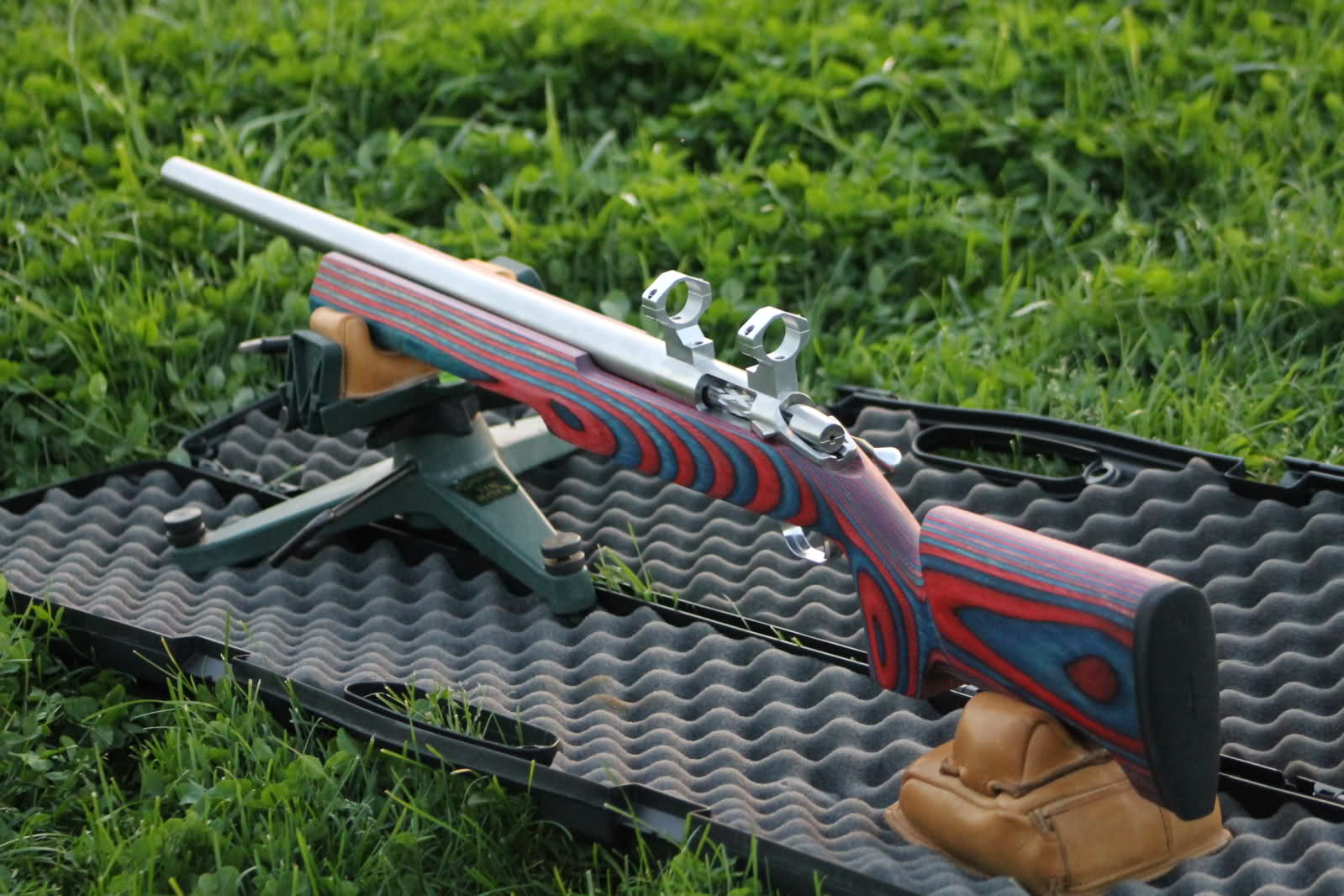
Bat SV 6BR Dual Port with Right Ejection
Shurley Brothers Lowrider stock
Brux four grove 27" 1-8 twist .272 Neck
Jewell trigger
Steve Hoskin did the barrel work and Tom Shurley headspaced and assembled it.
I think your bigges improvement will come from adding a scope to your gun! ;D
Erik Cortina said:
I think your bigges improvement will come from adding a scope to your gun! ;D
Now they tell me!!!

I was using an el-cheapo BSA 32x until my Weaver T-36 came in. The weaver is on there now.
BoydAllen said:
As far as loading at the range goes. I would suggest that you do the whole thing there. If nature of the powder(s) that you use is such that thrown loads will not suffice, the one issue that may take a little work will be working out a way to weigh charges.
Actually, I have a small digital scale from Rockford. It works pretty well and measures my test weights very accurately. An RCBS ChargeMaster 1500 is in my future.
When making charges, I usually lay the pan on the scale, and use scoops. Those little yellow scoops work great for me. I used to throw loads (and still do for my AR-15, since accuracy isn't as crucial), but found too much inconsistency with the RCBS thrower to be useful. Plus, it tends to throw the powder everywhere if you don't hold a casing right up to the nozzle. I can get it within about half a grain with the scoops and trickle in the rest.
rlandrum said:
BoydAllen said:
As far as loading at the range goes. I would suggest that you do the whole thing there. If nature of the powder(s) that you use is such that thrown loads will not suffice, the one issue that may take a little work will be working out a way to weigh charges.
Actually, I have a small digital scale from Rockford. It works pretty well and measures my test weights very accurately. An RCBS ChargeMaster 1500 is in my future.
When making charges, I usually lay the pan on the scale, and use scoops. Those little yellow scoops work great for me. I used to throw loads (and still do for my AR-15, since accuracy isn't as crucial), but found too much inconsistency with the RCBS thrower to be useful. Plus, it tends to throw the powder everywhere if you don't hold a casing right up to the nozzle. I can get it within about half a grain with the scoops and trickle in the rest.
I did the same exact thing until recently. The LEE scooper things work pretty well. Just throw it short, and trickle up.
For what it's worth, when I started loading at the range, I used a $10 Frankford Arsenal battery powered scale. I won multiple 1k yard relays with charges weighed on that thing... A few people were laughin when they saw me using the scale... but when I won my relay, a couple of people started considering picking one up! I'm not recommending it in any way, just making a point (for long range anyway)... reading wind means A LOT more than weighing charges to the Nth degree. A couple inches of vertical is nothing when the wind can push you 15+ inches in one direction, and switches back and forth
I guess the point I'm making, is to practice A LOT, and ALWAYS use your wind flags... it will pay off more than any reloading tool you buy.
As far as the flyers go... try a different hold on the rifle... you'd be amazed what that can do. Don't be afraid to put your left hand up on the forend with a little downward pressure. Try shooting groups with different holds... You'll likely find one that shoots more consistently than the others. Try a hard hold with a heavy cheek weld, try free recoil, try holding the forend, try thumb on the action tang only. (I have a 6BR that only shoots well with slight pressure on my shoulder, and my thumb up on the action tang. Any other way, and I get vertical on the target... even at 100yds)
You may find that the wind poses a problem when loading outside. My design could be done with an electronic scale. Powder measures are all about technique, and practice. There is not much that a new shooter would read that discusses this. On the other hand, if you are using a powder that is too coarse to throw, then there is little point. BTW, I do initial testing with two shots. If there is paper between them at 100, a third won't make it any better. I look for a condition that I think will hold for a few seconds, and shoot them as rapidly as I can load aim and fire, while keeping an eye on the flags. Once I have something that looks promising, I test with groups of larger numbers of shots.
Here’s something you’re probably not going to want to hear. Statistically speaking it takes a minimum of 42 shots fired as 6 seven shot groups to be 90% certain that your average group size, using extreme spread, is within 85% of the actual average group size. Or in other words to be 90% certain that your average group size really does run between .19â€- .23†and not .23â€- .27†you need to do a lot of shooting in a consistent environment and have a lot of luck.
http://www.border-barrels.com/articles/rimfire_accuracy/group_statistics.htm
I’ve been lied to by more 5 shot groups than I care to remember. I remember my first sub ½†group was from a 7mag sporter. But by the time I fired 4 more five shot groups with that same load it was up to near a 1 ¼†average. Even had a pair of 8 shot groups throw me off to the wrong powder for a couple matches the start of last year. So nowadays my load development is to start by shooting the most proven accuracy loads in a 35-40 round match and make changes from there while trying to “honestly†judge what changes are making for improvement. Thing is sometimes something you may not even be aware of may have happened at the reloading bench, at the range, or in your head that can throw that all off and this approach means you need to shoot a lot of matches or just plain shoot a lot with the same load.
Look up and start with the old tried and true loads first. Things like if it is an 8 twist 6BR, go with Varget or R15 and a 105 or 108 Berger and go from there. With a 17 or 18 twist 30BR go with H4198 and a custom 117 or 118g bullet and go from there. 6PPC, you want to start with N133 and a good 68g or so custom bullet. Give those loads a good sized trial first and compare any changes to that using a good amount of shots. Don't end up chasing loads like some chase their last shot. Now if it is an odd chambering or twist, yes you’re stuck with using test groups to try and get a feel for what the gun wants. Just remember while you’re doing that, that one 7 shot group can tell you a load is no good, but it can’t tell you for certain that it is the one to go with. The finer the tune you’re looking for the more you need to shoot. There’s a feel to this and nothing, nothing, beats experience.
I can't speak to long range, but I have spent a little time with the 6PPC and I can say that for mine, various loads repeat very well. The problem with shooting a lot of shots and a lot of groups is that barrels may only have a useful competition life of somewhere under 1,500 rounds. If a particular load is not in tune for the ambient conditions when it is being shot, with my rifle, it will show up right away. On the other hand a load can be very good, and a slightly errant wind condition that was not read correctly can open the group.
I read of shooters finding their load as if it was something that once found, was something permanent. The reason that short range benchrest shooters generally load between individual matches, at and event, is that as a group, their experience has been that loads can vary considerably, depending on the temperature, humidity, altitude, and conditions of the powder itself. If they required a great number of shots to validate a load, or more recently tuner setting, there would be no way to fit this into the match environment, so we learn to make educated guesses as to what is needed to improve a load, and whether the change has made it better, even though the test conditions available during a match may be quite a bit less than ideal.
I realize that long range matches are not set up so that it is practical to load at the range, but I believe that if shooters were allowed the time to do some experimenting, and then load for record based on what they had learned, IMO their average performance would be improved. It seems to me that when you preload, you have to make a guess as to what conditions will be at the match, and if you are wrong, and/or the altitude and climate are not available to test in, the probably of being out of tune at a match are significant. Under these conditions, I would think that a having a tuner on the barrel, and a good set of notes might be a significant advantage.
BoydAllen said:
I realize that long range matches are not set up so that it is practical to load at the range, but I believe that if shooters were allowed the time to do some experimenting, and then load for record based on what they had learned, IMO their average performance would be improved. It seems to me that when you preload, you have to make a guess as to what conditions will be at the match, and if you are wrong, and/or the altitude and climate are not available to test in, the probably of being out of tune at a match are significant. Under these conditions, I would think that a having a tuner on the barrel, and a good set of notes might be a significant advantage.
[br]
Boyd, I do have a lot of long range experience and don't think that loading at the range during matches is any significant benefit. During load development, yes. My loads, with long, heavy bullets, relatively slow powders and cartridges like .308 Win and .284, often show broad tuning windows. My .284 Shehane match load exhibits a .4 grain range where there is no significant change in velocity, grouping or impact point. I've shot that load at sea level (Camp Pendleton), high desert (29 Palms) and medium altitude desert (Ben Avery) with equal results. Our temperature and humidity runs the gamut and does not appear to affect long range performance except in zero point. Much of this may be masked by conditions and your discipline is more revealing in some aspects. Long range loads and cartridges just do not seem to behave the same way point blank 6 PPC loads with very short bullets do. [br]
Full disclosure: I have not shot benchrest since the .222 was somewhat competitive.

Boyd, I wonder how much of the advantage loading at the short range has to do with the sensitivity of the powder used? I’m thinking of the percentage of 30BR shooters using H4198 that come to a short range match pre-loaded as compared to PPC shooters. I shoot mostly benchrest groundhog matches where we’ll shoot 3 different distances ending at 400 or 500 yards. We’ve had a few guys that loaded at the matches. Many of our shooters are or were IBS short range shooters. I also wonder how much of that load adjustment at the range comes from experience. It isn’t like a guy goes up to the line with a block of 3 or 4 sets of 8 rounds with different amounts of powder in them and shoots 3 shot groups to see what’s working best before going to target. So it isn’t like you’re testing on the fly as much as going by the experience of what worked in the past and what others are doing. No? And this is with guns capable of shooting in the 1s. So it doesn’t take many shots to see it is in the 3s and something needs changing.
I once asked Henry Burhmann, one of the few guys who always loaded at matches, if he did it because of the changes in conditions or distances. Henry a long time top class short range shooter told me he wasn’t good enough to tell any difference with his 30BR. And besides almost all of us squeeze in as much H4198 as we can get into the 30BR all the time. But then I gotta admit there are days when I wish I could switch from Varget to R15 or match primers or vice-versa on the fly especially with something like the 6BR and I don’t use a PPC very much. Maybe some day I’ll have the time between relays to try loading on the spot. Lack of time and space at the shoots may be the main reason why most all of us pre-load in the groundhog game.
Steve,
What type of heavy bullet shooting do you do, and what sort of accuracy is required to win? It seems to me that different types of shooting can be challenging in different ways. This does not make one easier than another.
Bill,
Actually the short range benchrest shooter who has the most Hall of Fame points, is known to take multiple loads to the line. Evidently he is able to look at a test group on the sighter target and tell enough about which load should should be selected without trying them all.
As to the nature of the .30 BR lending itself to preloading, I agree, particularly for score. However, if you look at the dispersion that will still result in an X, I believe that it is more generous than what is required to win a tightly contested group match under ideal conditions. Also a friend who has shot group with a .30 BR as well as a 6 PPC tells me that the short .30 cal. bullets seem to be moved more by a given amount of wind, at 200 yards, than his typical 6PPC loads. There is also the issue of suitability of cartridges for being shot over an entire weekend, free recoil, with a 10.5# rifle, from slick bags. These factors may account for the fact that the .30 BR has not taken over short range group shooting.
Boyd
BoydAllen said:
Steve,
What type of heavy bullet shooting do you do, and what sort of accuracy is required to win? It seems to me that different types of shooting can be challenging in different ways. This does not make one easier than another.
[br]
Boyd,
I shoot F-Class, both T/R and Open. Particularly in F-Open, at the highest competition levels, dependable ¼ MOA accuracy is required. Additionally, velocities must be extremely uniform in order to maintain acceptable vertical at 1000 yards. [br]
Part of the issue may be case capacity. Using H4831 SC, my Sartorious GD-503 can reliably weigh charges to ±.02 grains. The scale is more accurate than that but is limited by kernel size. With a match load of 58.2 grains, that is a total range of .07%. If an experienced BR shooter can throw 28.5 grains of N133 to ±.05 grains, that is .35% or about 5X the variance. Another aspect, also noted by Bill, is the relative burning rate of the powders. The fast powders, like N133, may be more subject to pressure excursion than slower powders. I do know that H4831 SC is not very temperature sensitive. I've shot it in temps from 38°F to 100°F with the same accuracy results. [br]
As you said, it is not that any given shooting discipline is any more or less difficult. The requirements and equipment are different.
Thanks for the information. If I stop learning, it will get boring fast. On throwing 133....I have spent a lot of time and practice, and like to think that I have developed some skill, and I struggle to hit +-.1 gr. for short runs. Evidently the need for the sort of charge uniformity that you long range guys need is not as important for shorter range work. If you go to a match, you will see a few Chargemasters, but the rest will be throwing charges. If there was a clear cut pattern that favored the Chargemasters, they all would switch in short order. There is not.
Don't know if this was addressed but to me the most important thing about starting reloading is the method you record data
and what you do with it. Targets are placed in a 3 ring binder for each Rifle used with the recipes and dies used recorded. You don't want repeated
failures but repeated success. Duplicating a successful load is the name of the game. Single digit ES is a measure of your loading ability.
my 2 cents...
I think that there is any doubt that for every kind of shooting, single digit ESs are desirable, but I don't think that you will find much evidence of them, even at the top of short range benchrest. When shooting at 1-200 yd. ES is not as important as is is for longer ranges. Other factors dominate, and the only real measuring tool that is consistently used is the target. I will say that some of the things that contribute to low ES are also important in short range BR, such as consistent bullet seating force, and case volume. Also, having single digit ES does not mean that your load is in tune for the rifle or conditions. It means that all the factors that contribute to consistent production of pressure are in good order. For long range, one cannot do well without it, but having it does not by itself guarantee the highest accuracy.
I don't know how much "rest and bag" experience you have but you need to develop your style of shooting. You mention a couple of flyer's during testing, this can be a change in your technique at the bench. Are you holding the rifle or shooting free recoil? Have you read books that talk about bench shooting? The rest and bag need to be aligned so the gun can recoil back the same every time. Flag reading needs to be learned. I use 3 shot groups for developing loads and watch for the good "round" look, providing I did not pull a shot or missed the wind change. Bench guns are not that easy to shoot if you have been a field hunter/varmint shooter. Good luck and shoot small groups
Boyd, you missed my point.
Single digit ES is a measure of your loading ability.
You just can't read a book and get it. It's experience, plain and simple. I do agree with your other points though.
Don