
• This Forum is for adults 18 years of age or over. By continuing to use this Forum you are confirming that you are 18 or older. No content shall be viewed by any person under 18 in California.

Best Practices for Load Development

As a relative newbie to reloading, I'm struggling with the logistics of load development. I'm wondering what the best methods are for doing load development.

I've selected 87 grain berger for my 6mm BR at 100-200 yards. My local range is 100, and my not-so-local range is 200, so I suspect I will do most of my testing at the 100 yard range.

I did some simplistic bullet tests with 30 grains of Varget, and the bergers shot the best, but with a few flyers. Not the best testing method, I know. I'd like to start from scratch with this bullet. I was told by the previous owner that 30 grains was just about right for his loads, and that I should probably start at 29 and work up.

Should I load a few 5 round lots, going from 29 to 30 or 31 all at once, perhaps in .2 grain increments, or is there a better "binary search" method, were I go low, high, middle, etc, until I find the sweet spot?

Are there any clear-cut rules for seating depth (or jump)? I'm wondering at what point I need to start playing with this variable. Right now, I'm pushing them .005 in the lands (as suggested by the previous owner).

Thanks,

Rob
 
The problem I see here is that you appear to be completely new to reloading but decided to start using some of the most expensive components. IMHO, this combination is a recipe for frustration.

Unless you got a friend who is an experience reloader and willing to share all his learning with you, you are going to end up going into a lot of “blind alleys” and spending a lot of money before you figure it out. I understand that you think this is the most direct approach and so the most efficient but it is not. You are better off learning using a caliber like 223 which is much cheaper to learn on.
 
rlandrum said:
Should I load a few 5 round lots, going from 29 to 30 or 31 all at once, perhaps in .2 grain increments, or is there a better "binary search" method, were I go low, high, middle, etc, until I find the sweet spot?

Are there any clear-cut rules for seating depth (or jump)? I'm wondering at what point I need to start playing with this variable. Right now, I'm pushing them .005 in the lands (as suggested by the previous owner).

Thanks,

Rob
Personally, for the load testing, and using Berger bullets, I would shoot On The Lands (OTL) for all your load testing. Once you get your best load out of that, you can use that load and experiment with jumps and jams.

The range of your load testing, to a degree, depends on what you're shooting. Say you're going to shoot from 1,000 yds and you need a MV of 2800 fps to keep the bullet supersonic. If that doesn't happen without a minimum of 30 grains Varget, it doesn't make any sense to start at 29 grains in your load testing. A chrony would really help get you in the ballpark here.

If 30 grains gave you your minimum MV, then you might go 30.0, 30.3, 30.6, 30.9, 31.2.

I can't stress enough that your rifle must be in the most stable, consistent position possible for your load testing to be meaningful. Something like a Caldwell lead sled or other device. You don't want any heartbeat, differences how hard the rifle is shouldered or other variables in the mix. Especially if you're old and twitchy like me, it's critical.

Make sure you shoot the different loads in rotation and at regular intervals so things like barrel temperature don't come into the mix. You can get an infrared barrel temperature gauge for a mere $25.00 from (http://www.precisionaccuracycompany.com/barrel-temperature-gauge.html). This would allow you to know that the barrel temperature is consistent for all shots.

Chamber rounds and fire them consistently. If you chamber a round in a hot rifle and wait for a minute before shooting, then only wait 15 seconds for the next round, you're going to get skewed (vertical) results.

If you can do your load testing with a good chrony, you might be surprised with what the "regression" testing will tell you. You might have one group with more vertical spread than another. But when you correlate this to MV, it could tighten the bigger group up. Here's and example of what I mean.

Say you shoot 5 rounds at two different loads, 30.0 and 30.3 grains varget. When you look at the targets, the 30.3 group is tighter. But when you look at the chrony and adjust for different MVs, the 30.0 group may actually be tighter... or NOT. It could be the load is responsible for the MV differences.

Are you thoroughly confused? If you don't want to be confused, you could shoot your Berger bullets OTL and try to attain the minimum MV required to keep the bullet supersonic at the distance you're firing. You'll probably be fine.
 
jlow said:
The problem I see here is that you appear to be completely new to reloading but decided to start using some of the most expensive components. IMHO, this combination is a recipe for frustration.

Unless you got a friend who is an experience reloader and willing to share all his learning with you, you are going to end up going into a lot of “blind alleys” and spending a lot of money before you figure it out. I understand that you think this is the most direct approach and so the most efficient but it is not. You are better off learning using a caliber like 223 which is much cheaper to learn on.

I'm fully aware that I'm completely green, and admit it openly. But to be told "don't even bother" is a bit insulting.

If I weren't prepared to spend money, I never would have taken up shooting, or purchased a competition rifle, or any of my other guns. He who dies with the most debt wins! :)

Unfortunately, I don't have any more experienced friends to help.

And thanks for recommending the 223. However, I'm developing loads for the 6mm BR Norma, specifically at 100-200 yards, as I already have all the necessary components.
 
Until you read/do enough to feel comfortable loading, try this...
Check length of all brass trim to same .002 short of length shown in manual...
Load 28.5 three rounds same length
Load 29.0 three
Load 29.5 three
Load 30.0 three
Load 30.3 two
Fire these as carefully as possible..
Pick best group and work .2 grains each side
Pick best of above and shoot several 5 shot groups.
If you are not satisfied pick best load and move bullet in and out .002 each test load.
Dont leave bullet just touching lands"no mans land".
If you cant find what you are looking for try same program with Reloader 15, Fed BR primer.
Dont make a job out of this..Enjoy.
3 rounds test the equipment, 5 rounds test the shooter...
Be realistic..It wont out shoot a PPC..
 
Rob,

I'm like you... I started reloading and got myself involved in competition shooting with ZERO help from anyone. I have to figure everything out on my own. I pick things up pretty quick, but it took me a few years to truly get an understanding of the process, and I'm still working on it. People on this site are a great resource, but it's not the same as having a knowledgeable person at your loading bench showing you/telling you what you're doing wrong.

There are a number of things we should know to further assist you. Give us all the details on the rifle. (barrel twist, action, trigger, stock, etc). What rest setup you're using. Are you using wind flags? Once we know what you're working with, someone with a similar setup can probably give you a very good idea where to start.

edit: I just realized you're shooting the 87 grainers.... are they the 87gr VLD's?
 
If you want to conserve components and barrel life, loading at the range has great advantages. IMO loading multiples of various combinations is wasteful. Also, in order to do meaningful work, the rifle needs to be right, and you need to be using something to look at what the wind is doing between you and the target. I know that these answers don't seem to be responsive to your inquiry about working up loads, but given the concerns that you have expressed, they should be helpful to your process. Tell us of your rifle, and what has been done to it. What caliber are you shooting, and what kind of reloading equipment do you have?
 
DougMH said:
Personally, for the load testing, and using Berger bullets, I would shoot On The Lands (OTL) for all your load testing. Once you get your best load out of that, you can use that load and experiment with jumps and jams.

That makes a lot of sense, now that I think about it.

The range of your load testing, to a degree, depends on what you're shooting. Say you're going to shoot from 1,000 yds and you need a MV of 2800 fps to keep the bullet supersonic. If that doesn't happen without a minimum of 30 grains Varget, it doesn't make any sense to start at 29 grains in your load testing. A chrony would really help get you in the ballpark here.

Chrony is ordered.

I can't stress enough that your rifle must be in the most stable, consistent position possible for your load testing to be meaningful. Something like a Caldwell lead sled or other device. You don't want any heartbeat, differences how hard the rifle is shouldered or other variables in the mix. Especially if you're old and twitchy like me, it's critical.

I'm using a Sinclair Competition Rest. It's super stable. And my limited testing with it has shown it to be very dependable and easy to adjust.

Make sure you shoot the different loads in rotation and at regular intervals so things like barrel temperature don't come into the mix. You can get an infrared barrel temperature gauge for a mere $25.00 from (http://www.precisionaccuracycompany.com/barrel-temperature-gauge.html). This would allow you to know that the barrel temperature is consistent for all shots.

Chamber rounds and fire them consistently. If you chamber a round in a hot rifle and wait for a minute before shooting, then only wait 15 seconds for the next round, you're going to get skewed (vertical) results.

Ordered!

If you don't want to be confused, you could shoot your Berger bullets OTL and try to attain the minimum MV required to keep the bullet supersonic at the distance you're firing. You'll probably be fine.

Will do. Thanks for the help!
 
I am sorry if I insulted you. What I said was not “don’t even bother” but to go via a slightly different route.

FWIW, the recommended route I gave is the route I took, thus the advice. What I meant is that it is better to go FIRST via a cheaper route before going on the more expensive route. I made the effort to offer a different route that I think would make things easier and more efficient, not to insult.

For you or anybody for that matter to be successful in reloading, it is going to take a lot more than picking the right bullet, the right powder weight, and the right seating distance…. Queen_stick’s comments are right on and mirror my own experience i.e. it is harder than it looks and I am still learning how hard....
 
queen_stick said:
Rob,

I'm like you... I started reloading and got myself involved in competition shooting with ZERO help from anyone. I have to figure everything out on my own. I pick things up pretty quick, but it took me a few years to truly get an understanding of the process, and I'm still working on it. People on this site are a great resource, but it's not the same as having a knowledgeable person at your loading bench showing you/telling you what you're doing wrong.

There are a number of things we should know to further assist you. Give us all the details on the rifle. (barrel twist, action, trigger, stock, etc). What rest setup you're using. Are you using wind flags? Once we know what you're working with, someone with a similar setup can probably give you a very good idea where to start.

edit: I just realized you're shooting the 87 grainers.... are they the 87gr VLD's?

Yep. 87 Grain VLD Hollow Point Boat Tail.

I'm using a custom competition rifle I bought here. It's Bat SV Action, dual port, with ejector and a Jewell trigger. I'll have to consult my records for the barrel make and stock, but it was originally owned by Josh11. It's a 1:8 twist, 28 or 29 inches.

I've purchased wind flags (and stakes) for my testing, so I'll know more about what's going on the next time I setup.

I'm using the Sinclair competition rest, and Protektor rear.
 
BoydAllen said:
If you want to conserve components and barrel life, loading at the range has great advantages. IMO loading multiples of various combinations is wasteful. Also, in order to do meaningful work, the rifle needs to be right, and you need to be using something to look at what the wind is doing between you and the target. I know that these answers don't seem to be responsive to your inquiry about working up loads, but given the concerns that you have expressed, they should be helpful to your process. Tell us of your rifle, and what has been done to it. What caliber are you shooting, and what kind of reloading equipment do you have?

I've never considered loading at the range. I'm not sure how I'd manage that. I supposed I'd just prep and prime the cases, then pack the powder, scale, bullets, and seating die.

I'm using RCBS equipment, with a set of Forster 6mm BR dies (.243 caliber). I like the Redding shell holders better (they're less sloppy for priming). I've started with CCI BR4s, but am considering switching down the the 450s or over to the Federals.

I also have the Sinclair headspace gauge, and the 6mm micrometer seating depth die.
 
For 100 and 200 yd shooting, you would probably be better off with a non-VLD bullet. That doesn't mean the VLD's won't work for you.


VLD's can be finicky, and very sensitive to bullet seating. You might consider Berger's VLD seating guideline...

The following has been verified by numerous shooters in many rifles using bullets of different calibers and weights. It is consistent for all VLD bullets. What has been discovered is that VLD bullets shoot best when loaded to a COAL that puts the bullet in a “sweet spot”. This sweet spot is a band .030 to .040 wide and is located anywhere between jamming the bullets into the lands and .150 jump off the lands.

Note: When discussing jam and jump I am referring to the distance from the area of the bearing surface that engages the rifling and the rifling itself. There are many products that allow you to measure these critical dimensions. Some are better than others. I won’t be going into the methods of measuring jam and jump. If you are not familiar with this aspect of reloading it is critically important that you understand this concept before you attempt this test.

Many reloaders feel (and I tend to agree) that meaningful COAL adjustments are .002 to .005. Every once in a while I might adjust the COAL by .010 but this seems like I am moving the bullet the length of a football field. The only way a shooter will be able to benefit from this situation is to let go of this opinion that more than .010 change is too much (me included).

Trying to find the COAL that puts you in the sweet spot by moving .002 to .010 will take so long the barrel may be worn out by the time you sort it out if you don’t give up first. Since the sweet spot is .030 to .040 wide we recommend that you conduct the following test to find your rifles VLD sweet spot.

Load 24 rounds at the following COAL if you are a target competition shooter who does not worry about jamming a bullet:
1. .010 into (touching) the lands (jam) 6 rounds
2. .040 off the lands (jump) 6 rounds
3. .080 off the lands (jump) 6 rounds
4. .120 off the lands (jump) 6 rounds

Load 24 rounds at the following COAL if you are a hunter (pulling a bullet out of the case with your rifling while in the field can be a hunt ending event which must be avoided) or a competition shooter who worries about pulling a bullet during a match:
1. .010 off the lands (jump) 6 rounds
2. .050 off the lands (jump) 6 rounds
3. .090 off the lands (jump) 6 rounds
4. .130 off the lands (jump) 6 rounds

Shoot 2 (separate) 3 shot groups in fair conditions to see how they group. The remarkable reality of this test is that one of these 4 COALs will outperform the other three by a considerable margin. Once you know which one of these 4 COAL shoots best then you can tweak the COAL +/- .002 or .005. Taking the time to set this test up will pay off when you find that your rifle is capable of shooting the VLD bullets very well (even at 100 yards).
 
queen_stick said:
For 100 and 200 yd shooting, you would probably be better off with a non-VLD bullet.

Do you suggest any one in particular? I haven't gone below 80 grains, and it didn't perform well (with my test load). Were it not for the two distinct flyers (one in each 5 shot group), the 87 grain Bergers would've all fit under a quarter at 200 yards.

Thanks for the Berger info. I think I'll try their recommended testing procedure.
 
rlandrum...May I suggest Tony Boyer's book "The Book of Rifle Accuracy". His systematic approach to load development is the best I've seen anywhere. Using his method minimizes time and wear/tear on the rifle and is the least expensive as far as components. Good luck.

P.S.....I think Boyd Allen's advice is worthy of note,also.
 
gpoldblue said:
rlandrum...May I suggest Tony Boyer's book "The Book of Rifle Accuracy". His systematic approach to load development is the best I've seen anywhere. Using his method minimizes time and wear/tear on the rifle and is the least expensive as far as components. Good luck.

P.S.....I think Boyd Allen's advice is worthy of note,also.

Agreed. I think I may attempt loading at the range on my next outing.

I'll give the book a read when it arrives.
 
with an 8-twist, both of my 6BR's shoot very well with the Sierra 107gr SMK's over 30.0gr Varget and CCI450 primers. To date, my best 100 and 200 yd groups came about when using the 107's jumped .015" I shoot between 100 and 300 yds quite a bit, but I compete at 1k yds, so I'm always using the heavy bullets.

If I were you (primarily shooting at 100 and 200 yds), I'd probably try the Berger 80gr flat base bullets. I've heard the Berger 80gr bullets shoot awesome in the 8-twists, but I haven't tried them yet (there was an article on the Daily Bulletin about that, but I can't find it). They should be very easy to 'tune', when compared to the VLD's.
 
The link below has some great info. regardless of the range.

http://www.accurateshooter.com/technical-articles/long-range-load-development/
 
As far as loading at the range goes. I would suggest that you do the whole thing there. If nature of the powder(s) that you use is such that thrown loads will not suffice, the one issue that may take a little work will be working out a way to weigh charges.

For those situations where I am working with powders that are too coarse to throw consistently, I designed a scale enclosure that works very well. The trickler is inside the enclosure with the scale, with its handle protruding through a tight fitting hole in its end. That way charges can be trickled in an outdoor setting without interference by the wind. It is a simple design, easily built.

Using a large number of cases introduces an undesirable variable. With as set of say 20 cases, that have been selected for their similar bullet seating feel, you can have more confidence in your results. Some time back a friend was trying to do fine tuning for a 6BR, shooting through a large number of new cases. I suggested that he pick out a small set of experienced cases to work with instead, and he was able to get much better and more consistent results.
 
Rob, get a copy of Tony Boyer's book, The Book of Rifle Accuracy. Tony describes a way to work up loads that flat out works. Very methodical. He uses multiple powder charges, at several different seating depths, and shoots three shot groups. (If it won't shoot three into a tight group, it certainly won't shoot five into a tight group.)

I'm of the opinion that powder charge and seating depth are not independent of each other, so I like to try combonations of the two rather than settle on a powder charge then tinker with seating depth.

The technique described by Tony worked so well with my target rifles, I have since gone back and used the same technique with some of my factory rifles with equal success.
 
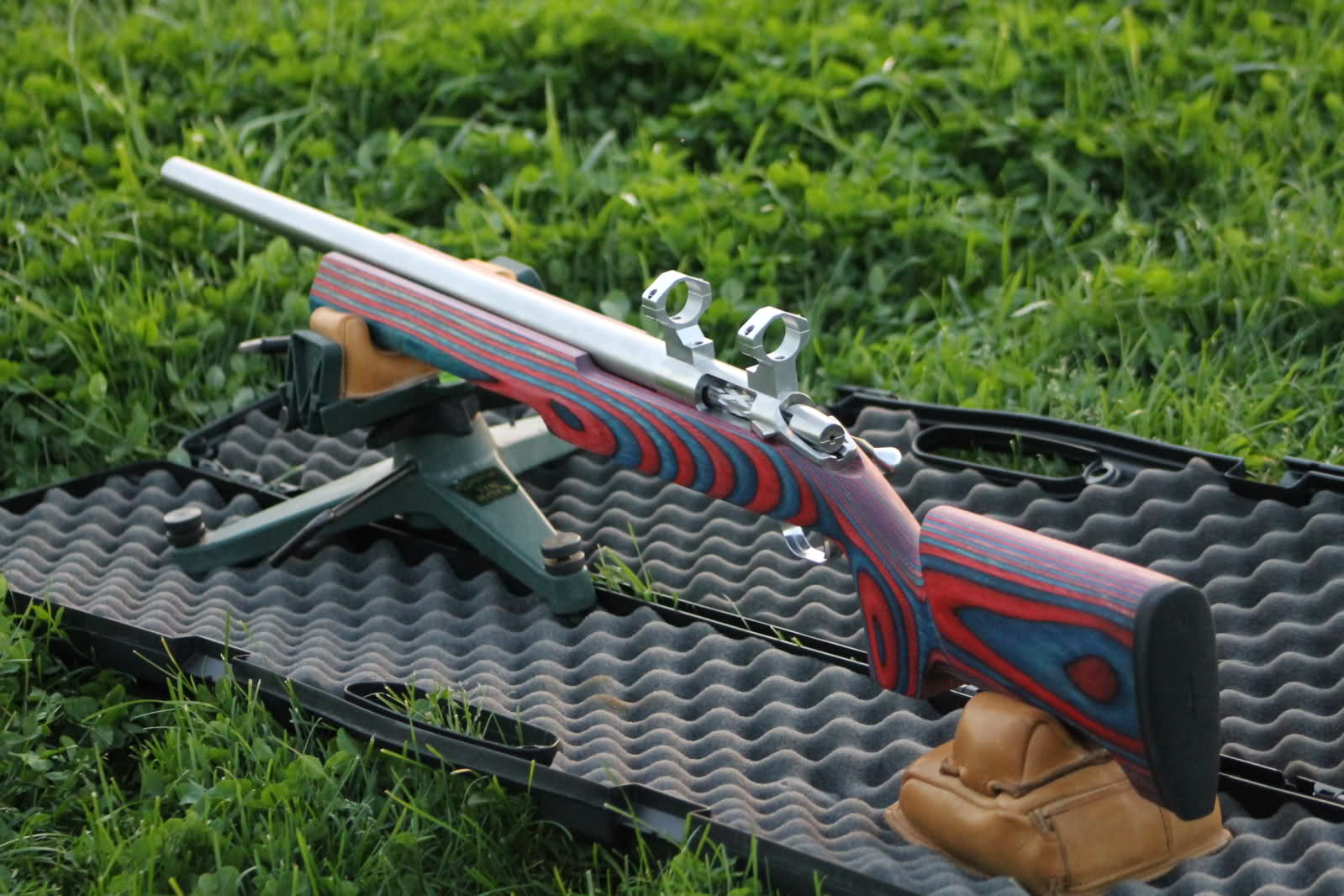
For the curious:

Bat SV 6BR Dual Port with Right Ejection
Shurley Brothers Lowrider stock
Brux four grove 27" 1-8 twist .272 Neck
Jewell trigger

Steve Hoskin did the barrel work and Tom Shurley headspaced and assembled it.

compgun.jpg
 

Upgrades & Donations

This Forum's expenses are primarily paid by member contributions. You can upgrade your Forum membership in seconds. Gold and Silver members get unlimited FREE classifieds for one year. Gold members can upload custom avatars.


Click Upgrade Membership Button ABOVE to get Gold or Silver Status.

You can also donate any amount, large or small, with the button below. Include your Forum Name in the PayPal Notes field.


To DONATE by CHECK, or make a recurring donation, CLICK HERE to learn how.

Forum statistics

Threads
167,745
Messages
2,239,077
Members
80,703
Latest member
Swamp Fox
Back
Top
