What chronographs did you use?
Oehler's.
How accurate are the Shotmarker systems for velocity?
Curious, Anyone here set unit up at target to determine velocity difference at distance? (100, 200, 300 yd etc.). Be interesting to see how this compares to a calculated velocity drop..
That's a good idea, I did it with my bow and my Oehler out to 50 yds, plenty of room to shoot thru the window on it, velocity drop was like 26fps. Shud be easy enough to do with one of the new small ones assuming they are big enough on the cone to read the bullet. reasonably close to the target at a safe height.
Love to shoot
Gold $$ Contributor
Brownells has the Athlon Rangecraft on a black Friday deal pretty cheap, if your looking for one.
Happy Monday!
Mikey
Brownells has the Athlon Rangecraft on a black Friday deal pretty cheap, if your looking for one.
Happy Monday!
Mikey
$399 is not a deal it's the regular price
Love to shoot
Gold $$ Contributor
$399 is not a deal it's the regular price
314.99 with free code, on their website today.
Mikey
Yeah, that's almost first responder discount pricing.
Yeah, that's almost first responder discount pricing.
Yep; ExpertVoice is $299.
Not real worried about any differences between brands, unless it's something vastly different, like 100fps+, it'll get settled downrange by adjusting the scope and writing down that setting on that day. All the chrono has to do is give me a rough starting point to set the scope to, to start with.
I’ve almost always had to tweak the scope dope day to day regardless of what a ballistic calculator and chronograph might tell me. That’s particularly so shooting 500 yards and longer with something like .223.
Curious, Anyone here set unit up at target to determine velocity difference at distance? (100, 200, 300 yd etc.). Be interesting to see how this compares to a calculated velocity drop..
Yes, I have done that with my older Labradar. Mostly to create BC data for the cast bullets I was shooting at the time. But, I have used it to confirm BC data for jacketed bullets as well. The key part is to have in hand the exact atmospheric data when shooting. The range I shoot is at 4500ft elevation so that means the std BC data is off unless I adjust for it. When using a ballistic calculator and I don't have current conditions available I at least put in the elevation. Another bonus to the range here is location, about 1 mile from a local airport.
Thanks for sharing this info. Very helpful when looking at purchasing.
I picked up a athlon, I like it I can read it better than my Garman that I gave to my son in law.
Yep; ExpertVoice is $299.
Where I bought mine too.
When using a ballistic calculator and I don't have current conditions available I at least put in the elevation.
Get yourself and learn to use a simple density altitude chart. More accurate results than just altitude when you can't pull data from the cloud. Temp is an important part of it not just altitude.
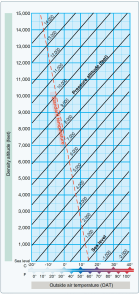
I enter temp separately (I have a temp gage in the shooting box). I use the altitude if I can't get a barometric pressure and humidity.
Our local Fleet Farm had the Athlon for $299 on Black Friday.
I enter temp separately (I have a temp gage in the shooting box). I use the altitude if I can't get a barometric pressure and humidity.
The key as WSnyder says above, is density altitude. As a combination of pressure, temperature and humidity, density altitude has a direct effect on aerodynamics. Planes have a tougher time at high density altitude, but bullets fly better. Just temperature, altitude or humidity by themselves don't tell the whole story.
You are right, in a way. Density altitude is calculated from other measurements. The standard tables are just that, a standard, not actual. Basically a cheat sheet if you don't have any other outside measurements. If you have actual measurements you should use them. Ideal gas law.
You are right, in a way. Density altitude is calculated from other measurements. The standard tables are just that, a standard, not actual. Basically a cheat sheet if you don't have any other outside measurements. If you have actual measurements you should use them. Ideal gas law.
???? Density altitude DOES affect drag. Directly. The ideal gas law (PV=nRT) hasn't a thing to do with it.
I sure don't understand what you mean when you say "The standard tables are just that, a standard, not actual. Basically a cheat sheet if you don't have any other outside measurements."
Tell me what I'm missing.
Air density is the key factor for drag. Air density changes as the temperature and pressure change. The ideal gas law relates the three values, temperature, pressure and density. Change one and the others change. As temperature goes up density goes down. As air pressure goes up, density goes up.
For aircraft (among others) a standard 'normal' temperature and pressure (hence density) was established. At sea level it is 68F and 1 atm of pressure. As the altitude increases the pressure decreases (less gravity). The density then is decreased. Due to the importance of stall speed for pilots. charts are made to show air density based on altitude and temperature, both of which can be measured in an aircraft.
But, the weather will change the air pressure (eg, high and low pressure areas). That changes the air density. Pilots change the setting on the altimeter based on airport barometric pressure to account for that. Then they can still use the altimeter to relate to the stall speed of the aircraft (density altitude).
The tables work fine as long as the sea level air pressure is at 1atm. If you are in a low or high pressure zone it will be off by that amount. Which is why I check with a local airport for the barometric pressure to enter into the ballistics calculator.



