I do not check my finished bullets for straightness. I measure the shank and base with a “tenth” micrometer, and I measure the ogive to base at a pre determined point to confirm that the bullets are what has proven to shoot well in my barrel load combination.
I trust that with my lubing techniques and attention to detail, my dies are making a straight and truly round bullet.
to anybody wishing to make their own precision Benchrest Bullets, the key is to listen to start with the very best in equipment, mainly the dies. The rest is listening to those with experience and learn. After a learning curve, and you gain knowledge of exactly how your components are are working together, you can tweak a few things to optimize your expectations.
Then you head to the range. That is when you really find out out if your efforts are as they should be.
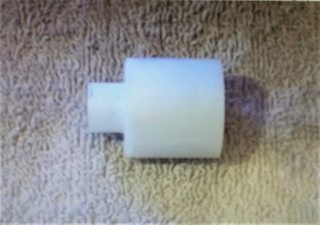
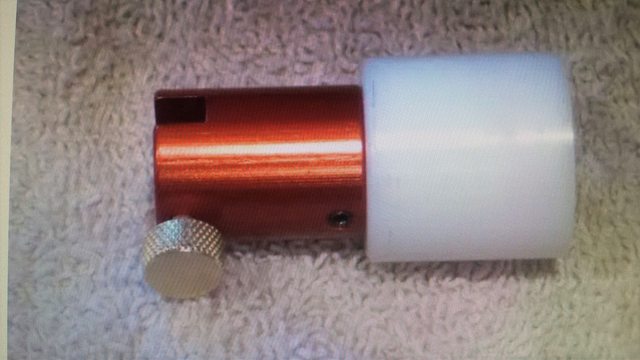
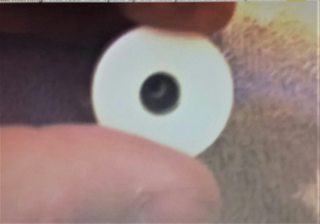
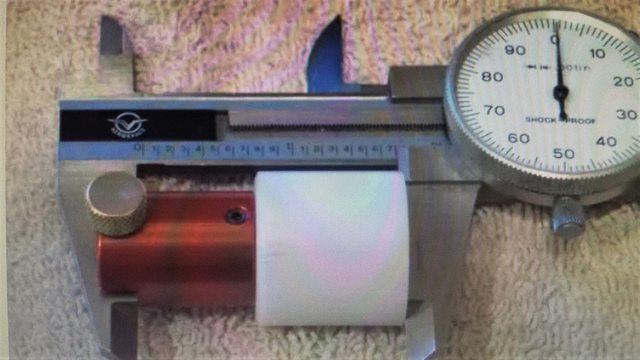
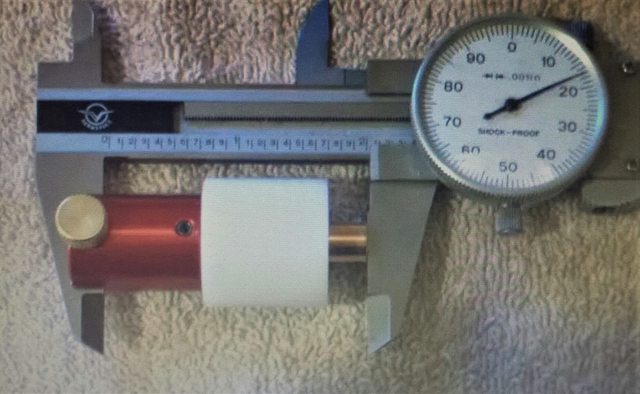
Out of curiosity, (since I have 45,000 of them), I made a 30 caliber mandrel to use on my little jacket checker, just to see how good or bad they are. Ed and I have been shooting the bullets made on these for going on three years.
They check pretty good.
View attachment 1625813View attachment 1625814View attachment 1625818
Been perusing this thread and am now, up to a full YEAR AGO! The issue with this pic/effort, is that the DATUM point is on the tapered jacket [section] ABOVE the core, on the ogive, thus, closer to the center,
therefore very little center-of-gravity offset.
On the J4 prints, the first DATUM point (hoop) above the base is specified:
T.I.R. 0.0003" @ 0.150" from the base - it is THIS dimension (
wall-thickness variation), along the STRAIGHT section, which will determine CG offset (concentricity). Both the inside and outside hoops may be perfectly ROUND, but offset, or, non-concentric. Bullet dies will not correct a lack of wall-thickness uniformity. Using
T.I.R. here is a misuse of the term, which is measurement of roundness, not concentricity.
At the approximate pictured DATUM point (hoop), the same print specifies:
T.I.R. 0.0007" at 0.839" from the base!! Again, even presuming a jacket full of core, the CG offset would not be significant, because, relative to the shank, the mass would be closer to the axis.
Regrettably, it appears that George Ulrich has deleted all of his replies. Though repetitive, my experience, parallels George's: the Juenke machine, which is mentioned in several posts, proved incapable of distinguishing between "good" and "bad" jackets.
I had an assortment of bullets made with varying amounts of wall-thickness variation , ranging from 0.0001" to 0.0008" at the base DATUM hoop, which I sent to several Juenke owners/users: not a single one sorted them to anywhere near to correct order . . . and no two "sorters" ahcieved the same sequence.
I do not know what the device measured(es), but it's neither wall-thickness, nor uniformity.
The reality is, as
Ferris Pendell advised a pal of mine, who had purchased a set of dies,"
The best bullet spinner is a good barrel". Targets don't lie. RG











 RG
RG