Follow along with the video below to see how to install our site as a web app on your home screen.
Note: This feature may not be available in some browsers.
This Forum is for adults 18 years of age or over. By continuing to use this Forum you are confirming that you are 18 or older. No content shall be viewed by any person under 18 in California.
I have used the TBAS for a while now with no issues. I decided to go ahead and try out Drew's Omni Adjustable Spider Chuck Adapter - it wasn't a good experience. I will leave it at that.
Just make an MT blank into a holder. It really wouldn’t be hard. Just grab the non taper part of the OD, dial it in, drill and bore it to size. If you were worried about it being dead on, drill, and bore underside and finish the bore with it in the tailstock and a boring head in the lathe chuck.
Pierce had a Kennametal DA collet floating holder with an MT shank. Not sure of the model number or if it was modified in anyway.
Here's an interesting floater I picked up on Fleabay a few years back.
Made by the Burg Tool Company, it's got a 1" holder but I machined a 7/16" bushing/reducer for it.
It allows for float/flex via a hard rubber insert in which the toolholder is set. There's a spanner wrench "nut" that presumably compresses the rubber to make the float more/less rigid (?).
I've used it with a small Supreme chuck for second ops drilling, haven't yet had the balls to ream a chamber with it tho...
When you hold a barrel only by the shank, you might want to consider balance. If you are indicating the end you are working on only, the other end will runout. You can dial in to zero, but at 1000 rpm centrifugal force becomes a concern. As a test, put your indicator in the breech end and push down on the muzzle end. Without an out board spider you will see movement. The outboard spider is not for jacking a barrel around to indicate, it for support. Without that support, your perfectly dialed barrel is no longer perfectly dialed at rpm. That is one reason I dont run a tbas.
Since we've drifted back to floating holders, I came across this on the PM forum.
Seems incredibly simple to build, and allows for axial float (which is the more common issue with lathes but not addressed by any commercial gunsmith holders I've seen) as well as the usual radial.
Can't think of any reason this wouldn't work, think I'll build one
Since we've drifted back to floating holders, I came across this on the PM forum.
Seems incredibly simple to build, and allows for axial float (which is the more common issue with lathes but not addressed by any commercial gunsmith holders I've seen) as well as the usual radial.
Can't think of any reason this wouldn't work, think I'll build one
Thats only angular like a U-Joint
Sorry, but wont work for chambering
---
Needs to float up and down, as well as left and right
Not simply adjust itself to the angle of approach
---
Think, Tailstock is too high but still in a parallel plane to bore centerline
---not tailstock is off angle
---
I still find, the easiest method is to simply push the reamer in and allow it to align itself to the bore as it follows the hole, it is impossible to enlarge a chamber this way without introducing side pressure.
Not following.
Sleeve is every so slightly oversize, it can move freely in any direction (tailstock too high, or low; or left or right, it will compensate).
Pins are press-fit into the shanks, but slip-fit through the sleeve allowing for minimal movement.
Seems to me it can float radial, and angular. We're only talking about being able to accommodate a few thousandths of an inch... if the tailstock is "off" more than that there's bigger issues at hand.
Thats only angular like a U-Joint
Sorry, but wont work for chambering
---
Needs to float up and down, as well as left and right
Not simply adjust itself to the angle of approach
---
Think, Tailstock is too high but still in a parallel plane to bore centerline
---not tailstock is off angle
---
I still find, the easiest method is to simply push the reamer in and allow it to align itself to the bore as it follows the hole, it is impossible to enlarge a chamber this way without introducing side pressure.
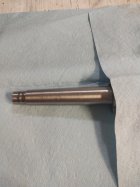
Make the copper colored sleeve steel. Use drill rods for the pins. Make the holes in the Morse-taper and Chuck end a tight slip fit. A press fit in the sleeve. Keep clean and lubricated with something like transmission fluid. You could also make the pins slip in the sleeve and tight on the Morse-Taper and Chuck. I just found it easier to do the other way.
Bingo!
All 3 axis of deflection accounted for. X, Y and Z.
Now, I'd loose the Chuck and make a much smaller, lighter adapter that the reamer will slip into snugly and add a set screw to prevent the reamer from spinning. No need to have the weight of that Chuck hanging on the reamer.
And I'd still align your tailstock to the headstock as closely as possible and strive for perfection when indicating your barrel in. You can't just slap stuff together and expect good results.
It works. Been doing it like that for a couple of decades. Haven't cut an oversized chamber yet that wasn't a reamer problem.
Not following.
Sleeve is every so slightly oversize, it can move freely in any direction (tailstock too high, or low; or left or right, it will compensate).
Pins are press-fit into the shanks, but slip-fit through the sleeve allowing for minimal movement.
Seems to me it can float radial, and angular. We're only talking about being able to accommodate a few thousandths of an inch... if the tailstock is "off" more than that there's bigger issues at hand.
Think of a U-Joint in a driveshaft that can also shift within both mounting ears.
The difference is, the driveshaft stays stationary. The stub spins in what would otherwise be the gear case because that's the reamer in the barrel. The other end is stationary because it's in the tailstock.
Apples and Oranges.
Best way I can describe it and you also have a picture.
Sorry. Re-read the post and I'm pretty sure you 'get it'.
The only other 'floating' holders I've seen that I thought were valid are the pushers. I personally didn't like the idea of holding onto the reamer with a holder knowing I might impart pressure one way or another.
The only other 'floating' holders I've seen that I thought were valid are the pushers. I personally didn't like the idea of holding onto the reamer with a holder knowing I might impart pressure one way or another.
I let the handle of my pusher "rest" on the table of the cross slide
every chamber done I have not seen any side pressure induced
--- the path of least resistance is taken by the reamer, which is into the hole only
every chamber is true to reamer size
---
there are other methods, but this is merely one way to ensure a true to size chamber which is why I personally favor it, not saying it is the only way to do it. it just prevents any mistakes
---
you can even hold the reamer with a little 3/8 wrench, and it will cut true to reamer size
I read of one famous gunsmith "Boots Obermeyer maybe???" who use to cut chambers just this way
with a little wrench in his hand.
I like it because you can "FEEL" what the reamer is doing and gauge tool pressure as it cuts
this to me helps save wear and tear on the reamer so you are allowing it to cut vs hogging it in
all my reamers are still as sharp as day one
I let the handle of my pusher "rest" on the table of the cross slide
every chamber done I have not seen any side pressure induced
--- the path of least resistance is taken by the reamer, which is into the hole only
every chamber is true to reamer size
---
there are other methods, but this is merely one way to ensure a true to size chamber which is why I personally favor it, not saying it is the only way to do it. it just prevents any mistakes
There's more than one way to do it. I'm just most comfortable with this floater design.
Whatever works for whomever you are is all good.
I only get hackled-up when someone insists there's only 1 way.
If I ever determine there's a better method, I'll switch. Until then, I'll keep goin' my way.
I like the idea that I can *lightly* withdraw the reamer before stopping the spindle as well. Using the tailstock. But if that's not been a problem with another method, that's fine, too.
When you hold a barrel only by the shank, you might want to consider balance. If you are indicating the end you are working on only, the other end will runout. You can dial in to zero, but at 1000 rpm centrifugal force becomes a concern. As a test, put your indicator in the breech end and push down on the muzzle end. Without an out board spider you will see movement. The outboard spider is not for jacking a barrel around to indicate, it for support. Without that support, your perfectly dialed barrel is no longer perfectly dialed at rpm. That is one reason I dont run a tbas.
This Forum's expenses are primarily paid by member contributions. You can upgrade your Forum membership in seconds. Gold and Silver members get unlimited FREE classifieds for one year. Gold members can upload custom avatars.



 drewsprecision.com