• This Forum is for adults 18 years of age or over. By continuing to use this Forum you are confirming that you are 18 or older. No content shall be viewed by any person under 18 in California.

Wet Moly

Belly Benchrester

Silver $$ Contributor
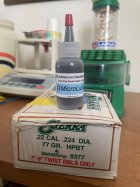
I’ll be opening my Moly factory tomorrow and do my own testing with my 223 service rifle along with my 6BR tactical rifle.

Reason Moly makes sense for me. Looking for an alternative to neo lube with my 6BR. Just looking for some more lubricity when seating bullets. I find that slick bullets have produced more consistency. Another added benefit appears to be less time fouling in a barrel.

Let me know what you guys think has been s positive or negative in your moly costing experiences.
 

Attachments

  • 7D075371-C359-4700-B646-E693C7B10E62.jpeg
    7D075371-C359-4700-B646-E693C7B10E62.jpeg
    508.3 KB · Views: 47
I’ll be opening my Moly factory tomorrow and do my own testing with my 223 service rifle along with my 6BR tactical rifle.

Reason Moly makes sense for me. Looking for an alternative to neo lube with my 6BR. Just looking for some more lubricity when seating bullets. I find that slick bullets have produced more consistency. Another added benefit appears to be less time fouling in a barrel.

Let me know what you guys think has been s positive or negative in your moly costing experiences.


My article and video.
 
I bought a rifle a year ago that wouldnt shoot under an inch and a quarter. Turned out to be moly fouled really bad. Tough stuff to remove but once it was out it shot 1/4”. Ill pass on the moly.

I should add that this same rifle (Cooper) after cleaning, went on to win the 2025 UBR Nationals, factory class.
 
Last edited:
Many years ago I decided to Moly my bullets. I used a Midway tumbler, some moly and a bunch of BB's. Threw them all in the tumbler and turned it on. worked great. a pain to separate the bullets and BB's. Wiped off all the loose moly with a towel.
You can use more powder when you shoot moly bullets. BUT................................. The moly tended to build up in the barrel, so I decided to go back to bare bullets. This was before I had a borescope, and before I had a resource like Accurate Shooter to make me smarter. Moly is tough to get OUT of a barrel.

I would not recommend moly. Back then I thought it might be easier to clean barrels, but now, with a borescope ($100 from Teslong) you can see the carbon (and know it's not moly if you don't use moly) and copper deposits (not much copper in a premium barrel from Krieger or Bartlien) and you can do what is necessary to clean it. The info on Accurate shooter is very helpful.

I simply see no advantage to moly. Trying to squeak out a few more FPS is a waste of time, shoot at the velocity that your best targets tell you is grouping best.

As for lubricity in seating bullets, I use Sinclair Graphite either on a nylon brush inside the neck, or a dip into the jar of graphite and small round balls.
 
I’ll be opening my Moly factory tomorrow and do my own testing with my 223 service rifle along with my 6BR tactical rifle.

Reason Moly makes sense for me. Looking for an alternative to neo lube with my 6BR. Just looking for some more lubricity when seating bullets. I find that slick bullets have produced more consistency. Another added benefit appears to be less time fouling in a barrel.

Let me know what you guys think has been s positive or negative in your moly costing experiences.
Tried moly way back when it first was introduced. It seemed O K but I never saw any positive results. Stopped using it and was content with that. Some years back I saw a video about HBN and decided to give it a try since according to the video it was not messy and practically left no residue on hands. That's what I found when coating with it. I do not coat bullets for all my rifles but for the ones I do coat for I see a much quicker barrel clean-up and the barrel does remain cooler longer in higher temps. As far as improved accuracy I have no proof of it but I can't see it hurting anything. Just like all coatings it does require a couple shots fired before shooting for groups or a match but if the HBN/Alcohol solution is applied with a couple of patches then that's what I've found works for me.
 
I remember buying moly-coated Sierra 69's in .224 15 years ago or more. Plain ones weren't available at that time (Hope & Change supply shortages) and I was starting XTC with 2 boys. Don't forget to buy borax for washing hands. :(
 
Tried moly way back when it first was introduced. It seemed O K but I never saw any positive results. Stopped using it and was content with that. Some years back I saw a video about HBN and decided to give it a try since according to the video it was not messy and practically left no residue on hands. That's what I found when coating with it. I do not coat bullets for all my rifles but for the ones I do coat for I see a much quicker barrel clean-up and the barrel does remain cooler longer in higher temps. As far as improved accuracy I have no proof of it but I can't see it hurting anything. Just like all coatings it does require a couple shots fired before shooting for groups or a match but if the HBN/Alcohol solution is applied with a couple of patches then that's what I've found works for me.

My wet coated moly bullets leave no residue on my fingers.

For those who don't know, that's the whole point of wet moly. No dust. Much cleaner application. The old school tumbled moly was very dirty by comparison.

Screenshot_20201014-074332_Gallery.jpg
 
Finished product. 2 hours in a vibratory tumbler in Gatorade bottles and a little corn Cobb media on the bottom to let the bottles rotate for a more even coat
 

Attachments

  • 33174E00-5A58-43E2-A55E-3DE41DE9600A.jpeg
    33174E00-5A58-43E2-A55E-3DE41DE9600A.jpeg
    912.9 KB · Views: 53
  • 25E557BC-8DCE-4AD9-A74E-9671EB266DB6.jpeg
    25E557BC-8DCE-4AD9-A74E-9671EB266DB6.jpeg
    876.6 KB · Views: 51
BAM!

Hard to dispute that. :oops:
There were (are?) a lot of folks who bought into the idea that you don't have to clean your barrel when using moly due to some articles that circulated of guys shooting 1,000 rounds when using moly and just running a dry patch down the tube. Personally, I think a normal cleaning regimen is in order, though using moly does extend cleaning if one wishes to do so. The accumulation of copper and, to a lesser degree, carbon buildup - is lessened. But some folks also apply moly WAY thicker than it should be applied (maybe thinking more is better?). if they also subscribe to the "never clean your gun" doctrine - I'd not be a bit surprised to see a barrel not shoot well.
 
I've been using moly for around 20 years +/-, and HBN maybe 12-15 years. I can't think of another product that has created such a decisive divide between those who love it and those who hate. my experiences using moly have been very good. There are a few applications where I feel moly excels and a few where I feel it adds little or nothing - and maybe even provide an undesired outcome.

I found that I get the best benefit from moly (and HBN) in my high-volume varmint rifles (both bolt guns and A/R's). On a good varmint day, I'll shoot perhaps 400-500 rounds out of one rifle, running a bronze brush through perhaps 8 strokes and perhaps five wet patches and two dry patches at 250 round intervals. In the A/R's, I'll also quickly disassemble the bolt carrier, do a quick clean and lube, reassemble and go. After several days of this, when doing the "deep clean" after the hunt, the barrels clean up very easily as compared to having not used moly. Copper will still build up, as will carbon, but to much less of a degree - especially the copper.

As far as the moly making the barrels last longer, I will disagree with anyone saying a barrel will last 25%-50% longer, though I do believe the barrel remains just a bit cooler due to reduced friction. Throat erosion and barrel wear is possibly slightly delayed by the use of molly as a result. I have seen NO ill effects to my barrels from having used moly. The throats still get cooked and fire cracks do form - just as with any other barrel. If anything, they are delayed, not accelerated from the use of moly.

When folks say it is hard to clean moly from a barrel, it is most true in older barrels with fire cracking, the moly being difficult to extract - just as carbon is difficult to get out. Carbon is far harder to remove than moly. To remove moly from any newer bore without any deep fire cracking, a nylon brush wrapped with a patch and JB Paste applied and run in and out of the bore a few dozen times will remove all trace. Shooters Choice or Butch's Bore Shine have worked well for me, as well as the Pro Shot products.

The second reason I use moly is on target rifle ammo which I jam. I used to occasionally dump powder into my action when unloading live ammo which was jammed. Seeing how that is a big match ender, I found that using moly, I have been able to avoid the powder dumps, as the bullet doesn't stick into the bore. Keep in mind I "soft jam". If one were to hard jamb, especially into a really worn, fire-cracked bore, it might still get stuck. I don't do either, so I'm not sure. I do know for a fact the odds would be less than not using moly.

Downside (Target shooting). Regardless of all the folks I have listened to, my best results were obtained by doing a good cleaning as often as one would do if not using moly. When using moly in my bolt target rifle, I ONLY do the molly to keep my bullets from sticking. By starting with a clean gun, shooting six to eight foulers and I know I'm starting with the same "barrel condition". The downside here is NEEDING to fire those foulers. Some guns won't shoot right till a dozen rounds are fired. For me, I'll pay that price in a rifle where the jambed load is worth it. If I have a load that does not require jamb in my target rifles, I often don't use moly. I'm not concerned with being able to shoot hundreds of rounds in a day without good cleaning as I do in my varmint rifles.

Downside (A/R's and other semi-autos). Moly, being very slick stuff, creates too much neck lubricity in .223/.556 bullets of small weights (like 40 grain and under) AND in .20 caliber or smaller - regardless of bullet weights (other than possibly 50 grain in .20 cal). The reason is there is too little surface bearing area of these small bullets in small diameter necks to adequately provide tension when moly is on the bullet. The bullets will tend to slide into the neck a bit when the round is pushed over the feed lips and the ramp while loading off the magazine. I found this occurrence no matter how much tension I applied to the neck. This could be solved with some bullets by crimping, though that will usually kill accuracy and few small bullets of 40 grains and under are suitable to crimp. In short, using moly on 50 grain or higher bullet weights works very well with few surprises.

I've read "horror" stories of folks not being able to go back and forth using -and not using -moly loads. Stories of how their rifle never shot the same and such. I think once folks have shot moly in enough situations and learned of what works and what doesn't, they might be a bit more open minded on it.

FWIW: I use the original NECO system, I tumble in a rotary tumbler with ball bearings, then repeat in a different drum with Carnauba Wax. I tried the wet system and while I found it to be a fine method, I just kept doing the dry system as faster when doing large quantities of bullets.
 
Last edited:
I've been using moly for around 20 years +/-, and HBN maybe 12-15 years. I can't think of another product that has created such a decisive divide between those who love it and those who hate. my experiences using moly have been very good. There are a few applications where I feel moly excels and a few where I feel it adds little or nothing - and maybe even provide an undesired outcome.

I found that I get the best benefit from moly (and HBN) in my high-volume varmint rifles (both bolt guns and A/R's). On a good varmint day, I'll shoot perhaps 400-500 rounds out of one rifle, running a bronze brush through perhaps 8 strokes and perhaps five wet patches and two dry patches at 250 round intervals. In the A/R's, I'll also quickly disassemble the bolt carrier, do a quick clean and lube, reassemble and go. After several days of this, when doing the "deep clean" after the hunt, the barrels clean up very easily as compared to having not used moly. Copper will still build up, as will carbon, but to much less of a degree - especially the copper.

As far as the moly making the barrels last longer, I will disagree with anyone saying a barrel will last 25%-50% longer, though I do believe the barrel remains just a bit cooler due to reduced friction. Throat erosion and barrel wear is possibly slightly delayed by the use of molly as a result. I have seen NO ill effects to my barrels from having used moly. The throats still get cooked and fire cracks do form - just as with any other barrel. If anything, they are delayed, not accelerated from the use of moly.

When folks say it is hard to clean moly from a barrel, it is most true in older barrels with fire cracking, the moly being difficult to extract - just as carbon is difficult to get out. Carbon is far harder to remove than moly. To remove moly from any newer bore without any deep fire cracking, a nylon brush wrapped with a patch and JB Paste applied and run in and out of the bore a few dozen times will remove all trace. Shooters Choice or Butch's Bore Shine have worked well for me, as well as the Pro Shot products.

The second reason I use moly is on target rifle ammo which I jam. I used to occasionally dump powder into my action when unloading live ammo which was jammed. Seeing how that is a big match ender, I found that using moly, I have been able to avoid the powder dumps, as the bullet doesn't stick into the bore. Keep in mind I "soft jam". If one were to hard jamb, especially into a really worn, fire-cracked bore, it might still get stuck. I don't do either, so I'm not sure. I do know for a fact the odds would be less than not using moly.

Downside (Target shooting). Regardless of all the folks I have listened to, my best results were obtained by doing a good cleaning as often as one would do if not using moly. When using moly in my bolt target rifle, I ONLY do the molly to keep my bullets from sticking. By starting with a clean gun, shooting six to eight foulers and I know I'm starting with the same "barrel condition". The downside here is NEEDING to fire those foulers. Some guns won't shoot right till a dozen rounds are fired. For me, I'll pay that price in a rifle where the jambed load is worth it. If I have a load that does not require jamb in my target rifles, I often don't use moly. I'm not concerned with being able to shoot hundreds of rounds in a day without good cleaning as I do in my varmint rifles.

Downside (A/R's and other semi-autos). Moly, being very slick stuff, creates too much neck lubricity in .223/.556 bullets of small weights (like 40 grain and under) AND in .20 caliber or smaller - regardless of bullet weights (other than possibly 50 grain in .20 cal). The reason is there is too little surface bearing area of these small bullets in small diameter necks to adequately provide tension when moly is on the bullet. The bullets will tend to slide into the neck a bit when the round is pushed over the feed lips and the ramp while loading off the magazine. I found this occurrence no matter how much tension I applied to the neck. This could be solved with some bullets by crimping, though that will usually kill accuracy and few small bullets of 40 grains and under are suitable to crimp. In short, using moly on 50 grain or higher bullet weights works very well with few surprises.

I've read "horror" stories of folks not being able to go back and forth using -and not using -moly loads. Stories of how their rifle never shot the same and such. I think once folks have shot moly in enough situations and learned of what works and what doesn't, they might be a bit more open minded on it.
Great testimony here! Thank you: my biggest concern was cleaning. Didn’t know how to go about it: seems like the most consistent way , like you mentioned was to clean…well, till the barrel is clean and then use a dozen or so shots to foul it in and get to work.
 
I bought a rifle a year ago that wouldnt shoot under an inch and a quarter. Turned out to be moly fouled really bad. Tough stuff to remove but once it was out it shot 1/4”. Ill pass on the moly.

I should add that this same rifle (Cooper) after cleaning, went on to win the 2025 UBR Nationals, factory class.
Moly is one of those things that when you apply it, if you think you have enough, you most likely have waaaay too much.
 

Upgrades & Donations

This Forum's expenses are primarily paid by member contributions. You can upgrade your Forum membership in seconds. Gold and Silver members get unlimited FREE classifieds for one year. Gold members can upload custom avatars.


Click Upgrade Membership Button ABOVE to get Gold or Silver Status.

You can also donate any amount, large or small, with the button below. Include your Forum Name in the PayPal Notes field.


To DONATE by CHECK, or make a recurring donation, CLICK HERE to learn how.

Forum statistics

Threads
168,841
Messages
2,264,098
Members
81,596
Latest member
tregehr15
Back
Top