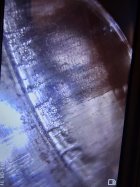
The carbon ring was unheard of until Boyer's book. Any idea of how much it carbon it takes before the buildup interferes with the brass opening upon firing?
It will be a cold day down below when I or many others take a brush off before pulling back through the barrel . Really?
I think the main reason that those of us in Short Range Benchrest do not worry about the carbon ring is we clean after every group on a regular basis.
The shooters in Disciplines that shoot as many as 100 rounds without cleaning, then wait to clean afore they get home or even later invite the ring to form.
The best time to clean your rifle is the minute you leave the line while the barrel is still warm. I NEVER take a dirty barrel home.
So, if cleaning with a properly fitting bore guide while cleaning the barrel, how does the carbon ring get touched? I assume this must be a separate step in the cleaning process without a bore guide.?
Relatively new to this compared to some, and this has always puzzled me.
For normal cleaning the brush is passed back and forth through the length of the barrel, and the brush is sized to the groove diameter of the barrel, not the chamber neck diameter. By going up a caliber in brush size and using a twisting motion while the brush is in the part you want to clean, you can get some benefit from the brush for removing a carbon ring at the end of the case neck part of the chamber. If your rod guide will let the larger brush pass, you can use it, but it is really not needed because the rod never gets into the throat for this operation. What you want is a rod that is of a convenient length that has a handle that is fixed to the rod rather than having bearings. There have been plenty of posts about what sort of cleaning liquids or abrasives different shooters prefer. Do you own a bore scope?
Bore tech has a nice chamber cleaning set up. The rod is a little longer than the sinclair.
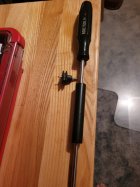
Before I joined this site, I knew nothing about, and never heard of a carbon ring. I just used #9 until patches came out clean and called it good. I have 2 high quality hunting rifles that always shot bugholes, then after a few years both started shooting worse and worse until I just quit using them. I even took one to a
"gunsmith" who said he couldn't find anything wrong.
As I started to read more and more posts about a carbon ring, it finally clicked that it might be my issue. I bought a Teslong borescope and some IOSSO and really got after it. Since the carbon had been in there so long it took a long time scrubbing, but I finally got them clean. Took both rifles to range after and accuracy was restored.
I find it hard to believe that the carbon ring thing is so unknown in the "average" shooting world. I think a lot of barrels have been replaced that simply needed a good scrubbing with some sort of abrasive.
As for Thorroclean, I don't see anything from the mfr. that states it's an abrasive? Maybe it is, but I can't find anything except internet conjecture that states that. All I know is that it REALLY works!
Before I joined this site, I knew nothing about, and never heard of a carbon ring. I just used #9 until patches came out clean and called it good. I have 2 high quality hunting rifles that always shot bugholes, then after a few years both started shooting worse and worse until I just quit using them. I even took one to a
"gunsmith" who said he couldn't find anything wrong.
As I started to read more and more posts about a carbon ring, it finally clicked that it might be my issue. I bought a Teslong borescope and some IOSSO and really got after it. Since the carbon had been in there so long it took a long time scrubbing, but I finally got them clean. Took both rifles to range after and accuracy was restored.
I find it hard to believe that the carbon ring thing is so unknown in the "average" shooting world. I think a lot of barrels have been replaced that simply needed a good scrubbing with some sort of abrasive.
As for Thorroclean, I don't see anything from the mfr. that states it's an abrasive? Maybe it is, but I can't find anything except internet conjecture that states that. All I know is that it REALLY works!
This is the kind of evidence (before and after) performance results that is meaningful, at least to me. Thanks for posting.
Before I joined this site, I knew nothing about, and never heard of a carbon ring. I just used #9 until patches came out clean and called it good. I have 2 high quality hunting rifles that always shot bugholes, then after a few years both started shooting worse and worse until I just quit using them. I even took one to a
"gunsmith" who said he couldn't find anything wrong.
As I started to read more and more posts about a carbon ring, it finally clicked that it might be my issue. I bought a Teslong borescope and some IOSSO and really got after it. Since the carbon had been in there so long it took a long time scrubbing, but I finally got them clean. Took both rifles to range after and accuracy was restored.
I find it hard to believe that the carbon ring thing is so unknown in the "average" shooting world. I think a lot of barrels have been replaced that simply needed a good scrubbing with some sort of abrasive.
As for Thorroclean, I don't see anything from the mfr. that states it's an abrasive? Maybe it is, but I can't find anything except internet conjecture that states that. All I know is that it REALLY works!
In my experience, if a bore cleaning product “works” by removing that hard carbon from throat forward 6” then it is most likely an abrasive bore cleaning product. I say this because I know of no liquid solvent that will remove that hard glazed carbon build-up. Brushing a lot…and I mean a lot with something like Free All may put a a dent in the hard carbon but you will be in the 100’s of brushing cycles to notice a difference. Why not just judiciously remove that crap the most efficient way and that is with an abrasive bore product such as Iosso, Thorroclean (which I believe to be a liquid type of Iosso), Flitz Bore Cleaner, JB (the gray JB with blue cap), KG2, Montana Extreme Copper Cream, or in extreme neglected cases - Holland’s Witches Brew. I prefer Iosso or Thorroclean using Iosso Blue Nylon brushes according to Iosso’s instructions. That never fails me in rather quickly removing all traces of any fouling. It really is a simple and effective solution without aimlessly hoping for and trying all sorts of liquid solvents that are not going to cut it.
Just because you see color doesnt mean you can measure it. Use a brush and dont worry about it
NRA life member
Gold $$ Contributor
I use a carbon arrow shaft to break up the carbon ring.
I use a carbon arrow shaft to break up the carbon ring.
Could you elaborate on this a little. TKS
I use a carbon arrow shaft to break up the carbon ring.
Yes, please explain
NRA life member
Gold $$ Contributor
Could you elaborate on this a little. TKS
I use a old arrow that I cut the broad head insert off, sand the shaft until it fits snug in the neck of the chamber, I used to use Rem 40x on the shaft but now I use a small amount of Thorroclean, insert shaft into chamber neck and work it back and forth and spin it around in the neck. This will break up most of the carbon if it’s not too hard but as previously mentioned you have to stay on top of the carbon ring and not let it get out of hand.
To clean my rimfire carbon rings, I use a Pro Shot 10” chamber cleaning rod fitted with a brush. The rod has a thin handle so it clears your stock and it has a non rotating handle. First I soak the chamber for about 10 min using a 22 bore swab wetted with bore tech C4. I only wet enough of the swab to reach the carbon ring, amd only inset the swab far enough into the chamber so it doesn’t go far into the lands. I use a spent 22LR shell to measure how much of the swab to wet. The carbon ring will be just beyond the end of the shell mouth. No need to be overly precise about this. It just gets me in the ballpark of the carbon ring without going too far into the lands. Reasoning behind this is: being a 22LR, I subscribe to the theory of not scrubbing my whole bore until accuracy falls off.
After 10 min of soaking the chamber, I remove the swab. Then attach the brush to the chamber rod. Apply c4 to the brush. Use the shell casing to measure how much of the brush to insert to reach the carbon ring. Then insert the brush the required depth and then rotate it to scrub the carbon ring off. I’ve checked with a borescope and found a 10 min soak and 5 to 10 rotations of the brush removes most rings. Heavy long-standing rings might require repeated cycles.
I finish off with pushing a couple of dry patches all the way through the bore to remove the excess C4 and carbon. This is my regular cleaning routine after each 22LR shooting session. I only fully scrub the whole bore when accuracy falls off. Again this is my 22LR cleaning routine. I scrub everything every time with other calibers.
You will not damage a barrel with a brush.
Forum Boss: I generally concur, if the person is using a proper bore guide and is not overly aggressive. However, I have inspected multiple barrels showing damage to the edge of the crown caused by sawing back and forth with bronze brushes. I know that many successful short-range shooters brush very aggressively, but some of those guys also regularly re-crown their barrels or toss them after 800 rounds.
Unless there is an extreme time constraint I recommend using a bronze brush in one direction, then removing it after it exits the barrel, and cleaning it with solvent, then putting it back on the rod and entering from the chamber end. That said, there are some barrels and types of fouling where back and forth movement in the throat area might be required. But I think most people, with custom barrels, will benefit by being conservative, if they clean before the carbon hardens.
People who have not competed in short range groups matches lack the experience to understand fully why those that do clean differently than they do. If the match has a single relay, a shooter may only have 30 minutes to attend to loading the ammunition for his next match and getting his barrel clean enough to shoot sub .2 groups if the conditions allow. This situation is unique to this sport. In competition barrels are consumables. As someone once said to me, that is why they have threads. If one is not operating under these constraints, then a different approach may be used.
If your brass necks are way short for the chambering you will get a wider carbon ring . I have a gun that has the chamber neck cut .040 longer than spec and brass that is .007 shorter then specks , and that makes the chamber .047 gap between the brass and the chamber neck . Mine is a 222 so I made 222 brass out of Lapua 223 brass for a .007 gap and check my brass after every firing . So far after 400 firings not of a carbon ring with normal cleaning .
If your brass necks are way short for the chambering you will get a wider carbon ring . I have a gun that has the chamber neck cut .040 longer than spec and brass that is .007 shorter then specks , and that makes the chamber .047 gap between the brass and the chamber neck . Mine is a 222 so I made 222 brass out of Lapua 223 brass for a .007 gap and check my brass after every firing . So far after 400 firings not of a carbon ring with normal cleaning .
What powder are you using and how often do you clean?
I do believe in Captain Crunch.
An over-sized Iosso bore brush coated with C-4 on a short cleaning rod spinning in that area will do wonders. Try 20 revolutions and check it. May take more. If the C-4 fails Iosso on the brush is the next step.
This is exactly my process as well.
And on a different topic, people need to be careful with their crowns even when using a boreguide.
Do this test. Fully Poke a brush or patch jag out your muzzle. Closely observe the jag base or the cleaning rod end. These are usually brass. I have noticed on a couple of my rifles and bore guide setups, the intersection of the jag and the cleaning rod (where it threads together) can drag on your crown. So if you think a brass brush can hurt, what then about solid brass?
However the simple and cheap fix is using a stop on your cleaning rods near the handle. So you never push a jag out the muzzle past this section:
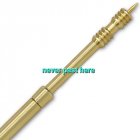
Possum hollow and PMA (or was it Bruno's?) is where I bought an adjustable rod stop for less than 5 bucks.
I do believe in Captain Crunch.
I think the main reason that those of us in Short Range Benchrest do not worry about the carbon ring is we clean after every group on a regular basis.
Might be the #1 or #2 reason I could never get into SR Benchrest!
What powder are you using and how often do you clean?
I'm using vv130 with light pass with 3 patches every 10 rounds . And a good cleaning before I leave the range .