Many precision reloaders use various gauges to monitor the seating force in their bullet seaters. The data helps them to sort cartridges in groups based on the amount of force and consistency. The problem is that the fast moving needle of the gauge does not allow getting many visual details. Some serious electronic tools are capable of providing detailed data presented by graphs, numbers etc.
I decided to build an electronic seating press, motorized, of course, to help with the pain in my arthritis hands – and to include all numbers of bells and whistles for a meaningful visual and analytical presentation.
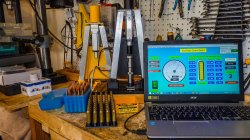
Here is my AccuPress:
Two sensors are collecting data – one is a load cell (Lbs) and the other is an optical encoder (converting the rotation of the threaded shaft into incremental 1/1000 inch distances).
The data is presented in two formats – analog and digital.
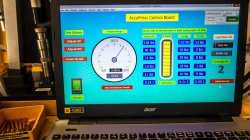
The analog format: Take a look at the pressure gauge on the computer screen. The hand of the gauge shows the amount of seating force (pounds) in real time. The dept of the seated bullet is shown in a dedicated box in real time as well.
Since the real time is very short, it is very difficult to observe any details (i.e. the correlation between force and the seating dept). A slow motion re-play of the entire seating process is provided (as many times as desired).
The digital format: In my opinion, digital evaluation of any process is crisper and more precise than multiple plotted curves.
Five control points from the continuously recorded data stream (force vs seating dept) are selected for evaluation. They are spread out at 10,30,50,70 and 90% of the seating dept line. After bullet seating each of the selected control points shows Full Force [Lbs], Avg Force [Lbs] and Standard Deviation [Lbs], similar to our chronographs [fps].
Additional calculations are provided for the “work done” numbers [in jouls] in a similar format – Full, Average, Standard Deviation.
All recorded data, if required, can be fed into a logging text file or a spreadsheet.
In case of rejection of a cartridge, the user can mark it as “deleted” in the log file. At the same time the associated data is excluded from future calculations.
I decided to build an electronic seating press, motorized, of course, to help with the pain in my arthritis hands – and to include all numbers of bells and whistles for a meaningful visual and analytical presentation.
Here is my AccuPress:
Two sensors are collecting data – one is a load cell (Lbs) and the other is an optical encoder (converting the rotation of the threaded shaft into incremental 1/1000 inch distances).
The data is presented in two formats – analog and digital.
The analog format: Take a look at the pressure gauge on the computer screen. The hand of the gauge shows the amount of seating force (pounds) in real time. The dept of the seated bullet is shown in a dedicated box in real time as well.
Since the real time is very short, it is very difficult to observe any details (i.e. the correlation between force and the seating dept). A slow motion re-play of the entire seating process is provided (as many times as desired).
The digital format: In my opinion, digital evaluation of any process is crisper and more precise than multiple plotted curves.
Five control points from the continuously recorded data stream (force vs seating dept) are selected for evaluation. They are spread out at 10,30,50,70 and 90% of the seating dept line. After bullet seating each of the selected control points shows Full Force [Lbs], Avg Force [Lbs] and Standard Deviation [Lbs], similar to our chronographs [fps].
Additional calculations are provided for the “work done” numbers [in jouls] in a similar format – Full, Average, Standard Deviation.
All recorded data, if required, can be fed into a logging text file or a spreadsheet.
In case of rejection of a cartridge, the user can mark it as “deleted” in the log file. At the same time the associated data is excluded from future calculations.