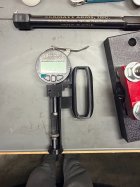
While measuring a projectiles overall length, I find myself wondering "Am I almost done?". I don't find it to be totally arduous but definitely find myself getting tired of the repetition and speed whilst using digital calipers. For that reason alone, I created a quick design to make a bullet measuring tool that cuts the time to measure projectiles in half. Below you will find pictures and video of what I created.
If this is something that interests you, just like the
Shotmarker Sensor Hub case I created, I'm more than happy to making some of these for members of this forum and for BRI members (sans shipping costs for BRI members).
For this design, I am using PETG-CF which adds rigidness to the overall design. There is a knurled tension screw for both the base adjustment and tension of the gauge to the body itself.
This QBMv1 will comfortably measure bullets from 6mm to .338 and some variants of .375. I do not have any other bullets larger than those stated, so please let me know if you are able to measure anything larger.
For the body only: $30 shipped USA Only
For Body + Digital Gauge: $65 shipped USA Only
I also have Shotmarker Protector Cases i'm currently offering. Can be found here:
https://forum.accurateshooter.com/threads/shotmarker-sensor-hub-protection-case-offering.4165958/
Sometime next month, I'll share an offering for a action/cleaning-rod shrouds that work in tandem to protect the action and stock from the solvents we use. Will go for around 13 bucks shipped.
If you purchase this, cheers and speedy measuring to you!
-

IMG_5460.jpeg
456.7 KB
· Views: 95
-
IMG_5461.jpeg
454.1 KB
· Views: 96
-

IMG_5463.jpeg
338.2 KB
· Views: 96
That is one slick tool!! Could it also be used with the appropriate cups to measure B2O?
Thanks,
Lloyd
That is one slick tool!! Could it also be used with the appropriate cups to measure B2O?
Thanks,
Lloyd
Thanks! I think it's possible but would require design modification and perhaps a stronger spring within the gauge itself. However, I think I prefer my b2o to be measured by my Mitutoyo Calipers! Great idea and maybe i'll put some thought to it and try something out next year, i'm always up for making the process faster whilst maintaining repeatability and accuracy!
Brilliant and well made. Why not measure with a hollow insert to the bullet's ogive?
Holy Cow Batman!!
I have had the same idea, but, never considered using the 3d printer sitting in the shop. Dumb. I need to fire up the cad program and get to work. I even have some GF filament on the shelf for it.
Brilliant and well made. Why not measure with a hollow insert to the bullet's ogive?
Thank you!! I'm actually working on a design to handle inserts and bullet bases now to test out bto measurements. Will keep you all posted.
Holy Cow Batman!!
I have had the same idea, but, never considered using the 3d printer sitting in the shop. Dumb. I need to fire up the cad program and get to work. I even have some GF filament on the shelf for it.
Although I sell this, it's really a hobby. I'm more than happy to share my design files with you for you to print or remix for personal use. Just message me if you're interested.
Holy Cow Batman!!
I have had the same idea, but, never considered using the 3d printer sitting in the shop. Dumb. I need to fire up the cad program and get to work. I even have some GF filament on the shelf for it.
Charlie.....You know I've been using the Hollands to sort by base and ogive.
i don't care about lengths but it would not be too hard to make a stop for
one then have a tool capable of doing both.
I was thinking the same. Making a base with interchangeable inserts for bullets, cases, ogive or oal, shoulders, etc.
Although I sell this, it's really a hobby. I'm more than happy to share my design files with you for you to print or remix for personal use. Just message me if you're interested.
Thank you!! I'll start looking into this and see of that would help.
For some reason I am still not in the habit of going to the printer first rather than cobbling up something in the shop. You'd think I'd be smarter than that

Charlie.....You know I've been using the Hollands to sort by base and ogive.
i don't care about lengths but it would not be too hard to make a stop for
one then have a tool capable of doing both.
I measure length for now for meplat trimming and bullet pointing. Are competitors also doing bullet base to ogive measurements as well? At this time, I do cbto as my final measurement when the round is completed. I'm a rookie F-Open competitor so i'm still learning!
I'm now inspired to do a bullet base to ogive tool that cuts time in half. In my head, I believe the design should be sitting on a flat surface. Give me some time and i'll eventually make a design soon, this is fun!
I was thinking of making a base that held various gauges, like the Hornady ogive comparator and/or shoulder comparator. Place the bullet nose down and then the dial indicator would touch the base of the bullet. Same for a cartridge to check base to ogive. The shoulder comparator would be inserted to check base to shoulder.
A different base could be put on to check bullet and/or case neck runout. The trick would be calibration for some of these. A dial indicator can't do more than an inch, so measuring a case means moving things about. Maybe a set of inch standards could be used when setting up?
Yes, plastic has a definite issue with dimensional stability, but, if kept at a reasonable room temperature and humidity then the 'calibration' during setup should solve that? Those who are more OCD about this could take the design and make it out of metal.
That Holland setup looks like a good idea as well. Horizontal rather than vertical. A larger base to make it more stable would be easier that way. Maybe look at the Forster/Lyman type trimmer, neck turning setups and see if those offer any ideas for how to set it up for measuring?
That is one slick tool!! Could it also be used with the appropriate cups to measure B2O?
Thanks,
Lloyd
^^^^^^^
The base to ogive is the important dimension.
^^^^^^^
The base to ogive is the important dimension.
I have always thought so as well Jackie.
I was thinking of making a base that held various gauges, like the Hornady ogive comparator and/or shoulder comparator. Place the bullet nose down and then the dial indicator would touch the base of the bullet. Same for a cartridge to check base to ogive. The shoulder comparator would be inserted to check base to shoulder.
A different base could be put on to check bullet and/or case neck runout. The trick would be calibration for some of these. A dial indicator can't do more than an inch, so measuring a case means moving things about. Maybe a set of inch standards could be used when setting up?
Yes, plastic has a definite issue with dimensional stability, but, if kept at a reasonable room temperature and humidity then the 'calibration' during setup should solve that? Those who are more OCD about this could take the design and make it out of metal.
Thanks for the thoughtful feedback! I really appreciate you raising those points.
PETG-GF was chosen and works well here because it balances rigidity and toughness. The glass fiber reinforcement adds the stiffness needed to hold accurate dimensions during measurement, while the PETG base keeps it from being brittle or prone to cracking with normal handling.
From a stability standpoint, PETG-GF is very resistant to environmental effects once printed. Unlike nylons, it doesn’t meaningfully absorb moisture in use, so humidity has little impact on dimensions or performance over time.
You’re also absolutely right that setting zero before each session is beneficial. Doing so helps account for any small environmental or setup variables and ensures the most consistent and repeatable measurements. That being said, metal would be the absolute best option, but of course that comes at a much much higher cost and the intention of this item was to save fellow members some greenbacks.
Thanks again for the input, I love having these type of conversations— it’s appreciated. To those who have ordered, I'll be sending out tracking numbers and have them shipped by Tuesday, enjoy!
^^^^^^^
The base to ogive is the important dimension.
I agree, I am working on a design and would like to use it for a couple of hundred rounds before I release it.
:-)
Silver $$ Contributor
Although I sell this, it's really a hobby. I'm more than happy to share my design files with you for you to print or remix for personal use. Just message me if you're interested.
Great you are willing to share!
.... been using something similar the past few years:
If you are only going to sort by one measurement then the OAL of the bullet seems to be the way to go. You can also sort by bearing surface, base to ogive, etc and it is more time consuming with minimal returns or impact on target.
I have been sorting by OAL using a set of calipers but it’s time consuming and requires care when placing the bullet on the caliper.
This tool will make sorting bullets a breeze and it won’t break the bank since it is 3D printed. It is comfortable to hold and quick to measure. I have measured .22(80.5, 85.5), 6mm(103,105,107,108) and 7mm(180 and 184) bullets...
You're welcome. It is always nice to bounce ideas off someone else as a new thing can come out every now and then.
Yes, PETG GF is one of those 'good' filaments that works well as long as temps don't get too high. I use the plain PETG quite a bit, especially if chemicals are involved. Have you tried one of the 'core' types yet?



