I'm curious if I am the only one? Does anyone else use an exacto knife to cut kernels in half? I'm thinking of making a kernel splitter that will retail around $300 bucks. Will there be a market?
I'm curious if I am the only one? Does anyone else use an exacto knife to cut kernels in half? I'm thinking of making a kernel splitter that will retail around $300 bucks. Will there be a market?
There is a market for anything that can give people who have the money a sense of comfort.
Call it the Precision Something Something - a catchy name - and off you go. And it has to be shiny, with smooth machined surfaces, and be heavy. People don't like plastic stuff.
First I drink the coffee, then I do the things.
Gold $$ Contributor
Colonel Splitter. Make it silver, in the shape of an eagle.
If anyone uses that name, I get royalties...........
We're gonna make a fortune....
I'm curious if I am the only one? Does anyone else use an exacto knife to cut kernels in half? I'm thinking of making a kernel splitter that will retail around $300 bucks. Will there be a market?
Win a Match using it and You won’t be able to keep up with orders

If you maintain your beam balance, keep the pivot points and knife edges clean, keep the balance covered to protect against dust and mount the balance so that it is level*, in my experience there is no accuracy or repeatability issues unless the balance is defective or worn out which does happen.
If you're using extruded powder, based on my experience of loading and testing thousands of reloads over the past 50 years, a few tenths of a grain .1 to .2 of variation make absolutely no difference at all in accuracy that I could discern.
However, I'm not loading for benchrest level of precision - I will defer to those guys on this issue. I'm talking about what I define as precision shooting, i.e.,1/2 - 5/8 moa.
*Credit to Boyd Allen for helping me make the necessary adjustment to the weighted pan to achieve this which stabilized the repeatability.
I load for 1000 yard BR, my scale will resolve very close to one kernel of H 4895, it takes about 6 kernels ( .1gr) to significantly change the target at that distance.
Then the question should be: Show me the person, any caliber, who can shoot the difference of plus or minus 1 single grain of any powder …..
Do smaller grains of an extruded powder, like Varget, burn faster or slower than larger grains?
What percentage of little grains compared to bigger grains do you get in a single charge?
I'm curious if I am the only one? Does anyone else use an exacto knife to cut kernels in half? I'm thinking of making a kernel splitter that will retail around $300 bucks. Will there be a market?
quite a large number of Short Range Shooters use N133. If you have ever taken a look at 133, you will see that no two kernels are even the same.
years ago, there was an article in the old Shooters News where some guy purchased various fine screen sieves to actually sort the various sizes.
From whatI could gather, the results were inconclusive.
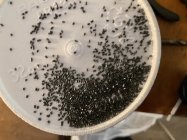
Here is a picture 2015 133 I am using now.
I wonder when guys start discussing how one kernel has a fps value of X and has a vertical factor of Y, just how they arrive at that beyond speculation or theory.
It’s easy to estimate an average value. If 1.0 grain changes velocity by 50 fps, then a single .02gr kernel is worth 1fps. But its near impossible to measure directly.
Then the question should be: Show me the person, any caliber, who can shoot the difference of plus or minus 1 single grain of any powder …..
waiting.....
Then the question should be: Show me the person, any caliber, who can shoot the difference of plus or minus 1 single grain of any powder …..
I already covered this. No one alive today can shoot the difference in +/- one kernel of powder. What we are getting by weighing powder to less than +/- one kernel range is that charge weight effectively is no longer a
variable. When I'm lying behind the rifle at a match, knowing in my mind that velocity variance due to charge weight variance is never, ever, ever, EVER going to be an issue is worth something to me. If that peace of mind is not desirable or of any interest to someone, then they don't need to be weighing powder to +/- one kernel.
As has been said, this site is all about shooting, and all procedures are ultimately resolved by groups on targets. Having said that, we are of course free to split all the process hairs we like, but at some point it starts to be less interesting to others unless they can see proof that it is useful for the particular type of shooting that they prefer. For instance, no one needs single kernel accuracy for short range benchrest, or really for anything that is less demanding than long range benchrest, 1,000 yard in particular. If one likes to play with the toys, as I often do, that is just fine, but we also need to keep an eye on whether splitting a particular hair matters at an actual target. I have tuned scales and with a web cam and monitor observed single granule response, but for the kind of shooting that I have done, it has not practical utility, other than knowing that my equipment is capable of doing that, which means that it is well up to lesser tasks. One of the down sides of these sorts of discussions is that less experienced shooters may come to obsess over a detail that in the total scheme of things may be totally unimportant, given the limitations in their desire and/or ability to address the other variables. Ultimately, in the pursuit of accuracy some things are more important than others. A lot of it has to do with things that have nothing to do with reloading, much less super charge weight precision. In the short range group benchrest game, if you have good equipment, all that is required is to stay within +- .1 gr. To further make my point, if you look in the NBRSA group records, all of the several owned by my friend Gary Ocock were shot with charges thrown directly from his powder measure into his cases, and as difficult as it is to throw 133, all of his records in the last five years have been shot with that powder.
Do smaller grains of an extruded powder, like Varget, burn faster or slower than larger grains?
What percentage of little grains compared to bigger grains do you get in a single charge?
Burn rate of a powder is not up to the grain size.
All powders are coated to reduce the burn rate. Only the very fast pistol powders are uncoated. Nitrocellulose is grey in the pure form.
The amount of coating with the average mass of a granule is what determines burn rate.
Slower burning powders have more coating on them.
Not sure what that coating is, maybe graphite ?
No one alive today can shoot the difference in +/- one kernel of powder.
The downrange effect on the target by a change to the load of 1 granule is lost in the noise of other variables.
It’s easy to estimate an average value. If 1.0 grain changes velocity by 50 fps, then a single .02gr kernel is worth 1fps. But its near impossible to measure directly.
Math does not lie.
But to get an approximation to a real world result from math, means you have to take into account the major variables, with their correct values at the time of the shot.
Just looking at the shot itself for velocity purposes, the change from one kernel is not distinguishable above the mean noise of all the other variables.
Burn rate of a powder is not up to the grain size.
All powders are coated to reduce the burn rate. Only the very fast pistol powders are uncoated. Nitrocellulose is grey in the pure form.
The amount of coating with the average mass of a granule is what determines burn rate.
Slower burning powders have more coating on them.
Not sure what that coating is, maybe graphite ?
Actually the surface area of granules of powder is used as one of the primary methods of controlling burn rate. Here is an article that gets into the details.

en.wikipedia.org



