Follow along with the video below to see how to install our site as a web app on your home screen.
Note: This feature may not be available in some browsers.
This Forum is for adults 18 years of age or over. By continuing to use this Forum you are confirming that you are 18 or older. No content shall be viewed by any person under 18 in California.
From the OPs wording, I am thinking the question is really about seating depth, not headspace? In terms of headspace, I typically select 10 pieces of brass from a single prep at random and record all the pertinent measurements "before" and "after" re-sizing. If the die is set properly, variance for each set of 10 measurements is usually well below the precision of the calipers.
In terms of seating depth, I am typically looking for an "acceptable" CBTO range of no more than .001", with the majority of loaded rounds falling within .0005". For example: the CBTO range I used for some .308 rounds I loaded up last week with 168 Hybrids for a match was 2.2130" to 2.2125" .
To accomplish that, I set my seating dies to deliver a CBTO value at the longer end of the range on a typical stroke; in the example above that would be 2.2130". With the seating die micrometer set properly, I generally observe better than ~75-80% of the loaded rounds will measure to this longer "acceptable" CBTO range measurement with a single stroke of the press. With this approach during the course of seating 70+ rounds for a match, you might observe a small number of loaded rounds where you either seated the bullet with a little more force than the others, the neck tension might have been slightly lower, etc. Those rounds might give a CBTO measurement of 2.2125".
Only in extremely rare cases will I find the CBTO of a loaded round to be less than the lower end of the "acceptable" range (i.e. </= 2.2120" in the above example). Any such rounds are used only as foulers/sighters. You might also occasionally observe a round to be longer than the upper end of the acceptable range (i.e. >/= 2.2135" in this example). Those rounds simply receive additional "taps" in the seating die until they reach an "acceptable" CBTO measurement.
It may be argued that this approach is a needless expense of time, even though it really doesn't take that much extra effort. However, I have loaded enough rounds by this method over the years to know that if you aren't measuring every single loaded round, there is a good chance a typical seating die will deliver a CBTO range of as much as .002" to .003" (or more) during the course of loading ~70 rounds for a match. In other words, you will have a small number of rounds in every batch that are essentially as far apart in terms of seating depth as we typically use between test increments during seating depth testing (i.e. ~.003"). I personally do not find that to be acceptable and am willing to spend the extra time/effort to correct an issue that actually IS correctible. Some issues we can never fully address during the reloading process, and we have to accept certain things on faith. Seating depth is not one of those issues.
If you're doing a large lot , say over a hundred , I'd randomly check about one of every 15 to 20 . Stuff happens .....Better to check a few , than have to go back and re-run a bunch .
If you have your dies set up correctly, have locked the die locking ring off, and are using a press of at least moderate quality, your headspace should never change. Certainly wont be increasing or decreasing the shoulder bump unless your press is seriously broken or the die locking ring moves. Same goes for your sesting depth and seating die. Set them, lock them off and you shouldnt need to change them, or even check. After a few hundred rounds you will need to check seating depth as you get some throat erosion, or you change batch of projectiles. but otherwise your dies shouldnt change.
I do have a custom, high quality, extremely accurate case length checker though.... and i check every round for headspace before i fire it. If any of my loaded cases are tight in that gauge, next time i reload that batch of cases i will double check shoulder bump (but hasnt happened yet). Yep, that case gauge is my rifle....
I would add that if you think that a minor variation in seating depth of your projectile will impact on accuracy (say 0.0015" like suggested above) then thats not as very well tuned load.
If you have your dies set up correctly, have locked the die locking ring off, and are using a press of at least moderate quality, your headspace should never change. Certainly wont be increasing or decreasing the shoulder bump unless your press is seriously broken or the die locking ring moves. Same goes for your sesting depth and seating die. Set them, lock them off and you shouldnt need to change them, or even check. After a few hundred rounds you will need to check seating depth as you get some throat erosion, or you change batch of projectiles. but otherwise your dies shouldnt change.
I do have a custom, high quality, extremely accurate case length checker though.... and i check every round for headspace before i fire it. If any of my loaded cases are tight in that gauge, next time i reload that batch of cases i will double check shoulder bump (but hasnt happened yet). Yep, that case gauge is my rifle....
I would add that if you think that a minor variation in seating depth of your projectile will impact on accuracy (say 0.0015" like suggested above) then thats not as very well tuned load.
Quote: If you have your dies set up correctly, have locked the die locking ring off, and are using a press of at least moderate quality, your headspace should never change. Certainly wont be increasing or decreasing the shoulder bump unless your press is seriously broken or the die locking ring moves.
Please explain how thats incorrect. Does your barrel over time move forward or backwards from the face of your bolt? How does the headspace change? I am interested in how you can explain this change?
Please explain how thats incorrect. Does your barrel over time move forward or backwards from the face of your bolt? How does the headspace change? I am interested in how you can explain this change?
Please explain how thats incorrect. Does your barrel over time move forward or backwards from the face of your bolt? How does the headspace change? I am interested in how you can explain this change?
Argh - I have experienced this with Norma brass and a 6 PPC. When I first got the dies/rifle combo and set everything up, I was bumping about .001. Got to the range, shot some great groups ( for me anyway ) but about 6 in 20 would not fully chamber. After pulling down and remeasuring, it was like I hadn't bumped anything back. All this brass was fireformed, annealed and new. Now my die is set for a .002 bump and I haven't had as much trouble.
Never saw this with Lapua brass in my BR's. So spring back can happen depending on metallurgy. At least I assumed that was the culprit.
Dusty
I use the RCBS Standard Full Length Sizing die , it gives full support to the case when adjusted as instructed and yes will oversize the case by .005 that is with the standard shellholder .125 deck height .
The Competition Shellholders have 5 Shellholders from .135 on up in .002 . Giving full contact on shellholder to die , using these Shellholders I can set my cases from zero on up , depending on what brass brand I'll go .001 to .002 no more or less , I hesitate to use the word " headspace "
I’m normally in the minority however once my Die is set producing consistent results I’ll check periodically to confirm.
IMO
Even if a cartridge varied 001 thousand, ( which is most likely the tool or a case that is resisting) I doubt very seriously that you or anyone else could see it on paper or shoot the difference.
If you spend more time shooting with wind flags and reading conditions then measuring primers etc. you’ll see those results on paper for sure.
Shoot Small
J
Mike
I agree , once I found a reload that shot accurately I stuck with that load for two plus years now and concentrated on form , groups got even tighter . Shooting is more enjoyable . Untill the next barrel change and it starts all over again . Only difference I know when to stop .
Please explain how thats incorrect. Does your barrel over time move forward or backwards from the face of your bolt? How does the headspace change? I am interested in how you can explain this change?
I'm not even sure how you came up with that thought . Maybe you don't understand the shell holders . They are a set of five with graduating deck heights in .002 increments of +.002 to +.010 from the standard shell holder deck height of .125 . If you are bumping the shoulder .005 or what ever number to much , you're not using the correct shell holder from the set . If you include the standard shell holder you have 6 different sizes you can size your cases while making firm contact between the die and shell holder for a total of .012 in variance from shortest to longest . Since your SAAMI chamber should only have a .004 head clearance spread from Go gauge to NoGo gauge . The extra .008 in .002 increments you have to work with means you should be GTG regardless of the chamber spec unless it's WAY out of spec .
I recently bought a PA-10 rifle and the headspace is long . Like fails the NoGo gauge long ( passes field gauge ). I just sized my cases with the largest shell holder in the set which is the +.010 shell holder . That is bumping my shoulders back .004 , that in it's self should tell you how long this chamber is .
I can and do . Since I started using the Redding competition shell holders I've not adjusted my die . That's 5 years , thousands of cases sized and loading for now 4 different rifles chambered in the same cartridge with all having different headspace measurements . All the adjustments are done with the shell holders rather then the die as explained above .
They are by far the tool that made my reloading process more precise with very little effort .
Of course you can. That's the simplest approach and is how they were designed to be used. As long as the external dimensions of the brass are maintained, the changes that occur over time that affect internal brass dimensions during the life of a barrel/chamber job can be accounted by minor load adjustments, which most people are already going to be doing anyway.
Of course you can. That's the simplest approach and is how they were designed to be used. As long as the external dimensions of the brass are maintained, the changes that occur over time that affect internal brass dimensions during the life of a barrel/chamber job can be accounted by minor load adjustments, which most people are already going to be doing anyway.
I guess youve never measured brass over time. You bump it .002 this firing and 2 firings later that same setting may only bump .001 on some. But your mileage may vary
If you adjust the die per the Lee instructions it will push the case shoulder back far enough to fit in any chamber and most likely you will not need to check cartridge headspace.
Example when I first got out of the service in 1973 I bought a Remington 760 Gamemaster in .270 Win.(AKA amish machine gun) And I set up my new Rockchucker press and dies to make hard contact with the shell holder with press camover. Meaning no minimum shoulder bump or even a way to measure the shoulder bump. I was lucky and in the 10 years I used this pump action rifle I never had a case head separation. And this was because the FL die was a good match to my chamber.
If you get a Wilson type case gauge a fired case may not fit in the gauge and not know how long the case was before being sized.
If you get a Hornady cartridge case headspace gauge you can measure a fired case and a resized case and set the die up for minimum shoulder bump. This is far more accurate "BUT" then you will see variations in shoulder bump location due to brass spring back, lube build up in the die etc.
Chambers and dies vary in size and if you have a plus size chamber and a smaller minus size die you might push the shoulder back too far and have a case head separation.
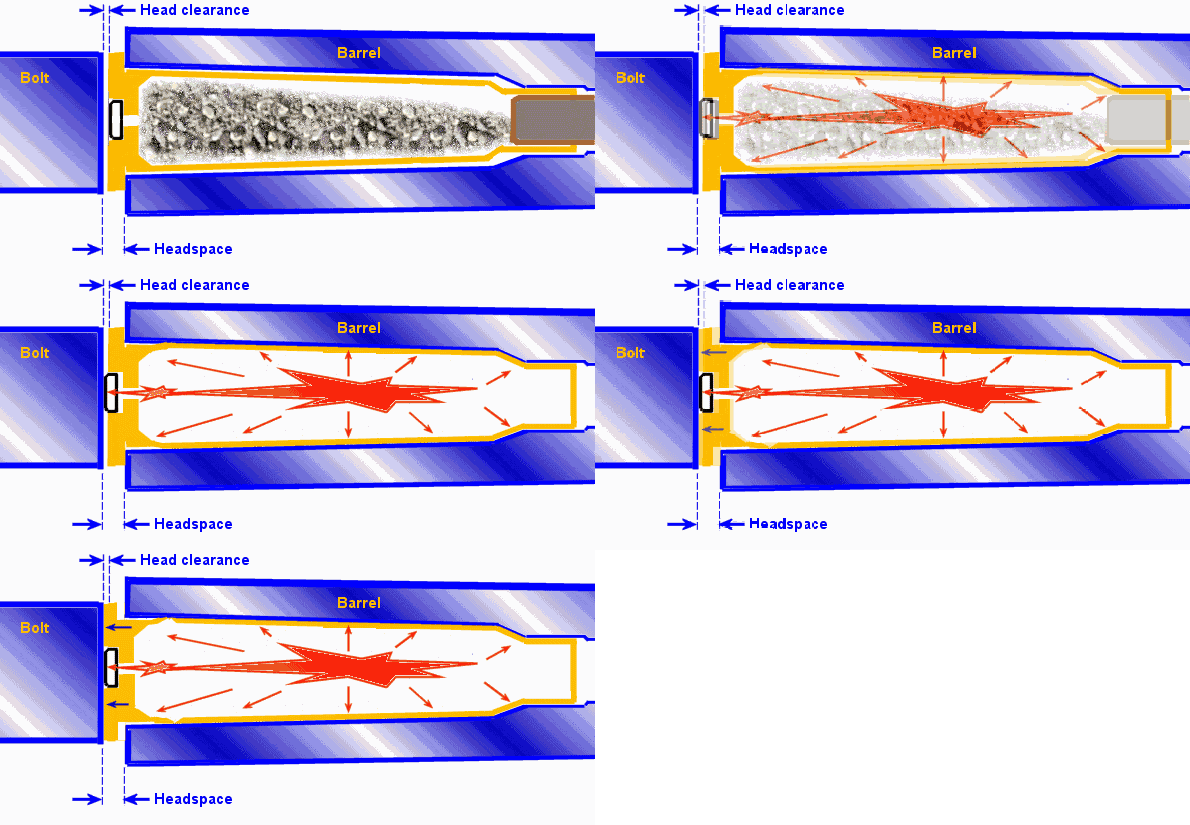
Below is a exaggerated image of full length resizing and the closer you push the shoulder back toward the green dotted line the more case stretch you will have and a greater chance of a case head separation.
Bottom line, I have been lucky, in over 48 years of reloading, the only case head separation I ever had was with a old worn .303 British Enfield rifle close to maximum headspace. And having good gauges will help with this problem, "BUT" the more gauges you have the longer it takes to reload. Meaning it can become excessive compulsive if you just have a off the shelf factory rifle.
If you do not want to buy and mess with gauges then keep it simple and just get a muzzle loader.
P.S. If you are looking for perfect shoulder bump every time just contact F. Guffey.
But the important part is the size of your chamber, the bit where your resized brass has to fit. That doesnt change. So if your die is set to bump the shoulder of your brass back a certain distance from the chamber size, it should never have to change until you rechamber or rebarrel.
Btw, i use 3 different brass brands in my 308 and only lapua in my dasher, but for each barrel/chamber i set my dies up and dont ever need to change. I dont see any difference in ease/difficulty in chambering those rounds, and i certainly dont waste my time at the loading bench check measuring every round, or even one in 10 rounds.....
This Forum's expenses are primarily paid by member contributions. You can upgrade your Forum membership in seconds. Gold and Silver members get unlimited FREE classifieds for one year. Gold members can upload custom avatars.