
• This Forum is for adults 18 years of age or over. By continuing to use this Forum you are confirming that you are 18 or older. No content shall be viewed by any person under 18 in California.

Fire Cracking and Barrel Heat

I've spoken with some pretty sharp people on this subject and most agree that temp is a big factor BUT not the only factor. Under extreme heat, the bbl is also expanding and contracting under pressure. They, and I agree, this expansion and contracting plays a role in what we see on the shallow surface of the bore. So, I think attributing it only to heat, is likely not completely the case, but certainly it factors largely into it.

I'm playing with a couple of reamers now that may help in regard to the heat and flame aspect. I'm simply laying the 45° angle at the chamber case mouth..end of chamber, from 45° to 15°. The whole idea is a much larger heat sink area as well as a far smoother step for the flame to flow over, as opposed to a very abrupt 45° step. Time will tell. I have seen no detriment to accuracy but still early. Way too early to see what affect it may have on bbl life, but that's the main objective behind it.

I've mentioned this a few times but will again... When S&W introduced their big 500 Mag revolvers, flame cutting of the top strap of the frame, above the cylinder gap, was a real issue. Their engineers cured it by simply polishing the inside of that area of the frame, allowing the flame to smoothly flow over and around without the rough eges that were there before, which started the cut and exacerbated it. Same principle with these reamers. Pretty much exactly but carrying it a little further.
 
Last edited:
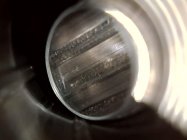
If you're doing the work then maybe. If you have to pay someone then I wouldn't do it.
^^^^^ this right here!

Dave your lucky! I told a customer that one time and he went off on me!

To add to Dave's post.... if you don't mind Dave?

If you don't cut the whole breech end off and you still have some threads left and you have to pick up the thread timing... again even more work and time added.

Also the wear/cracking goes up further into the barrel than most people think it does. O.K. so you cut 1" off the breech end, rethread it, recut the breech cone and rechamber it... yes it does put you into some cleaner rifling but if you only got a 1k rounds out of the barrel new (I'm just picking a number based on some calibers) don't expect to get another 1k rounds out of it the 2nd go around. You’re lucky if you even get 50%. It's usually less than that.

Don't forget being as your redoing the breech end to flip the barrel around and touch up the crown.

So..... It's not worth doing as Dave said, "if you have to pay someone to do the work."

If your doing it yourself... and the time doesn't mean anything to ya... knock yourself out.

If I have to pay someone to do the work... I'm putting a new stick on the gun.
 
Last edited:
I sold a really good low round count 6mm CM to a guy a last year. 7.5 twist Shilen Select Match large shank. It shot the 115s really small. Abought six weeks later he came back to buy a Model 12 BR action. I asked him how it shot for him. He said he didn't install it because it was worn out. I printed him the last couple pages of the spread sheet for the groups I shot. Mostly .2 to low .3". Some people should not be aloud to own bore scopes.
 
That's more or less how you case harden steel. Add heat and carbon.
Yes, but it's not. I've got a couple of reamers that cut absolutely beautiful chambers that have also done multiple setbacks of some pretty terrible looking bbls. Not sure how much time plays a role in case hardening but it's not even close to a bbl bore in terms of hardness. If it was, those reamers would be junk before finishing the very FIRST setback. Instead, one is possibly the best I've ever had and still makes winning and pretty chambers/ throats. Go figure is all I can say.
 
I've spoken with some pretty sharp people on this subject and most agree that temp is a big factor BUT not the only factor. Under extreme heat, the bbl is also expanding and contracting under pressure. They, and I agree, this expansion and contracting plays a role in what we see on the shallow surface of the bore. So, I think attributing it only to heat, is likely not completely the case, but certainly it factors largely into it.

I'm playing with a couple of reamers now that may help in regard to the heat and flame aspect. I'm simply laying the 45° angle at the chamber case mouth..end of chamber, from 45° to 15°. The whole idea is a much larger heat sink area as well as a far smoother step for the flame to flow over, as opposed to a very abrupt 45° step. Time will tell. I have seen no detriment to accuracy but still early. Way too early to see what affect it may have on bbl life, but that's the main objective behind it.

I've mentioned this a few times but will again... When S&W introduced their big 500 Mag revolvers, flame cutting of the top strap of the frame, above the cylinder gap, was a real issue. Their engineers cured it by simply polishing the inside of that area of the frame, allowing the flame to smoothly flow over and around without the rough eges that were there before, which started the cut and exacerbated it. Same principle with these reamers. Pretty much exactly but carrying it a little further.
This was also a problem with the .357 Maximum. The top strap was cut.
 
Consider I was ignorant about many things early in my career. I have observed a lot the last 25 years . It easy to address the big things. The subtle things that are linked to other subtle things, some can do the math and some can't. I know once a barrel is fire cracked you can never get all the carbon fouling out of those cracks. I also know from cleaning my SR BR after every group that if I first push a wet patch down the barrel to remove the loose powder fouling my brass bore brush will last twice as long. Also we use abrasives, sometimes aggressively, to remove carbon. The math says the carbon is an abrasive. I want the throat, the most critical of the reamer/chamber to stay fresh as long as possible. I take reamers out of service when the freebore, lead angle and the junction with the cylinder section show the first signs of wear. YMMV
 
This was also a problem with the .357 Maximum. The top strap was cut.
I've heard that as well. The info I posted on the 500 came from an engineer at S&W. He didn't mention the 357 Max but yes, I've heard the same more than once now. That's one I've never owned. My all time favorite big revolver caliber is probably the 41 Magnum. Now back to our regular programming. ;)
 
Consider I was ignorant about many things early in my career. I have observed a lot the last 25 years . It easy to address the big things. The subtle things that are linked to other subtle things, some can do the math and some can't. I know once a barrel is fire cracked you can never get all the carbon fouling out of those cracks. I also know from cleaning my SR BR after every group that if I first push a wet patch down the barrel to remove the loose powder fouling my brass bore brush will last twice as long. Also we use abrasives, sometimes aggressively, to remove carbon. The math says the carbon is an abrasive. I want the throat, the most critical of the reamer/chamber to stay fresh as long as


possible. I take reamers out of service when the freebore, lead angle and the junction with the cylinder section show the first signs of wear. YMMV
Dave good information. How many barrels can you turn with a reamer?
 
I've heard that as well. The info I posted on the 500 came from an engineer at S&W. He didn't mention the 357 Max but yes, I've heard the same more than once now. That's one I've never owned. My all time favorite big revolver caliber is probably the 41 Magnum. Now back to our regular programming. ;)
You must be too young to be influenced by Elmer Keith! Lol

I think he played with the 41 a little bit.
 
Dave good information. How many barrels can you turn with a reamer?
Most calibers I rough out the chamber with a core drill. That lessons the wear on the important parts. 60 maybe as many as 80 with hss, but 80 is a stretch. They still cut pretty cleanly but a lot of my work was for people going in harms way. They deserve only the best. Carbide is the other side of 300 and even then it's cutting pretty cleanly.
I once had to trouble shoot, problem solve for an elite unit. I would have rejected every piece. Actions, barrels etc. Imagine a feather of metal coming off the trailing edge of the throat. That's the extreme but every throat cut has that to some degree. Minimizing wear is paramount for me.
 
Went to the range today equipped with my new laser thermometer. Found out that the barrel temperature half way down the barrel was 20 degrees hotter then at the chamber. Why then does fire cracking appear at the chamber?
Rocket science!!!!
When you start the combustion, it takes around 1/4 to 1/3 burn of propellant to start sliding the bullet into the rifling. All the unburnt powder is forced forward!! About the time the bullet is almost in the rifling, the mass density of the retaining powder and the combined high mass gases have approached the density of fluids!! This fluid now has more power than gas power! The phase change (gas to liquid) absorbs the heat (endothermic reaction) and hydrostatic force accelerate the liquid (now a plasma) and the bullet down the barrel while pressure washing (high transport velocity) the barrel!! At a certain point, near complete burn, the volumetric increase behind the bullet reduces the density back down to gas phase chance!! At this point, heat is released (exothermic reaction), scorching the barrel, and releasing all the transport residue!!!

Isn't this combustion engine we call firearms great!!!

A quick lesson on Newton's 2nd Law, and the fundamentals (basics) of Thermodynamics and Hydrodynamics!!!

Aim small, hit BIG
BILL!!
 
Last edited:
Rocket science!!!!
When you start the combustion, it takes around 1/4 to 1/3 burn of propellant to start sliding the bullet into the rifling. All the unburnt powder is forced forward!! About the time the bullet is almost in the rifling, the mass density of the retaining powder and the combined high mass gases have approached the density of fluids!! This fluid now has more power than gas power! The phase change (gas to liquid) absorbs the heat (endothermic reaction) and hydrostatic force accelerate the liquid (now a plasma) and the bullet down the barrel while pressure washing (high transport velocity) the barrel!! At a certain point, near complete burn, the volumetric increase behind the bullet reduces the density back down to gas phase chance!! At this point, heat is released (exothermic reaction), scorching the barrel, and releasing all the transport residue!!!

Isn't this combustion engine we call firearms great!!!

A quick lesson on Newton's 2nd Law, and the fundamentals (basics) of Thermodynamics and Hydrodynamics!!!

Aim small, hit BIG
BILL!!
You're obviously better versed in this subject than I but I've never heard of the combustion process of smokeless powder involving becoming a liquid. If I understand you right, you are saying it starts as a solid, turns into a gas, then a liquid and back into a gas. I've simply never seen this expressed anywhere else.
 
You're obviously better versed in this subject than I but I've never heard of the combustion process of smokeless powder involving becoming a liquid. If I understand you right, you are saying it starts as a solid, turns into a gas, then a liquid and back into a gas. I've simply never seen this expressed anywhere else.
Part of the solids burn to form a gas!!! That gas volume is huge compared to the volume of the solids that burnt and gas pressure spikes!!! Heat is generated from the chemical burning of the NO3 fuel which is already oxidized!! As more power burns, the mass of the gases and the remaining mass of powder squeezed forward due the parabolic internal shape of the case and the pressure, are as dense as a liquid!! But this liquid is unique!!! It absorbs the heat and is a pure high energy fluid called plasma!!! This is called the Adiabatic process in thermodynamics!! A gas/liquid phase change that absorbs heat!!! As the volume increase in the barrel/case there is a point where the plasma loses density and the plasma releases heat and returns to being a hot gas!!! The Diabatic process is the reverse of the Adiabatic process!!! Liquid to gas and releases heat!!!

I've read several reports from the 60s-80s that were releases to the public from military labs and testing field and grounds from internal ballistics studies of small firearms to the big guns!!! All stated reports identify these processes but in mathematical terms!!! Having a physics degree, I could read the language of the higher math!!! Plus, it was also mentioned in the written words!!!

By the way, the parabolic internal shape of the case is similar to the double parabolic shape of the 5 F-1 engines of the Saturn 5 1st stage rocket that sent men to the moon!!! The F-1 engines, built in the 60s, are the most powerful engines ever built by man!!! Parabola have a focal point or focus!! That shape will focus energy to a single point on the axis!!! The cartridge is a rocket engine! Not an air gun with just compressed gases!!
 
Last edited:

Upgrades & Donations

This Forum's expenses are primarily paid by member contributions. You can upgrade your Forum membership in seconds. Gold and Silver members get unlimited FREE classifieds for one year. Gold members can upload custom avatars.


Click Upgrade Membership Button ABOVE to get Gold or Silver Status.

You can also donate any amount, large or small, with the button below. Include your Forum Name in the PayPal Notes field.


To DONATE by CHECK, or make a recurring donation, CLICK HERE to learn how.

Forum statistics

Threads
169,887
Messages
2,283,207
Members
82,376
Latest member
kethomas397
Back
Top
