• This Forum is for adults 18 years of age or over. By continuing to use this Forum you are confirming that you are 18 or older. No content shall be viewed by any person under 18 in California.

Bolt disassembled when not in use?

If you play with various rifles, most cock on opening ( Dry fire/close bolt while pulling the trigger) if they cock on closing ( like many older rifles, leave bolt open and un-cocked) this releases the pressure on the springs and aids in spring pressure lose be nothing to worry about.
 
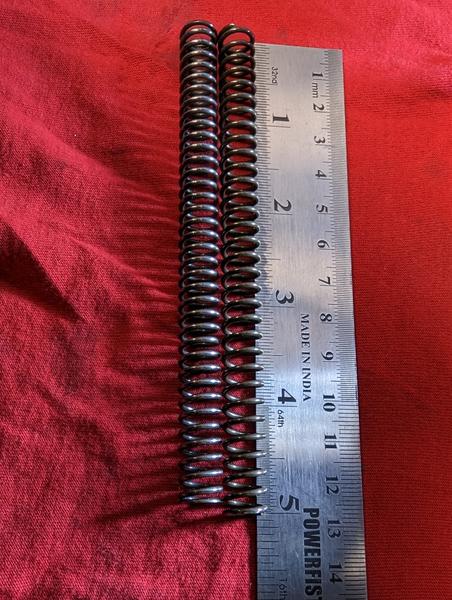
I received my replacement springs from Kelblys, below is a comparison picture. The old one on the left is about 1/8" shorter, it is 12 years old, gun hasn't been shot in 10 years.

The old spring weight was about 22.5lbs, the new one about 24.5lbs.

9ulKlkH.jpg


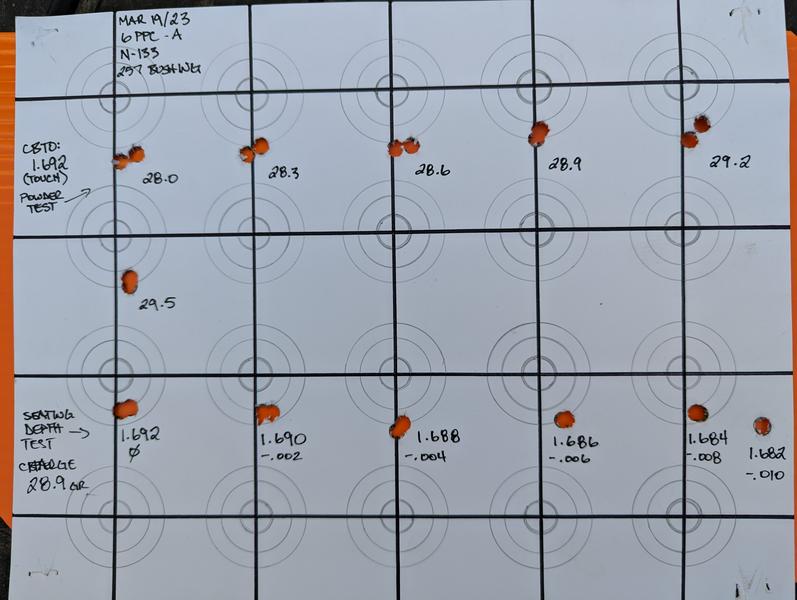
Did a bit of load development today as well, just 2 shot groups - I felt that would be enough while I try and get a feel for the gun and work on getting my bags setup properly etc. Shows some promise I think.

N-133, Rem 7.5BR primers, 64gr Stinger Killer Bees (FB) from Wally Pollock here in Alberta.

sqj6KMV.jpg
 
Bat changed the springs sometime ago.
I had one action that i called "newer" than the other.
When i changed the springs i found out the"newer" one had the older model spring in it and the older one had the latest design of spring

The latest design was 1" longer and a bit beefier coils. I can't tell the two springs apart on my older action vs new spring. I've been shooting it 3yrs and it's 5+ in use. Never been decocked.
 
I was searching the net years ago and found where one of the Mc Millans had posted a bunch of Emails from years of conversations with people in the gun business. Someone with a barrel business that learned under the Mc Milans was talking about breaking in barrels, and Mc Millan couldn't understand why. The guy says just thought I would get owners to shoot more so I could sell more barrels. Mc Millan said breakin was never necessary. Since then I have been very skeptical of all the stuff I read or hear, this sounds like one of those times. There a discussion about changing springs here a few years back, and it got to magazine springs, Ive heard LEOs take spare mags and leave them sit for a month empty then cycle it back in the rotation, so one magazine is always resting empty, then someone brings up finding grandpas 1911 thats been in the drawer loaded for 40 years and the spring is fine. I have no idea what is true and what is BS. I had read in G&A that oil in the bore would use hydraulicly ruin riffling when the bullet went down the bore. Dave Tooley set me straight, I hope he will clarify this spring debate. He is one that I trust.
 
I think it's important to note that just because a spring takes a slight set over time, doesn't mean that the force it puts on the firing pin changes materially. It's only a short amount travel on what's a relatively long spring. I'll leave it to you guys to say whether or not that matters.
 
My thought is this type of stuff was taking into consideration when the action is built to give thousands of rounds of life to a spring, especially if decocked before it is put away.
 
  • Like
Reactions: ebb
Might want to turn car interior lights off and leave doors and trunk cracked open to relieve pressure on those gaskets.
 
I received my replacement springs from Kelblys, below is a comparison picture. The old one on the left is about 1/8" shorter, it is 12 years old, gun hasn't been shot in 10 years.

The old spring weight was about 22.5lbs, the new one about 24.5lbs.

9ulKlkH.jpg


Did a bit of load development today as well, just 2 shot groups - I felt that would be enough while I try and get a feel for the gun and work on getting my bags setup properly etc. Shows some promise I think.

N-133, Rem 7.5BR primers, 64gr Stinger Killer Bees (FB) from Wally Pollock here in Alberta.

sqj6KMV.jpg
Those are two entirely different spring designs, as you can see by the pitch of the coils. I’m not sure how the length could be compared.

You could compare them by measuring the poundage at compressed length, which is a constant in your firing pin assy.
 
I received my replacement springs from Kelblys, below is a comparison picture. The old one on the left is about 1/8" shorter, it is 12 years old, gun hasn't been shot in 10 years.

The old spring weight was about 22.5lbs, the new one about 24.5lbs.

9ulKlkH.jpg


Did a bit of load development today as well, just 2 shot groups - I felt that would be enough while I try and get a feel for the gun and work on getting my bags setup properly etc. Shows some promise I think.

N-133, Rem 7.5BR primers, 64gr Stinger Killer Bees (FB) from Wally Pollock here in Alberta.

sqj6KMV.jpg
This proves exactly what a lot of people preach which is that you can start at jam and work back in 2 thou increments and it should really tighten up in the 9-15 thou window. This testing shows that tightening perfectly. Nice shooting.
Dave
 
I have worked with and had friends who were not just metallurgists but spring experts in the past. They have all and uniformly said:
  • Springs do not "take a set" unless very very badly made (there are many badly made springs, we assume we have quality parts in our guns, made in the past 150 years or so).
  • Springs fail from
    • 1) Heat (lots of heat, not hot days but enough to change the temper)
    • 2) Cycles (moving spring up and down)
  • Springs are often quite different from each other. Any change at all (wire size, rate, etc) are just not comparable. Springs are measured in a bunch of ways, but pounds is by no means the whole story, and length is interesting but not a repeatable way to indicate anything in particular.
  • Stretching springs is old wives tale pointless. You can't fix a temper by stretching with your hands, and see point above: length is not a serious indicator of wear anyway.
(It also isn't great to over-compress them, and things like magazine springs, how you compress till the coils touch, are a nightmare but for the part where that's considered very very very little tension in the world of springs, so also is not a problem).

Anecdotally, lots of guns work with no maintenance, even to mags loaded for 50 years, when pulled out of the attic for the next revolution.

From all this, I change my springs entirely on cycles, not age, and leave magazines loaded (not incidentally, but explicitly on return from range I reload mags and put back in the bag, for the carbines and pistols.
 
Last edited:
I have worked with and had friends who were not just metallurgists but spring experts in the past. They have all and uniformly said:
  • Springs do not "take a set" unless very very badly made (there are many badly made springs, we assume we have quality parts in our guns, made in the past 150 years or so).
  • Springs fail from
    • 1) Heat (lots of heat, not hot days but enough to change the temper)
    • 2) Cycles (moving spring up and down)
  • Springs are often quite different from each other. Any change at all (wire size, rate, etc) are just not comparable. Springs are measured in a bunch of ways, but pounds is by no means the whole story, and length is interesting but not a repeatable way to indicate anything in particular.
(It also isn't great to over-compress them, and things like magazine springs, how you compress till the coils touch, are a nightmare but for the part where that's considered very very very little tension in the world of springs, so also is not a problem).

Anecdotally, lots of guns work with no maintenance, even to mags loaded for 50 years, when pulled out of the attic for the next revolution.

From all this, I change my springs entirely on cycles, not age, and leave magazines loaded (not incidentally, but explicitly on return from range I reload mags and put back in the bag, for the carbines and pistols.
What happens to springs when they are “over-compressed”?
 
Passing the maximum spring compression can cause them to take a set (or partly so). Now, you can also design springs to not take a set when compressed all the way, but it is a little hard to do so repeatedly cycling over as wide a range as mag springs (or to a smaller degree, recoil springs) does cause them to wear out faster. But note that most of the other springs move over fairly small distances (look at your mainspring for example) so last... forever.

Spring quality generally is better (better tempering systems and electronic controls most of all) so I mean literally forever. There are springs in machines including bits of firearms now with NO replacement cycle. As long as not on fire etc, just leave it there. Life is 10 or 100 or 1000 times the expected max life of the rest of the system.

Over time designs have gotten more tolerant of mistakes as well. I have seen things like firing pin return springs that were designed only for their intended stroke; if you messed with it and over-inserted it (compressing the spring all the way)... spring was ruined! Did that. Flopped around once assembled, now mail order /another/ $2 spring. But that was like 30 years ago. Now gun designers assume humans are falliable (and the easier-to-make-well makes doing that more reliable and cheaper) so don't make them so fragile and even springs that mostly move over a small range are not ruined /immediately/ by exceeding compression a few times.
 

Upgrades & Donations

This Forum's expenses are primarily paid by member contributions. You can upgrade your Forum membership in seconds. Gold and Silver members get unlimited FREE classifieds for one year. Gold members can upload custom avatars.


Click Upgrade Membership Button ABOVE to get Gold or Silver Status.

You can also donate any amount, large or small, with the button below. Include your Forum Name in the PayPal Notes field.


To DONATE by CHECK, or make a recurring donation, CLICK HERE to learn how.

Forum statistics

Threads
169,917
Messages
2,284,238
Members
82,407
Latest member
tyler1524
Back
Top