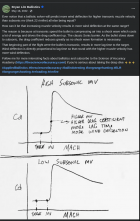
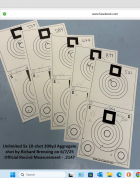
I came across something counter-intuitive while working on a load-comparison tool for my website. I was comparing wind drift for two different loads at various distances and noticed that, past a certain range, the total wind drift between the faster/higher-BC bullet and the slower/lower-BC one began to re-converge. That seemed wrong, so I dug into it further.
What appears to be happening is that once a bullet drops into the subsonic regime, its drag decreases dramatically. Since wind drift is largely driven by aerodynamic drag acting at an angle to the bullet’s flight path, the reduced drag in the subsonic region produces much less lateral deflection. I confirmed this using the CDM model in the Applied Ballistics app. For example, if I calculate drift for a bullet with a BC of 0.311 (such as the 140 Hybrid) at 500 yards in a 10 mph crosswind: a bullet launched at 1000 fps ends up with roughly the same total wind drift as one launched at 2500 fps. That’s a surprising result.
This made me wonder whether, for short-range shooting (around 300 yards), it might be viable to use a heavy subsonic bullet something like a 245-gr .30 cal Hybrid from a .308 subsonic or an 8.6 Blackout. You’d get lower recoil, big holes to break the line, and great barrel life.
However, the problem becomes vertical dispersion. While a subsonic bullet might experience similar wind drift to a much faster load, its drop is nowhere near the same, and its sensitivity to muzzle-velocity variation is dramatically worse. Subsonic loads inherently produce far more vertical spread, which makes them impractical for precision rifle or F-Class use at a distance. So, while the observation is interesting, its probably only relevant for black-powder, or rimfire shooters. In those disciplines shooting faster could be counter productive.
I put together the following color-coded table (green = better, red = worse) showing wind drift in MRAD at 300 yards with a 10 mph crosswind for various BC and muzzle-velocity combinations. You can clearly see that there’s a sub-optimal velocity range where wind performance degrades before improving again.
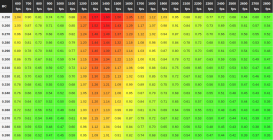
I also created a table showing the vertical spread produced by launching a bullet 10 fps slower and 10 fps faster than the nominal muzzle velocity. In other words, it illustrates how sensitive a given load is to MV variation (i.e., its response to SD). What’s interesting is that this sensitivity improves greatly once the bullet is supersonic. My best interpretation is that the higher drag in the supersonic region tends to “equalize” velocity differences: faster bullets experience more drag and shed speed more quickly, while slower bullets experience less drag and lose proportionally less velocity. As a result, MV variation matters a bit less and the flatter trajectory also helps.

As mentioned above, you can achieve similar wind performance by shooting a bullet subsonic with much less recoil, but the penalty is usually terrible vertical dispersion.
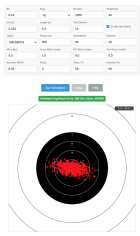
To explore this further, I ran a Monte Carlo simulation on the MR63-FC target at 200 yards using a .22 LR bullet with a G1 BC of 0.14 at 1200 fps and 1050 fps, assuming a 1 mph crosswind standard deviation and a 5 fps muzzle-velocity SD. The subsonic load produced a higher expected score. That aligns with why rimfire match ammunition is intentionally subsonic: it avoids the transonic regime and benefits from the reduced drag variability in subsonic flight.
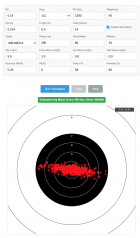
If anyone wants to play around with this themselves...
 www.ballisticstoolkit.com

 www.ballisticstoolkit.com
What appears to be happening is that once a bullet drops into the subsonic regime, its drag decreases dramatically. Since wind drift is largely driven by aerodynamic drag acting at an angle to the bullet’s flight path, the reduced drag in the subsonic region produces much less lateral deflection. I confirmed this using the CDM model in the Applied Ballistics app. For example, if I calculate drift for a bullet with a BC of 0.311 (such as the 140 Hybrid) at 500 yards in a 10 mph crosswind: a bullet launched at 1000 fps ends up with roughly the same total wind drift as one launched at 2500 fps. That’s a surprising result.
This made me wonder whether, for short-range shooting (around 300 yards), it might be viable to use a heavy subsonic bullet something like a 245-gr .30 cal Hybrid from a .308 subsonic or an 8.6 Blackout. You’d get lower recoil, big holes to break the line, and great barrel life.
However, the problem becomes vertical dispersion. While a subsonic bullet might experience similar wind drift to a much faster load, its drop is nowhere near the same, and its sensitivity to muzzle-velocity variation is dramatically worse. Subsonic loads inherently produce far more vertical spread, which makes them impractical for precision rifle or F-Class use at a distance. So, while the observation is interesting, its probably only relevant for black-powder, or rimfire shooters. In those disciplines shooting faster could be counter productive.
I put together the following color-coded table (green = better, red = worse) showing wind drift in MRAD at 300 yards with a 10 mph crosswind for various BC and muzzle-velocity combinations. You can clearly see that there’s a sub-optimal velocity range where wind performance degrades before improving again.
I also created a table showing the vertical spread produced by launching a bullet 10 fps slower and 10 fps faster than the nominal muzzle velocity. In other words, it illustrates how sensitive a given load is to MV variation (i.e., its response to SD). What’s interesting is that this sensitivity improves greatly once the bullet is supersonic. My best interpretation is that the higher drag in the supersonic region tends to “equalize” velocity differences: faster bullets experience more drag and shed speed more quickly, while slower bullets experience less drag and lose proportionally less velocity. As a result, MV variation matters a bit less and the flatter trajectory also helps.
As mentioned above, you can achieve similar wind performance by shooting a bullet subsonic with much less recoil, but the penalty is usually terrible vertical dispersion.
To explore this further, I ran a Monte Carlo simulation on the MR63-FC target at 200 yards using a .22 LR bullet with a G1 BC of 0.14 at 1200 fps and 1050 fps, assuming a 1 mph crosswind standard deviation and a 5 fps muzzle-velocity SD. The subsonic load produced a higher expected score. That aligns with why rimfire match ammunition is intentionally subsonic: it avoids the transonic regime and benefits from the reduced drag variability in subsonic flight.
If anyone wants to play around with this themselves...
Perf Matrix | Ballistics Toolkit
Compare wind drift, drop, and MV sensitivity across different ballistic coefficients and muzzle velocities.
Target Simulator - Monte Carlo Match Simulation
Monte Carlo match simulator with competitive targets. Analyze shooting performance with statistical modeling, realistic variability, and detailed scoring.