• This Forum is for adults 18 years of age or over. By continuing to use this Forum you are confirming that you are 18 or older. No content shall be viewed by any person under 18 in California.

Need Help with Variable Frequency Drive VFD

Bill Rodolph

Silver $$ Contributor
First off, my knowlege of electrical stuff consist of knowing that if I grab two bare wires, I will die. After that, my knowlege gets pretty scketcy.

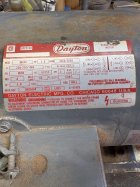
When I bought my lathe used, 30 years ago or more, it had a 3 phase motor on it. I didn't have 3 phase electricity so I bought a single phase motor and put on it and it has worked for all these years, no problem. I keep reading how much better the 3 phase is,so now I'm wondering if I put the 3 phase moter back on, what difference I would see. I have no idea how to pick a VFD, nor any idea how to wire it up. So lets start with first things first, and see if I can afford a VFD, so can y'all come to an agreement on what would be a good VFD. Picture of the 3 phase motor attached. I have 220V single phase in my shop.
 

Attachments

  • 3 phase lathe motor.jpg
    3 phase lathe motor.jpg
    597.1 KB · Views: 47
There are a variety of VFD's that will handle the amps needed to drive that motor. You can buy inexpensive one that has such a variety of configuration options that you will spend weeks trying to decipher what you need. Then you can buy relatively simple VFD's that do not have a lot of configuration options but are tough as nails. I have one of each. I like the simple VFD that has a knob you can use to control motor speed. I don't use the knob much because both machines are variable speed. One is on a mill and the other is on a vertical bandsaw.

Looks like a VFD that will handle 5 amps will be needed and you want one that supports your input and 3 phase output. If you Have 220 2 phase that'd be my first choice for inputs. Single phase input VFD's are available as well. Basically what these devices do is take the input voltage and drop it on a DC bus. That voltage is then split into three outputs and timed perfectly for the three phases of 220 AC output. Very efficient and very clean power compared to the motor alternative.
 
I got several Durapulse VFD's from Automation Direct a few years back for my milling machine.
Awesome company to deal with.
Couldn't recommend them more highly.
In my day job I am constantly working with different brands of VFD's. The Durapulse stack up very well for the price.
Get one that's a little bit bigger than you need, they last longer that way.
 
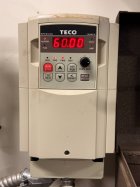
I have a Clausing 5914 with three phase motor. It's in good shape with Reeves drive intact and functioning well. Previous owner had a rotary phase converter in his shop that he used for several different 3 phase tools, but it went with the horizontal mill. I put in a TECO 7300CV VFD, the kind with the frequency knob. Until recently, I had not tried using it at any setting other than 60, although I recently started experimenting with is as a speed control. Would it be best to have the Reeves variable speed drive on the lathe set at maximum RPM, and use the variable speed on the VFD to select the RPM I find appropriate for different operations?

IMG_5093.JPG
 
If the lathe is currently performing to your expectations I wouldn't change it. I am not sure if you will see any significant gains in performance by switching it back to 3 phase. However if you are having issues with chatter , vibration ,lack of power ect then a vfd might be well worth the effort
 
If the lathe is currently performing to your expectations I wouldn't change it. I am not sure if you will see any significant gains in performance by switching it back to 3 phase. However if you are having issues with chatter , vibration ,lack of power ect then a vfd might be well worth the effort
The way I read it, The VFD is currently mounted, He just wonders what sheave setting on the reeves drive would be optimal.

And I am usually the first one to read into something wrong, Hahaha
 
I'm not sure what your budget is but this is the simple one I have on the vertical bandsaw:


They have gone up in price but you can spend a lot less and get the same functionality. For example:


You can also find everything in between. The above give you the price range for a VFD that would drive that motor.
 
You wanna hitachi 2hp with reverse
What lathe do you have? You can simply wire it up and use the buttons on the vfd, or you can rig it to use the controls , jog, e stop on your lathe by wiring but you’ll have to put some time in wiring and researching the programming
It’s not hard
 
First off, my knowlege of electrical stuff consist of knowing that if I grab two bare wires, I will die. After that, my knowlege gets pretty scketcy.

When I bought my lathe used, 30 years ago or more, it had a 3 phase motor on it. I didn't have 3 phase electricity so I bought a single phase motor and put on it and it has worked for all these years, no problem. I keep reading how much better the 3 phase is,so now I'm wondering if I put the 3 phase moter back on, what difference I would see. I have no idea how to pick a VFD, nor any idea how to wire it up. So lets start with first things first, and see if I can afford a VFD, so can y'all come to an agreement on what would be a good VFD. Picture of the 3 phase motor attached. I have 220V single phase in my shop.

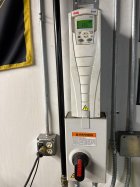
I have an extra ABB drive set up for what you want and Allen Bradley selector switches. PM me if you want it and I will tell you how to wire it and get you set up.
 
Wow, lots of options! Sheldon lathe, threaded spindle, reverse not an option. Time to do some homework. Thanks for all of the responses. Do I need a special switch with the VFD?
 
VFD's were never intended to act like power supply replacements. The motor needs to be wired directly to the output of the VFD, no contactors between VFD and motor. You open a contactor while the drive is powered up, you'll see the magic smoke cloud from the VFD. For lathe operation, the controls such as E-stop, stop, forward, reverse, jog are all low level inputs back to drive, usually 24 volt AC or DC. Most lathes also have an interlock relay that if power fails and lathe switch is in forward or reverse. When power returns the lathe won't restart on it's own, the handle has to be moved back to stop, then back in a direction. Important safety features.

Your motor is 1.5HP, there are 746 watts per HP, so 1150 watt is probably minimum. Nothing wrong in having a 1500 watt or 2HP drive. Check out https://www.hobby-machinist.com/ and look for MKSJ posts, he is the resident expert on VFD conversions. Lots of schematics and parts list.
 
VFD's were never intended to act like power supply replacements. The motor needs to be wired directly to the output of the VFD, no contactors between VFD and motor. You open a contactor while the drive is powered up, you'll see the magic smoke cloud from the VFD. For lathe operation, the controls such as E-stop, stop, forward, reverse, jog are all low level inputs back to drive, usually 24 volt AC or DC. Most lathes also have an interlock relay that if power fails and lathe switch is in forward or reverse. When power returns the lathe won't restart on it's own, the handle has to be moved back to stop, then back in a direction. Important safety features.

Your motor is 1.5HP, there are 746 watts per HP, so 1150 watt is probably minimum. Nothing wrong in having a 1500 watt or 2HP drive. Check out https://www.hobby-machinist.com/ and look for MKSJ posts, he is the resident expert on VFD conversions. Lots of schematics and parts list.
Some good info here. I'll just add that when using a VFD to do phase conversion it is typically recommended to double the hp rating of the motor.
 
image.jpg
You should be able to pick these abb drives up reasonably from marketplace
They have excellent customer service and will help you get it programmed correctly, I’ve been using them for years and they work great
 
Completely not necessary
I believe that doubling recommendation has to do with the ripple current that the bulk aluminum electrolytic capacitors see, when fed by single phase input power. But we lathe users rarely use all the hp our motors are capable of, so ripple currents probably average something much less than worse case. Capacitor life depends largely on ripple current & temperature.

Some VFDs like the Hitachi I use, are built for easy replacement of this capacitor bank. I’ll not likely use the lathe enough to wear them out any time soon.
 
For my 1.5hp 1970s mill I bought a fuji vfd from Marshall wolf automation. They were extremely helpful. I wouldn't hesitate to use them again.
I built my own phase converter for my 10hp lathe. a vfd would have been a lot easier, the phase converter worked brain hard.
From my research the concern about motors being vfd compatible is not quite as big a deal as previously thought and doubling the horsepower may not be necessary, perhaps 1.5x will work for you.
 

Upgrades & Donations

This Forum's expenses are primarily paid by member contributions. You can upgrade your Forum membership in seconds. Gold and Silver members get unlimited FREE classifieds for one year. Gold members can upload custom avatars.


Click Upgrade Membership Button ABOVE to get Gold or Silver Status.

You can also donate any amount, large or small, with the button below. Include your Forum Name in the PayPal Notes field.


To DONATE by CHECK, or make a recurring donation, CLICK HERE to learn how.

Forum statistics

Threads
167,742
Messages
2,239,372
Members
80,706
Latest member
EdH
Back
Top