Follow along with the video below to see how to install our site as a web app on your home screen.
Note: This feature may not be available in some browsers.
This Forum is for adults 18 years of age or over. By continuing to use this Forum you are confirming that you are 18 or older. No content shall be viewed by any person under 18 in California.
I’m trying to understand something about stock materials, recoil behavior tracking dampening etc. in either bench or F-Class. (short to mid-range)
I know laminate stocks like Dima, Cerus, Xring, Avila, etc. are popular in F-class, but composite makers like Felso, McMillan, Manners, and others claim very high stiffness and stability.
My question is:
Does a fiberglass or composite stock track just as well as a high-end laminate stock in the bags, or is there still a noticeable difference in recoil behavior or dampening? Also tunability, or any other area that could contribute accuracy, etc.?
Just trying to learn the differences in the two and if one has an advantage or disadvantage over the other.
Tracking has more to do with design and straightness along with how “straight” the barreled action is worked into the stock
Material differences will recoil differently.
My Daughters rifle has noticeably less recoil than my rifle, hers is walnut mine is a laminate, both are same cartridge.
Just my opinion but a wooden stock thats cut properly is going to be truer than a composite stock.
Most modern wooden stocks for competition are cut on a CnC whereas the composite being a resin that cures through a exothermic process generate heat and warping when released from the mould, and they have parting lines down the center.
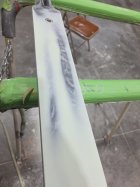
This is the bottom of a composite stock you can see edges and center were warbly by thickness of finish putty, I hope this helps explain my thoughts on the subject.
And the colors of just about ANY "laminated wood" stock look better than ANY composite stock. Throw a little clear on it, step back and see the colors jump out you never saw before.
Just my opinion but a wooden stock thats cut properly is going to be truer than a composite stock.
Most modern wooden stocks for competition are cut on a CnC whereas the composite being a resin that cures through a exothermic process generate heat and warping when released from the mould, and they have parting lines down the center.
This is the bottom of a composite stock you can see edges and center were warbly by thickness of finish putty, I hope this helps explain my thoughts on the subject. View attachment 1719904
I’m trying to understand something about stock materials, recoil behavior tracking dampening etc. in either bench or F-Class. (short to mid-range)
I know laminate stocks like Dima, Cerus, Xring, Avila, etc. are popular in F-class, but composite makers like Felso, McMillan, Manners, and others claim very high stiffness and stability.
My question is:
Does a fiberglass or composite stock track just as well as a high-end laminate stock in the bags, or is there still a noticeable difference in recoil behavior or dampening? Also tunability, or any other area that could contribute accuracy, etc.?
Just trying to learn the differences in the two and if one has an advantage or disadvantage over the other.
I’m trying to understand something about stock materials, recoil behavior tracking dampening etc. in either bench or F-Class. (short to mid-range)
I know laminate stocks like Dima, Cerus, Xring, Avila, etc. are popular in F-class, but composite makers like Felso, McMillan, Manners, and others claim very high stiffness and stability.
My question is:
Does a fiberglass or composite stock track just as well as a high-end laminate stock in the bags, or is there still a noticeable difference in recoil behavior or dampening? Also tunability, or any other area that could contribute accuracy, etc.?
Just trying to learn the differences in the two and if one has an advantage or disadvantage over the other.
Just my opinion but a wooden stock thats cut properly is going to be truer than a composite stock.
Most modern wooden stocks for competition are cut on a CnC whereas the composite being a resin that cures through a exothermic process generate heat and warping when released from the mould, and they have parting lines down the center.
This is the bottom of a composite stock you can see edges and center were warbly by thickness of finish putty, I hope this helps explain my thoughts on the subject. View attachment 1719904
That might have been true at one time but it not true anymore on quality carbon fiber stock. The resin used on quality stock is aerospace material -used to make helicopter blades - composite for aircraft ect. I own a Victrix Blackbelt and that stock is made by an aerospace composite maker with a full aluminium bedding.
Composite stock are here to stay and will take over wood if not already done.
Don’t take me wrong..nothing beat the beauty of carefully selected or composite wood with mirror finish..but wood compress..shift with humidity - must be bedded ( composite) dryness..composites are impervious to that and tuff..resisting scuff and use better.
That might have been true at one time but it not true anymore on quality carbon fiber stock. The resin used on quality stock is aerospace material -used to make helicopter blades - composite for aircraft ect. I own a Victrix Blackbelt and that stock is made by an aerospace composite maker with a full aluminium bedding.
Composite stock are here to stay and will take over wood if not already done.
Don’t take me wrong..nothing beat the beauty of carefully selected or composite wood with mirror finish..but wood compress..shift with humidity - must be bedded ( composite) dryness..composites are impervious to that and tuff..resisting scuff and use better.
I've shot and owned both and for me I just shoot wood a lot better (chock it up to my brain, my body, my gear, etc) and you definitely see more top shooters with wood BUT the current long range F Class record is held by a McMillan ZR several years ago that Norm @Rope2horns still dominates with to this day. Both stocks can have their day on the podium.
Edit: If I remember correctly SWN & Nationals have also been won with composites including @tvaught and PJ
Also, keep in mind composites really should still be at least skim coat bedded even if manufacturers claim they're ready to go. I don't know any top F Class shooter who uses composites that doesn't at least skim coat them.
I've shot and owned both and for me I just shoot wood a lot better (chock it up to my brain, my body, my gear, etc) and you definitely see more top shooters with wood BUT the current long range F Class record is held by a McMillan ZR several years ago that Norm still dominates with to this day. Both stocks can have their day on the podium.
Also, keep in mind composites really should still be at least skim coat bedded even if manufacturers claim they're ready to go. I don't know any top F Class shooter who uses composites that doesn't at least skim coat them.
You ever use dima stocks? Lol jk. I bought a Dima stock after watching a couple of your videos. Ended up selling the rifle, but the stock was beautiful. I believe it was a G6.
Also, a follow up that probably won't make sense or I'm not thinking correctly, but if the only part of the rifle that is actually touching the stock itself is the action and the action is sitting on the bedding compound I feel like the stock material choice wouldn't make much difference? Bear in mind I have no idea what I'm talking about.
I would think the geometry of the stock and how well it fits would have a lot to do with it.. The BR stocks look so different to me than what I'm used to shooting.
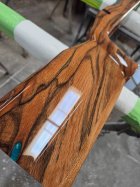
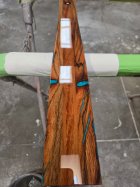
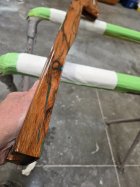
This mesquite and epoxy stock of Brad Johnson's just set a national Fopen 1000 yard record of 600-48x at Bayou last weekend. Stock was cut by Baron James.
I’m trying to understand something about stock materials, recoil behavior tracking dampening etc. in either bench or F-Class. (short to mid-range)
I know laminate stocks like Dima, Cerus, Xring, Avila, etc. are popular in F-class, but composite makers like Felso, McMillan, Manners, and others claim very high stiffness and stability.
My question is:
Does a fiberglass or composite stock track just as well as a high-end laminate stock in the bags, or is there still a noticeable difference in recoil behavior or dampening? Also tunability, or any other area that could contribute accuracy, etc.?
Just trying to learn the differences in the two and if one has an advantage or disadvantage over the other.
This Forum's expenses are primarily paid by member contributions. You can upgrade your Forum membership in seconds. Gold and Silver members get unlimited FREE classifieds for one year. Gold members can upload custom avatars.
This site uses cookies to help personalise content, tailor your experience and to keep you logged in if you register.
By continuing to use this site, you are consenting to our use of cookies.