Follow along with the video below to see how to install our site as a web app on your home screen.
Note: This feature may not be available in some browsers.
This Forum is for adults 18 years of age or over. By continuing to use this Forum you are confirming that you are 18 or older. No content shall be viewed by any person under 18 in California.
charlie b,
I looked more carefully at your pictures and tried to determine if the velocity differences in each group had any relationship to the position of the particular round on the target.
The 23.2 load would lead me to believe a higher velocity would result in a bullet position that is slightly lower.
But the 23.3, 23.4 and 23.5 loads seem to violate that result that the higher velocity would have a lower POI.
I generally get the same result with slightly higher muzzle velocities.
I find that 0.1 gr of powder results in 10 to 11 fps change in predicted velocity. Your velocity numbers don't seem to result in that kind of difference.
I'm not sure this particular velocity ladder can be relied upon to make a decision on accuracy.
The 23.2 group seems to be the most consistent for 3 groups, but the two loads with velocities the closest (9 fps) are the furthest apart and the two close groups have velocity differences of 29 fps.
The 23.3 gr load has the two closest rounds (with a velocity difference of 38 fps almost touching with the higher velocity very slightly lower while the round with a velocity difference of 21 fps is lower still and to the right. The 23.3 load actually might be your best velocity group of the ladder if the #11 round wasn't off to the right (possible shooter induced variation) and the highest velocity round was actually higher than the two slower rounds.
The 23.4 load result show a larger separation that 23.2 for rounds with velocity difference of 4 fps with the slowest round and fastest round with just about the same vertical position for POI even though the velocity difference is 37 fps.
The 23.5 load result seems to follow the premise, but the higher velocity round (by 22 fps) was much lower than the 23.2 load would predict.
Most of the single round separations are to the right of the two groups with the closest velocity, with the exception of the 23.2 & 23.5 groups.
Part of the reason I don't have much confidence in velocity ladders is that the natural powder/primer burn variation seems to have about the same extreme difference in velocity as 0.2 grains of powder (about 22 fps).
Other than consistency in individual round position, there isn't any real basis for judging on the base of velocity.
That probably shows my personal bias.
I generally try to decide on the best load for a powder/bullet combination based upon the overall average group size for at least 10 to 20 5-round groups.
I believe that is statistically more accurate.
I decide upon choosing that I have a sufficient number of groups based upon the Standard Deviation of the group sizes within the sample. If the St Dev is small (around 0.030) , the variance is relatively small, so I could make my decision based upon a 10 group average. If the St Dev is larger, I continue to shoot groups until I get a larger sample up to a limit of 20 groups.
It takes a lot more rounds to make a decision, but once you decide, I then shoot a lot of groups using the best load for that bullet/powder combination.
That approach seems to work for me, but it is not a low cost solution.
FWIW, I usually start with 3 shot groups just to find an area where there might be a node and to find where pressures get too high. I then find 2 nodes to work around and will then do 5 round groups to determine where I want to be at, usually 3 groups around each node. Then I will do 3 round groups to determine seating. A couple times, when I went from a jump to jam I had to readjust the powder to stay in the node.
As I alluded to, the .223 has always had a 'high' ES/SD for me. And, higher vel does not always mean a lower POI (as you can see here). If my shooting was good enough I will still be under 0.5MOA. Basically I rely more on the groups than velocities to determine nodes.
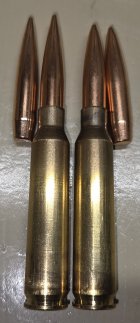
I loaded up some 90VLD's today. The left is the VLD, right is the SMK. Both are 0.010 jump in my rifle. That bright band is the edge of the boat tail.
Part of the reason I don't have much confidence in velocity ladders is that the natural powder/primer burn variation seems to have about the same extreme difference in velocity as 0.2 grains of powder (about 22 fps).
Other than consistency in individual round position, there isn't any real basis for judging on the base of velocity.
That probably shows my personal bias.
This is something I have seen a lot. The ES/SD is within the difference between the change in powder charge. Dut to that I tried ladders with 0.2 or 0.3gn intervals. But, I found I was missing an important part of the node 'discovery'. The width of the node. Which is almost as important to me as where the node is. So, I burn a bit more with 0.1gn steps to see if I can determine a wider node.
It is complicated by my shooting skills. If I can only shoot 0.5MOA then I may 'miss' a node simply due to my poor shooting. It is a problem I work on every time I go to the range. Sometimes I wonder if those tiny groups are just a combination of errors that somehow aligned, eg, low vel with normally high POI is 'jerked' low so it stays in the group despite the vel difference. FWIW, I am a lot better than I used to be
Even though your 90s seem way out there, you still have lots of bullet body in the neck.
I would expect them to perform really well.
Since Aug, the 90 Bergers have averaged 0.205 and the 90 SMKs have averaged 0.211, but there were a couple of groups with the SMKs that were 'shooter induced variations' that spoiled the SMK average. Without those two SIV groups, the 90 SMKs averaged 0.206, so I would say that both actually shoot about the same in my new barrel.
I am close to finishing an experiment to determine what amount of bullet body in the neck can maintain consistent neck tension and accuracy.
So far I have gotten down to 0.039 in the neck (considering boat tails not in the neck) or 17.2% of the .224 bullet caliber. The average of 4 groups of 80 gr SMKs with that little bullet body in the neck was 0.176. I was shooting pretty good that session.
But 12 groups with both 80 and 90 SMKs averaged 0.194, all with less than 0.043 bullet body in the neck.
I am amazed that that little bullet body in the neck can still maintain that kind of accuracy.
I'll be trying more 0.040s (under 20%)and even as little as 0.025 (10.7%) in the neck over the next two sessions with Hornady 80 gr ELD-Ms.
I don't have much hope for the 0.025s, but I was surprised by the results with the 0.039 to 0.043 results, so who knows what the results might be.
I'll share the results when I get all the results completed and tabulated.
This is something I have seen a lot. The ES/SD is within the difference between the change in powder charge. Dut to that I tried ladders with 0.2 or 0.3gn intervals. But, I found I was missing an important part of the node 'discovery'. The width of the node. Which is almost as important to me as where the node is. So, I burn a bit more with 0.1gn steps to see if I can determine a wider node.
It is complicated by my shooting skills. If I can only shoot 0.5MOA then I may 'miss' a node simply due to my poor shooting. It is a problem I work on every time I go to the range. Sometimes I wonder if those tiny groups are just a combination of errors that somehow aligned, eg, low vel with normally high POI is 'jerked' low so it stays in the group despite the vel difference. FWIW, I am a lot better than I used to be
I love it! You admit that the variable could possibly be you, the shooter. I too feel that I’m the large variable creating the group size on the target. For me with my rifles I have a difficult time getting less than 3/4 moa groups sometimes at 100 yards and then immediately with the same rifle and ammunition dial up to the 700 yard target and make a 1/2 moa group with 10 rounds. I believe it’s a mental issue with me and I’ve just grown to accept it. I actually sight in at 700 yards or any shorter range between and then dial back to 100 and accept the short range group because I can make the head shot at 700 and because the group tightens as I shorten the range, I always have confidence in the POA/POI. Using this method, I aimed at a hog. 1 inch above the eye at 530 yards and the bullet hit 1 inch left of my aim. Down and out!
CFJ, I have seen a lot of discussion about how much bullet needs to be in the neck. It ranges from 'a lot' to 'not much' I come from cast bullet shooting where it is also a 'thing' to not have any bullet below the neck. There is a class of cast shooting using separate ammunition. Common in Schuetzen style single shots. Like artillery, the bullet is precisely pushed into the bore, seating it a consistent depth into the lands. A case with powder charge is then loaded behind it. They get some impressive groups with those guns and don't have to worry about seating tension. I used what are called 'bore rider' bullets where the nose section is sized to be an interference fit to the lands, and then the drive bands are jammed into the throat. These methods center up the bullet in the bore. Also makes me wonder if less bullet in the case makes neck tension less of a factor?
You do realize that many (most) 223 'match' chambers have a freebore diameter of 0.2242“, right? Things are already pretty well aligned just by chambering the round; if it's seated into the lands, even more so.
So far my best results (average of 0.171 for four 5-round groups) have come from 0.039 bullet body in the neck (not considering the boat tail since the boat tail doesn't touch the neck). I have to admit that was a good day for my shooting (didn't screw up any groups out of the 4).
8 groups at 0.043 in the neck average 0.206.
4 groups at 0.060 average 0.207.
4 groups at 0.080 average 0.206.
Overall average of 40 groups from 0.080 to 0.039 average 0.209, including 12 groups with Shooter Induced Variations that were my screw ups. For 28 of those groups the average was 0.197 and for 20 of those groups the average was 0.186, so there really isn't a lot of data that shows the amount of bullet in the neck more than 0.038 causes any real difference in accuracy.
Like most of us, my shooting is the biggest variable, so I have to get a pretty large amount of data.
I have about 21 more loads (84 more groups) with varying amounts of bullet body in the necks to get enough data to be statistically valid.
During my next session, I am going to try 0.024 in the neck.
My initial impression when loading was that at 0.024 in the neck, there is some possibility that the bullet might fall out of the neck before they every get into the chamber.
I suspect that might be the real limit.
If you can't transport the loaded round into the chamber intact, you could have powder everywhere in the action.
That would be the practical limit, regardless of whether there is any impact in accuracy up to that point.
I had some fun with the Tikka this morning. I've recently learned that our lack of humidity here in LV makes more of a difference when leaving powder in the hopper than it did in ND so I've been trying to be more disciplined about it. As a result, my MV has gone down from 2870 with the 90 smks to 2830. While it's still shot pretty well, I feel like it shot better at 2870 so I decided to step on the gas and see how it shoots. I ended up going up .5gr to 25.7gr Reloder 15.5 and a MV of 2911. It shot like a laser in the 10mph wind at 600 today.
I had some fun with the Tikka this morning. I've recently learned that our lack of humidity here in LV makes more of a difference when leaving powder in the hopper than it did in ND so I've been trying to be more disciplined about it. As a result, my MV has gone down from 2870 with the 90 smks to 2830. While it's still shot pretty well, I feel like it shot better at 2870 so I decided to step on the gas and see how it shoots. I ended up going up .5gr to 25.7gr Reloder 15.5 and a MV of 2911. It shot like a laser in the 10mph wind at 600 today.
I had some fun with the Tikka this morning. I've recently learned that our lack of humidity here in LV makes more of a difference when leaving powder in the hopper than it did in ND so I've been trying to be more disciplined about it. As a result, my MV has gone down from 2870 with the 90 smks to 2830. While it's still shot pretty well, I feel like it shot better at 2870 so I decided to step on the gas and see how it shoots. I ended up going up .5gr to 25.7gr Reloder 15.5 and a MV of 2911. It shot like a laser in the 10mph wind at 600 today.
I know it's been a while. Life happens I did put the .223 barrel on my Savage 12BVSS instead of the Axis. The only mod to the rifle (other than barrel) is I gave it an adjustable cheek piece. The scope is an older Burris Fclass scope. It has worked well for me and I like the simple dot and box.
I've been trying to get the 88's to shoot well in my rifle. I can get them under MOA but not consistently under 1/2MOA (call it 3/4). So, I went back to the Berger 90's and did a workup. This morning I had a load of 24.9gn of N140 seated to lightly in the lands (about .010 the way I measure them). This seems to help ES/SD but at shorter ranges (200yd) a small jump works just as well.
I decided to test it at range for the first time. 200yd to check zero (I had changed scopes around). First round was off a bit and the other 4 were right about where I wanted them. Went to 600 and it seemed to like it. The 5" plate was a bit boring with no wind so did a group just for grins. Then went to 1000yd. This one shocked me. First round hit the bottom of the plate. That's never happened to me before with a 'new' load and just ballistics computer data. Wind was starting to pick up a little and my windage skills aren't that good. I'd even forget to look at the flags between shots Despite that it seemed to keep most of the shots near the 10" plate and a lot of hits. You can see the vertical stringing from ES. Shots to the right were just my wind skills.
I know it isn't Fclass or BR level but for me this is a good day.
PS the 200yd center is 1". The 600yd yellow is 3", blue is 6". 1000yd plate is 10".
This Forum's expenses are primarily paid by member contributions. You can upgrade your Forum membership in seconds. Gold and Silver members get unlimited FREE classifieds for one year. Gold members can upload custom avatars.
This site uses cookies to help personalise content, tailor your experience and to keep you logged in if you register.
By continuing to use this site, you are consenting to our use of cookies.





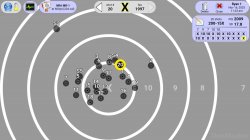

 Despite that it seemed to keep most of the shots near the 10" plate and a lot of hits. You can see the vertical stringing from ES. Shots to the right were just my wind skills.


