Follow along with the video below to see how to install our site as a web app on your home screen.
Note: This feature may not be available in some browsers.
This Forum is for adults 18 years of age or over. By continuing to use this Forum you are confirming that you are 18 or older. No content shall be viewed by any person under 18 in California.
Generally, I do my powder work ups, then seating. However,
lets muddy the pond a bit by going off the reservation.....
I won't talk about components used but what I've been doing
with a particular .284 cat of mine, and it bows back to powder
changes for a given method. I like method over theory.
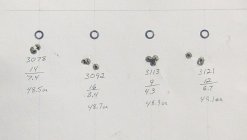
1.....Set neck interference at .002" (good carbon, no neck lube)
2.....Seat bullet .015 long, and let bolt closure do the final seating.
3.....I set my Ezell PDT tuner to one half turn out, and leave it alone.
4.....Fire 3 rounds at 100 yards doing a charge change of 2/10th's
I shot 4 targets, and this was the last one because I started to get
into some pressure. Had 2 flags out and wind was less then 5 mph.
For what it's worth, I just set the barrel back, and re-crowned it.
And lets get some neck tension in the conversation. That sure does
go hand in hand with seating depth......
More powder produces more expanding gas volume. Not really the same. More powder represents an increase in potential energy (pre-ignition) and chemical energy subsequent to ignition.
I am not sure what everybody is talking about when they say “seating depth test”.
I simply start in the lands, and go in in .005 inch steps untill the bell rings. Then work from there
The problem most shooters have is they do not load at the range, where you can change things instantly and get real time results, plus seeing if a promising combination repeats.
you could look up on (your load bookhere)for the cartridge COL . its information that's easy to get. them move the bullet out ,003 shoot it ,then move out .003 shoot it then move it out shoot it .003 ect. its very possible you will find that sweet spot. if not change powder ,start over
I’ve been told that velocity changes as seating depth changes, I haven’t seen that correlation play out with any consistency. It may just get caught up with the standard deviation. Any thoughts on that ?
Pressure and velocity are correlated. It varies greatly across different powders, but with a specific powder the relationship between peak pressure and velocity is reasonably consistent. It is not linear (a cubic function, actually). Smokeless powder oxidizes (burns) in the blink of an eye and the vessel containing the gases produced by that reaction has a constant volume - the case/chamber and the barrel. We've all read about and experienced a change in seating depth having an effect on velocity and, therefore, pressure with all other things being equal. Whether or not the change is contained by the standard deviation of measured velocity depends on the degree of change, as @Alex Wheeler mentioned above. A large change in seating depth will show up in measured velocity and a small one won't.
I don'tknow specifically what barrels were cut, but I'd guess that would apply to 22 rimfire in sporter class since tuners are not allowed. Typically, I think rifles are tuned with changing powder and seating depth, and maybe a tuner, or in the case of 22 rimfire, a tuner.
The mystery for me about seating depth changing case volume was that as depth increases, case volume decrease and it used to seem to me that should increase velocity. But the data from my chrono was showing velocity decreasing. I didn't think the additional chamber volume along with the blowby would offset what the decrease in case volume did. But that report I posted, makes it pretty clear.
And yes, no doubt changes in pressure changes the tune, as we're talking changes in barrel time.
I don'tknow specifically what barrels were cut, but I'd guess that would apply to 22 rimfire in sporter class since tuners are not allowed. Typically, I think rifles are tuned with changing powder and seating depth, and maybe a tuner, or in the case of 22 rimfire, a tuner.
This is very interesting to me.
My accuracy needs are in the 1/2 MOA range.
Do we think that I could arbitrarily choose a powder charge [223] and tune with seating depth to get 1/2 MOA? Assuming match bullet, match barrel and rifle capable of shooting it?
Yes. We can take recommended pet loads from this site, and do as You said. It’s what some of us have to do because of lack of being able to tune, for various reasons.
And, in doing so, do a lot better than 1/2 MOA.
very good discussion on this topic! Lot of knowledge and opinions being shared
just wondering what’s the most you’ve had to jump to fine that sweet spot and as that goes what the most you ever had to jam With any bullet or caliber Just wondering.
thanks for sharing
very good discussion on this topic! Lot of knowledge and opinions being shared
just wondering what’s the most you’ve had to jump to fine that sweet spot and as that goes what the most you ever had to jam With any bullet or caliber Just wondering.
thanks for sharing
.080 for a 155 SMK in .308 using Varget. It did really well!
For 169 SMK, I started at .009 off the land in my .308, though that was only the starting point and I never paid any attention as to how far that load was off the lands since. I'm still loading at the same seating depth 2250 rounds fired later and the distance to the lands is now .035" with the bullet's BTO being ~.004" longer. (I do sort the bullets accordingly )
very good discussion on this topic! Lot of knowledge and opinions being shared
just wondering what’s the most you’ve had to jump to fine that sweet spot and as that goes what the most you ever had to jam With any bullet or caliber Just wondering.
thanks for sharing
very good discussion on this topic! Lot of knowledge and opinions being shared
just wondering what’s the most you’ve had to jump to fine that sweet spot and as that goes what the most you ever had to jam With any bullet or caliber Just wondering.
thanks for sharing
AR Service rifle shooting Berger 80.5 I found the tightest roundest group pushed in to 0.130” off of touch. Had a load for 75 Vmax that was bug holes at 0.090” off.
I use the Berger concept of test out in 0.025-0.030” bands from 0.010” jam and 0.010” off to 0.120” jump first and then fine tune Off of that winner.
Could I have missed a closer in “node” by moving out in the big steps ? Likely, but the 0.130” jump load shot well and had no pressure signs and got me a P100 tab.
Predicted and actual velocities will change in step with a seating depth test. But the step change for each increment is very small - on the order of a couple fps and maybe 100-200 psi per .003 seating depth change - and so the velocity change is usually hidden within the normal ES/SD we see, unless the seating depth test spans a very large range.
And because the pressure variance is so slight at each increment, I'm not convinced that changing the pressure curve is the reason why seating depth works; and why it's so important. Most of us have observed groups tighten pretty significantly over relatively small seating depth changes.
I'm inclined to think seating depth is important because at some point it reaches a spot where the cartridge is optimally referenced - meaning round-to-round differences are at a minimum - within the chamber.
Despite our best efforts to measure to what seem very fine resolutions - thousandths of an inch - I think there's actually much more slop in the cartridge/chamber interface than we might give credit. Bullets vary dimensionally from sample to sample. So do each of our pieces of brass. But we're limited in seeing much of that variation because of the limits of our measuring tools. And despite us talking about things like "touch" and "hard jam," I think the range where a loaded round has the bullet somewhat into the lands is greater than we often admit.
So in that kinda sloppy world where each round fits in the chamber ever so slightly differently, a seating depth test exposes where there's just enough bullet interface with the lands to give us an idealized round-to-round reference. The point where cartridges seat in the chamber with least variation; and where the needed shot start pressure - the psi needed to actually begin moving the bullet - is closest from shot to shot.
If that theory is correct, it begs the question of why, then, do some rifles prefer some amount of jump? In that case, I'd guess other factors, like the amount of neck tension causing chambered round variation if the bullet gets into the lands, to be at play.
A lot talk and discussion on seating depth and a lot of theory about what all its doing to help with accuracy. We all agree “I think” that it does help
I would like to hear your thoughts on WHY Over the years I hear many theories from bullet alignment, adjusting case capacity, pressure and others. talking about this could enlighten us all
There is definitely a “why” because physics. But our ability to model internal combustion and dynamics is either government secret or does not yet exist. This seems to be a wildly sensitive and complicated system. I’m willing to bet that even if we had the engineering methods to predict the perfect tune, it would take many measurements and parameters that are more difficult to get than just shooting a couple of ladders like we do now.
In trying to understand internal ballistics as best I can, it's quite evident that seating depth effects pressure and velocity. But, I had a hard time finding out why and how. A couple years ago I discovered an in depth study from back in 1965 that pretty much nailed it for me. Though there's more to read (see attached PDF file), here's the graph of the data on page 47 that made it clear to me what's going on with seating depth: View attachment 1571054
This graph is interesting, nothing wrong with these data as far as I can tell. I was not able to determine the significance of the open circle vs filled circle data points, due to a lack of patience, but if anyone sees that mentioned in the report, please reply.
If anyone reads the associated report just be aware that there are conclusions based on assuming Boyles Law for ideal gases. Combustion gases in a rifle chamber while pushing a bullet (mainly CO2 and water vapor) are at pressure conditions far exceeding ideal gas pressure. The critical pressure of CO2 is about 1071 psi, and for water it’s about 3204 psi. Both gases are what is known as supercritical under chamber pressure conditions, and by a wide margin. Any conclusions in the report assuming ideal gases and using Boyles law are far too simplistic and may not be reliable.
This Forum's expenses are primarily paid by member contributions. You can upgrade your Forum membership in seconds. Gold and Silver members get unlimited FREE classifieds for one year. Gold members can upload custom avatars.





 )
)


